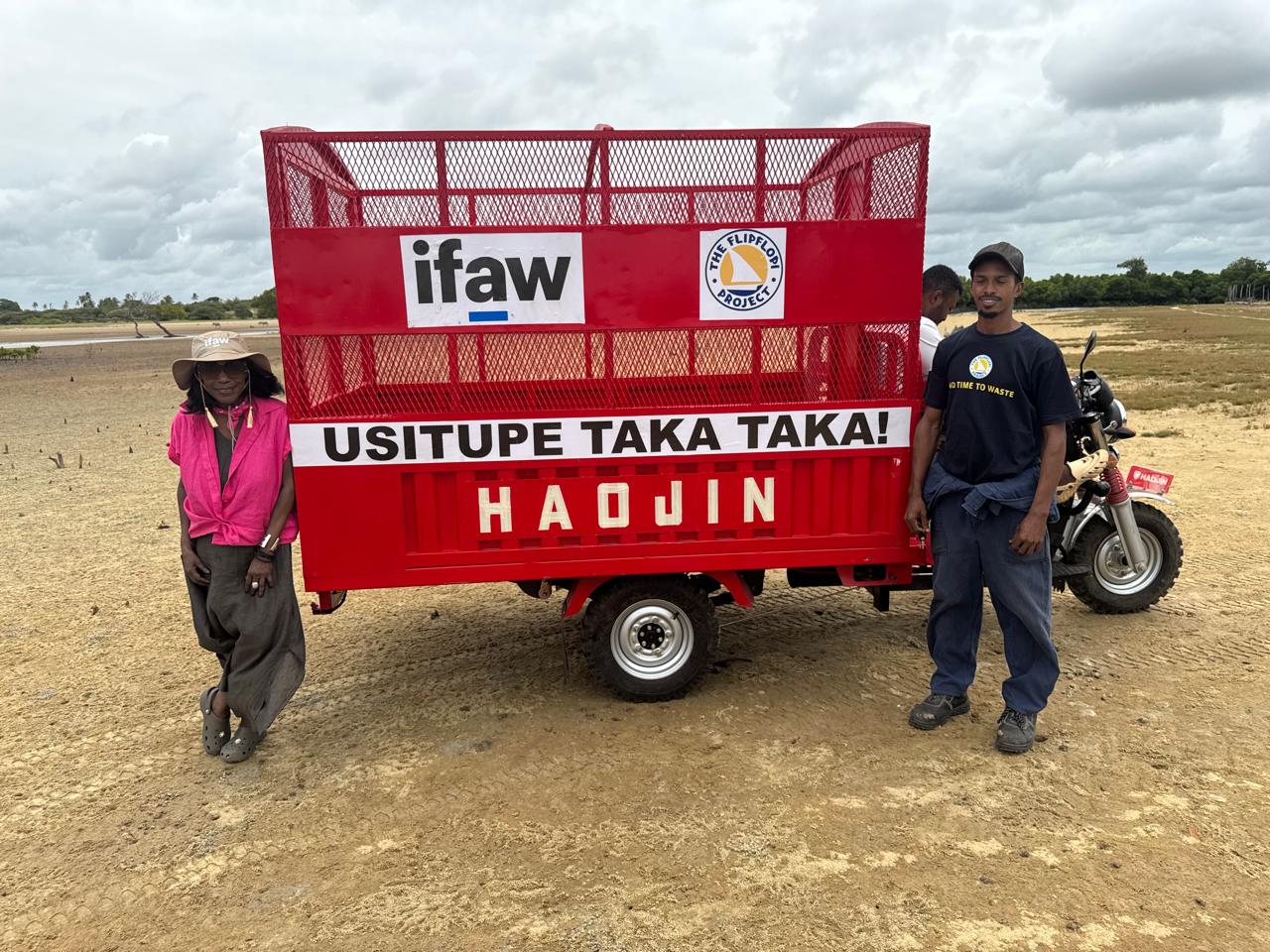
 Ifaw board member Prof Judi Wakhungu hands over a tuk-tuk to the FlipFlopi project./HANDOUT
Scientists have warned that the planet is confronting unprecedented environmental challenges, which they have collectively termed the triple planetary crisis.
This refers to three interlinked threats: climate change, pollution and biodiversity loss. For communities around the world, these crises are not abstract—they affect livelihoods, food security and the delicate balance of ecosystems.
Former Environment Cabinet Secretary Judi Wakhungu, who also served as Kenya’s Ambassador to France, the Holy See, Portugal, Serbia and Monaco, and is currently a board member at the International Fund for Animal Welfare (Ifaw), breaks down the scale of the threat and what must be done to mitigate it.
Ifaw is a global network of affiliated nonprofits dedicated to helping animals and people thrive together.
“The planet is warming because of our excessive use of fossil fuels,” Wakhungu says. “Since the Industrial Revolution, our carbon footprint has increased dramatically. As a result, the atmosphere, oceans and global temperatures are rising.”
The oceans, which absorb the majority of the planet’s heat, are particularly vulnerable. When the oceans warm, their pH levels drop.
This acidity threatens coral reefs, which are vital for marine biodiversity,” she says. Coral bleaching, caused by these changes, is only one visible effect. Rising temperatures and altered water chemistry also disrupt ecosystems that have existed for millennia.
Marine animals such as turtles are facing direct consequences of human activity.
“Turtles need specific spaces to nest, but encroachment and pollution are reducing those spaces,” Wakhungu says.
Polluted waters, often contaminated with sewage and industrial waste, make it even harder for these creatures to survive.
“Turtles play a critical role in maintaining ecosystem balance. When we damage their habitats, we undermine the health of entire marine systems,” she said.
The impacts extend beyond wildlife. Coastal communities, which make up about 65 per cent of the global population, depend on marine resources for food and income.
Coral reefs, for instance, support fish, crabs, shrimp, seabirds and other marine life while protecting coastlines from storm surges.
“Without healthy reefs, fisheries suffer, food security is threatened and tourism declines,” Wakhungu warns.
Illegal, unreported and unregulated fishing adds another layer of complexity.
“In parts of the Western Indian Ocean, there are vessels operating offshore that evade detection. They disrupt marine life, entangle dolphins and turtles, and harm fisheries. One of our programmes at Ifaw teaches local fishers how to safely disentangle animals at risk,” she says.
Addressing these intertwined crises requires a coordinated approach. Wakhungu points to the crucial role of government partnerships and international collaboration.
“The government alone cannot meet these challenges. Bilateral relations and organisations like Ifaw provide scientific expertise and training to help conserve protected areas,” she explains.
During her tenure in government, Wakhungu tried to expand Kenya’s marine protected areas but faced obstacles beyond her control.
Today, she stresses that Kenya is at a tipping point. Without expanding marine protected zones, livelihoods depending on these ecosystems are increasingly at risk.
Funding remains a major challenge.
“Kenya has some of the best policies on marine resources and neighboring countries often look to us for guidance. But policies on paper do not translate to action unless they are properly implemented and funded,” Wakhungu observes.
International support is declining, meaning that local communities and governments must increasingly take responsibility.
She emphasises the importance of nature-based solutions—conserving ecosystems and empowering communities to lead conservation efforts.
Reflecting on her tenure as Environment CS, Wakhungu recalls Kenya’s ban on single-use plastics, a move that drew global attention.
“Plastics contain chemicals and when misused, pollute our waterways, harm livestock and enter our food chain. The ban was essential to protect our health and that of future generations,” she says.
She urges Kenyans to recognise that caring for the environment is a direct investment in their own wellbeing.
As the triple planetary crisis intensifies, Wakhungu stresses that individual actions, community engagement and strong policy implementation are all essential to safeguard both human and ecological futures.
“Protecting our environment is not just about conservation—it is about survival, health and the legacy we leave for our children,” she says.