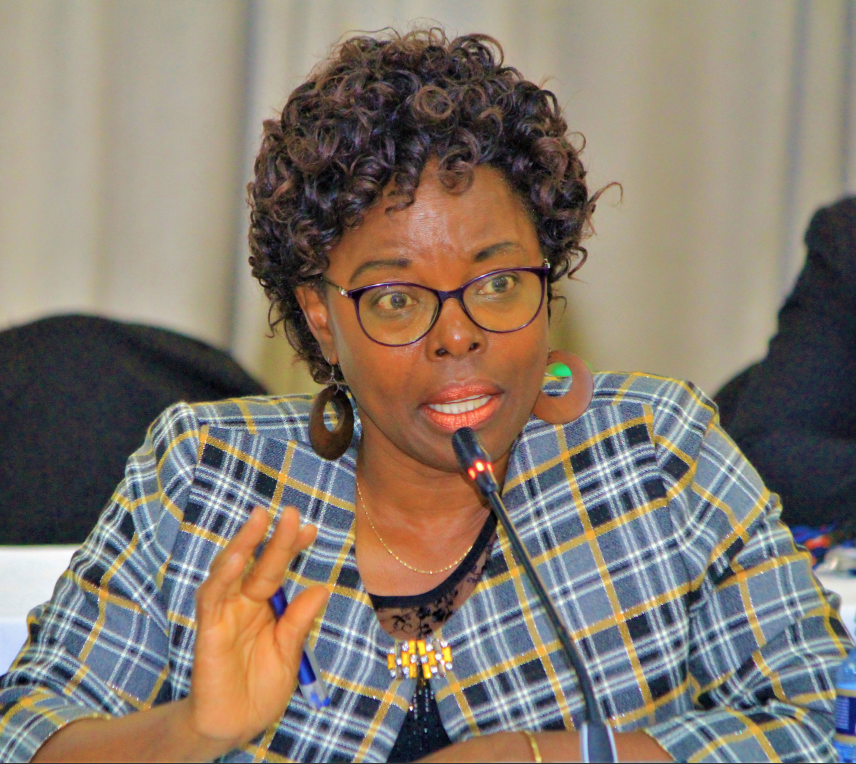
 Controller of Budget Margaret Nyakang’o. /FILE
Twenty county governments have been thrust into the spotlight after a new expenditure report revealed they failed to spend a single shilling on development projects during the first three months of the current financial year.
The revelations have raised serious questions about priorities under devolution.
This came even as Isiolo county emerged as the best performer in the absorption of development funds during the period under review, standing out amid widespread underperformance by devolved units.
According to the latest County Governments Budget Implementation Review Report for the first quarter of the 2025-26 financial year, several devolved units did not absorb any portion of their development budgets.
The report, released on Monday by Controller of Budget Margaret Nyakang’o, paints a grim picture of stalled projects even as counties continue to incur heavy recurrent costs.
The counties that recorded zero expenditure on development include Kericho under Governor Eric Mutai, Tana River led by Dhadho Godhana, Turkana under Jeremiah Lomorukai, Bomet headed by Hillary Barchok and Siaya governed by James Orengo.
Others are Trans Nzoia (George Natembeya), Baringo (Benjamin Cheboi), Kilifi (Gideon Mung'aro), Kwale (Fatuma Achani), Kajiado (Joseph ole Lenku), Kisumu (Anyang’ Nyong’o) and Mombasa (Abdulswamad Nassir).
Also on the list are Vihiga (Wilber Ottichilo), Busia (Paul Otuoma), West Pokot (Simon Kachapin), Bungoma (Ken Lusaka), Uasin Gishu (Jonathan Bii), Wajir (Ahmed Abdullahi), Laikipia (Joshua Irungu) and Kisii (Simba Arati).
Beyond the counties that spent nothing on development, the report shows that an additional 26 counties posted a development budget absorption rate of 10 per cent or less.
Nyeri, Narok, Nandi, Nakuru, Migori and Lamu each recorded a one per cent absorption rate, while Tharaka Nithi, Samburu, Nyandarua, Nairobi and Embu stood at two per cent.
Elgeyo Marakwet, Garissa, Kiambu and Marsabit recorded three per cent each, while Taita Taveta, Nyamira and Meru posted a slightly better but still low four per cent absorption rate.
The figures highlight widespread delays in the implementation of development projects across the country.
In contrast, Isiolo county emerged as the top performer, posting an impressive 17 per cent development budget absorption rate in the first quarter.
Kirinyaga followed with seven per cent, while Machakos, Mandera, Murang’a, Kitui and Makueni counties each attained five per cent, placing them among the relatively better-performing devolved units.
Overall, county governments spent only Sh3.69 billion on development activities during the period under review, representing a meagre two per cent of the annual development budget of Sh220.46 billion. This marked a sharp 45 per cent decline compared to the Sh6.71 billion spent in the same period of the 2024-25 financial year.
“The Controller of Budget advises county governments to increase their expenditures from development budgets for the remainder of FY 2025-26,” Nyakang’o said.
“This action will help improve the absorption rate of development funds and promote overall county development.”
The report shows that total county expenditure in the first quarter stood at Sh55.15 billion, translating to an absorption rate of nine per cent of the annual county budget of Sh603.72 billion.
Of this amount, recurrent expenditure accounted for Sh51.46 billion, or 13 per cent of the annual recurrent budget, while development expenditure remained disproportionately low at Sh3.69 billion.
Ironically, even as counties failed to roll out development projects, they splurged heavily on personnel emoluments.
A staggering Sh43.70 billion—equivalent to 79 per cent of total expenditure—went to compensation of employees.
Operations and maintenance consumed Sh7.76 billion, or 14 per cent, leaving development expenditure at just seven per cent of total spending.
Nairobi county spent the highest amount on salaries and allowances at Sh4.79 billion, followed by Bungoma at Sh2.01 billion, Kitui at Sh1.77 billion, Nakuru at Sh1.55 billion, Kisii at Sh1.47 billion and Kisumu at Sh1.25 billion.
Other counties with high personnel costs include Meru (Sh1.21 billion), Kilifi (Sh1.20 billion), Makueni (Sh1.17 billion), Mandera (Sh1.16 billion), Marsabit (Sh1.15 billion), Mombasa (Sh1.12 billion) and Nyeri (Sh1.03 billion).
The figures imply that county governments spent about 11 times more on personnel emoluments than on development during the quarter, a trend that continues to undermine service delivery and public confidence in devolution.
Under Section 107(2)(b) of the Public Finance Management Act, 2012, county governments are required to allocate at least 30 per cent of their budgets to development expenditure over the medium term.
Regulation 25(1)(g) of the Public Finance Management (County Governments) Regulations, 2015 further requires actual spending to align with this threshold, a benchmark many counties are yet to meet.
INSTANT ANALYSIS
In the first quarter of FY 2025-26, county governments spent Sh3.69 billion on development activities, representing an absorption rate of 2 per cent of the annual development budget of Sh220.46 billion. This reflects a 45 per cent decrease compared to the Sh6.71 billion spent during the same period in FY 2024-25. Further analysis revealed that 20 county governments reported nil development absorption rate, while 26 counties reported an absorption rate of 10 per cent or less for their development programmes.