Read Also
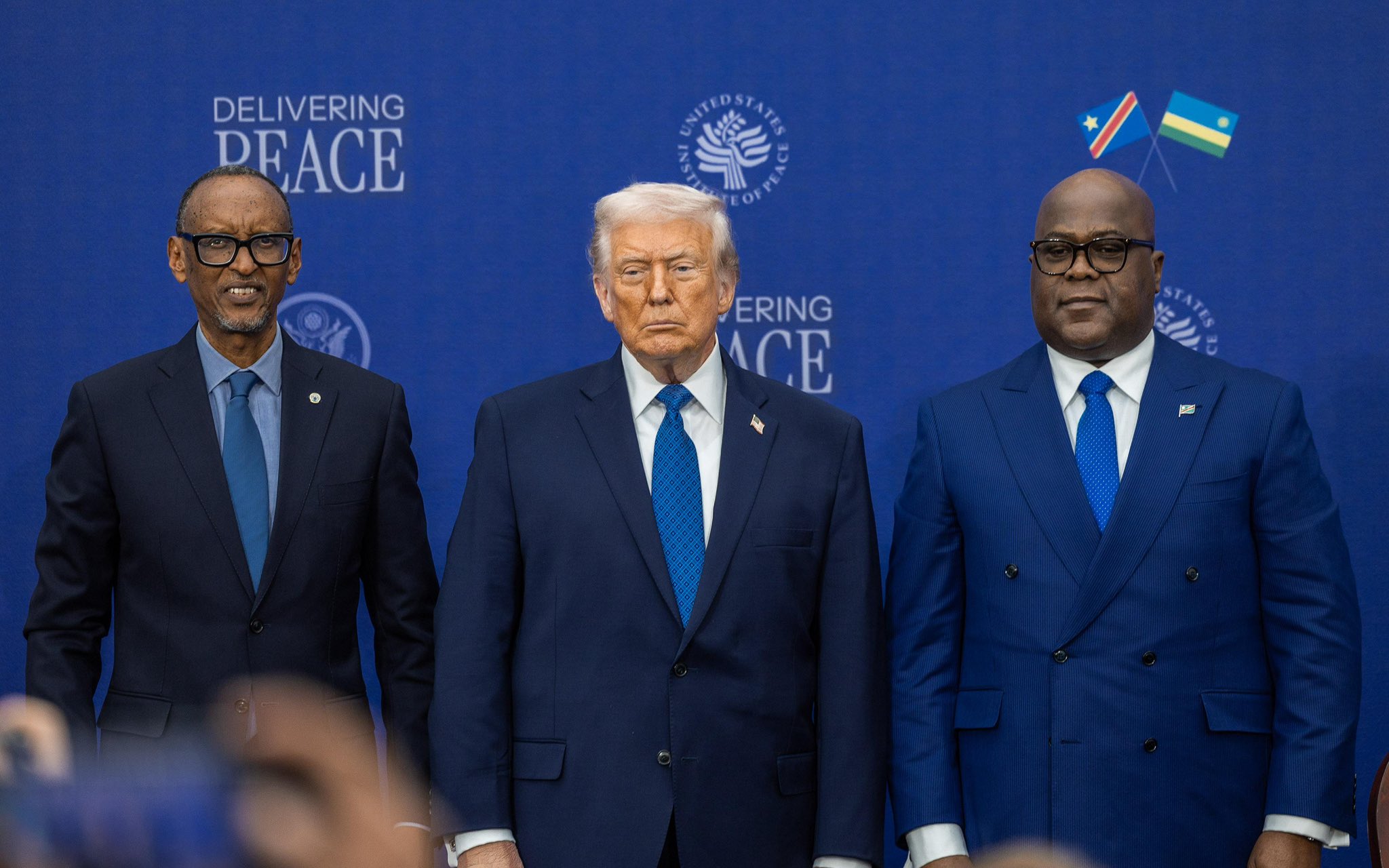
The ink on Donald Trump’s Washington peace accord is barely dry, yet the deal is already in ruins as the eastern DRC plunges back into all-out war.
Just a week after President Félix Tshisekedi and Rwanda’s Paul Kagame signed the Washington Accord under US mediation and guaranteed by President William Ruto, Rwanda-backed M23 rebels have stormed South Kivu, triggering mass killings and fears of a regional war.
UN reports indicate more than 400 people have been killed and over 500,000 displaced in just days in what the global agency calls a dramatic escalation, the worst since the rebel resurgence began three years ago.
M23 are reported to have taken over Uvira town, a strategic hub near the Burundi border, on Wednesday as the rebels fighters advanced through Kamanyola, Luvungi and Katogota. Dozens were left dead and forcing families to flee for safety.
The developments are a huge indictment of the Washington pact, which was championed by the Trump administration as a breakthrough in stopping Rwanda’s support for armed groups.
The rebels were not party to the deal as they are under the other US backed Qatar-led negotiations in Doha.
The offensive has drawn the attention of the African Union and the United Nations.
UN secretary general António Guterres has warned that the escalation risks seriously undermining efforts to achieve a sustainable resolution of the crisis and increases the risk of a “broader regional conflagration”.
Through deputy spokesperson Farhan Haq, Guteress called for an “immediate and unconditional cessation of hostilities”.
The UN boss further urged all parties to honour commitments made under the peace accords signed in Washington on December 4 and the Doha Framework Agreement reached in November.
“The UN remains fully mobilised to support lifesaving assistance and ongoing diplomacy,” Guteress said, stressing that “the risk of regional conflagration is real and the need for de-escalation is urgent.”
African Union Commission chairperson Mahmoud Ali Youssouf has also sounded the alarm, lamenting that the onslaught “run counter to the momentum” created by the Doha Agreement and the Washington Accord.
Youssouf condemned violence against civilians and warned against attempts to establish parallel administrations in eastern Congo.
“Lasting peace depends on full respect for sovereignty and territorial integrity,” he said, urging the region to return to the Addis Ababa Framework and Non-Aggression Pact commitments.
The DRC government has accused Rwanda of violating peace agreements and providing military support to the M23 rebels and called for urgent international action.
In a letter to the UN Security Council on December 9, DRC’s Minister of Foreign Affairs Thérèse Kayikwamba Wagner formally accused Rwanda of violating its commitments under the Washington Accords and called for urgent action.
President Tshisekedi, in a national address, described the conflict as a "proxy war aimed at challenging our sovereignty".
But Kigali has aggressively pushed back, placing blame squarely on Kinshasa and its regional allies.
Rwanda accused the Congolese and Burundian armies of bombing civilian villages near its border, forcing M23 to “counter” the attacks. It said more than 1,000 Congolese fled into Rwanda last week and claimed Burundi has deployed 20,000 troops inside South Kivu, laying siege to Banyamulenge communities.
Kigali added that DRC has openly admitted it will not observe the ceasefire, insisting Tshisekedi “was never ready to commit to peace” even as he stood beside Trump during the signing ceremony. The real obstacle to peace, Rwanda argued, remains Kinshasa’s failure to neutralise the FDLR militia as required under the June 2025 agreement.
On Thursday, Rwanda’s Kagame said the developments in Uvira revealed that 20,000 of Burundian soldiers were operating in Uvira, Minembwe, Kalemie, Kindu and others who had moved to Walikale and Kisangani.
“You have to ask, how did such a large Burundian force enter Congo? Clearly there is a serious problem. They spend their days shelling people in Minembwe with artillery and drones. And those in the international community who talk endlessly — where are they? People have cried out for help, and no one has intervened,” he said.
In a hard-hitting joint statement, the International Contact Group for the Great Lakes, chaired by Germany, said M23’s new offensive, supported by Rwanda, threatens to destabilise the entire region.
They expressed particular concern at the growing use of attack and suicide drones, calling it a dangerous escalation. The group demanded an immediate halt to offensive operations by both M23 and the Rwanda Defence Force, a withdrawal of Rwandan troops from eastern DRC and strict compliance with UN Security Council resolution 2773 and the December 4 Washington accords.
The collapse of Trump’s deal leaves the region at its most precarious point in years, as the move had rendered the local ongoing peace processes irrelevant.