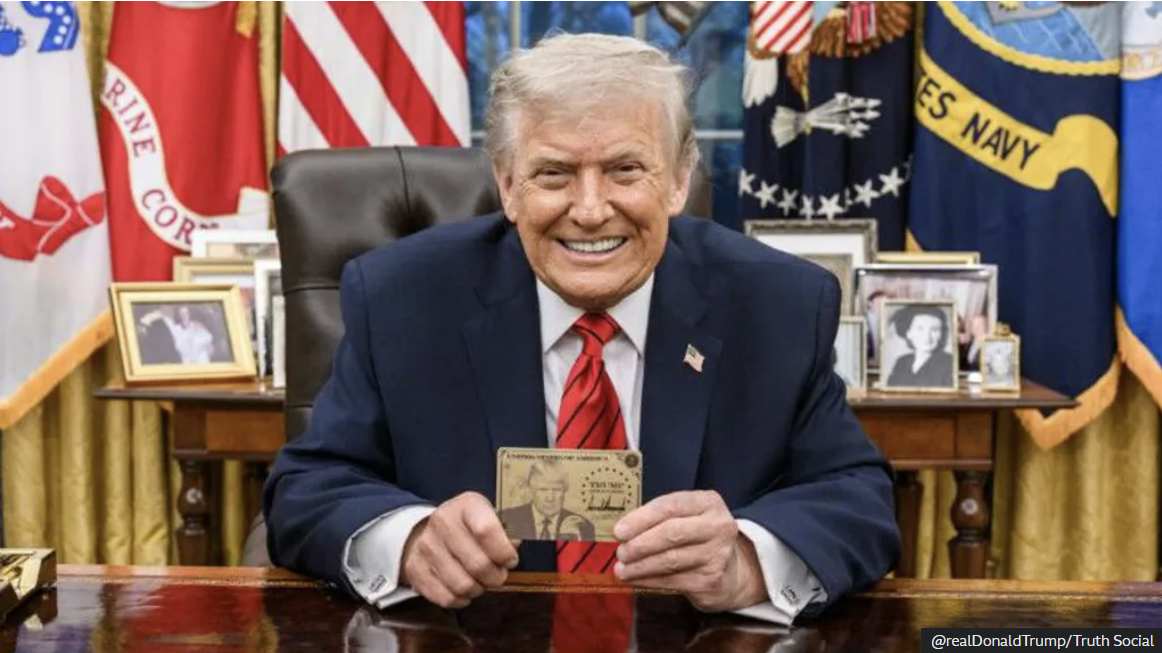
 President Donald Trump / HANDOUT
Africa must decipher the stark
MAGA rhetoric Trump has used in the new US National Security Strategy, released on
December 4 without his normative fanfare.
He defines strategy as “a concrete, realistic plan that explains the essential connection between ends and means: it begins from an accurate assessment of what is desired and what tools are available, or can realistically be created, to achieve the desired outcomes”.
This definition sounds okay, until you realise it’s based on transactional and mercantilist premises that will project US power, to secure American economic interests and, in the process, benefit corrupt authoritarian regimes in Africa.
The NSS represents a radical departure from Trump 1.0 and Biden’s NSSs, released in November 2017 and October 2022 respectively; in three critical realms: political, economic and security.
On the political realm, the NSS does not address chronic and systemic corruption prevalent in Africa, which is a root cause of human suffering.
In the 2017 NSS, Trump stated that the US is “prepared to sanction government officials and institutions that prey on their citizens and commit atrocities. When there is no alternative, we will suspend aid rather than see it exploited by corrupt elites.”
In the economic sphere, Trump begins with the statement “The United States should transition from an aid-focused relationship with Africa to a trade-and investment-focused relationship, favoring partnerships with capable, reliable states committed to opening their markets to U.S. goods and services”. He asserts that an immediate area for U.S. investments, with prospects for a good return on investments is the energy sector and critical mineral development.
He promised to “help Africa unlock its digital economy, double down on tackling food insecurity, and expand clean energy infrastructure”. This was to be achieved through three initiatives: Prosper Africa, Feed the Future, and Power Africa.
Prosper Africa is now severely weakened or dormant. Feed the Future is unlikely to continue at the same scale under Trump’s current funding posture, and Power Africa has been officially ended by his administration.
In addition, the lapse of Agoa on September 30 marks the end of a 25-year trade framework giving African exports duty-free access to the U.S. market. Trump has also imposed ridiculous tariffs ranging between 50 per cent and 30 per cent to African countries like Lesotho, Madagascar, Mauritius, Botswana, Angola, Libya, Algeria, South Africa.
Finally, in the security sector, the NSS states that “we must remain wary of resurgent Islamist terrorist activity in parts of Africa while avoiding any long-term American presence or commitments”. If Trump doesn’t want long-term security commitments, then he should stop his publicity stunts of peace mediations Africa.
In 2017, one African priority was to continue working with partners “to improve the ability of their security services to counter terrorism, human trafficking, and the illegal trade in arms and natural resources.”
Biden’s NSS was more elaborate. He would support “African-led efforts to work toward political solutions to costly conflicts, increasing terrorist activity, and humanitarian crises, such as those in Cameroon, Democratic Republic of the Congo, Ethiopia, Mozambique, Nigeria, Somalia, and the Sahel.”
It’s clear now. Trump doesn’t have African interests at heart. In consequence, patriotic Africans should not allow Trump and his bumbling sidekicks to loot African wealth. Africa must represent its interests as a continent and with confidence.
First
Kenyan Ambassador to the Republic of Korea, Specialist in Korean Peninsula
Studies and geopolitical analyst, [email protected]