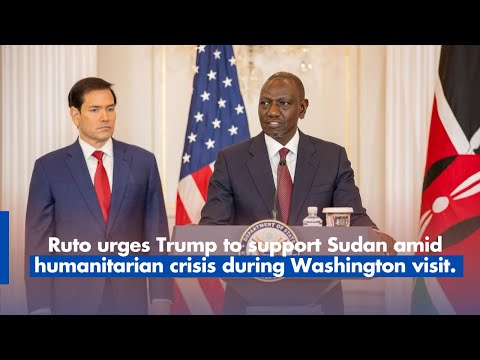
 President Ruto and US Secretary of State Marco Rubio last week.
The deal indicates the US will help Kenya establish one biosafety level 4 (BSL 4) laboratory and upgrade 4,541 other labs across the 47 counties, to help in identifying unique germs.
A BSL-4 lab is the highest security level for handling dangerous, exotic pathogens such as Ebola, which often cause fatal diseases with no vaccines or treatments.
The agreement says: “Kenya [should] notify relevant authorities, including critical parties in the national public health system and the US Government within 1 (one) day of an infectious disease outbreak being detected.”
The 7-1-7 approach is a global public health target for rapidly detecting, reporting, and responding to disease outbreaks: seven days to detect an outbreak, one day to notify authorities, and seven days to complete key early response actions, aiming to stop epidemics before they spread.
But the bilateral deal with the US has raised questions among global health experts that it possibly overrides the international pathogen-sharing systems now being negotiated under the World Health Organization (WHO).
The US is not currently a party to the WHO Pandemic Agreement, including its Pathogen Access and Benefit-Sharing (PABS) annexe, as it withdrew from the WHO under the current Trump administration.
The WHO Member States on Saturday concluded their latest round of negotiations on the new global Pathogen Access and Benefit-Sharing (PABS) system, which is meant to govern how countries exchange pathogens and related data during outbreaks.
Countries agreed on December 6 to resume talks in January, describing the process as urgent.
Global health experts warned that bilateral deals that include detailed pathogen-sharing conditions may conflict with the new PABS system being designed at the WHO.
Dr Michel Kazatchkine, a member of the Independent Panel for Pandemic Preparedness and Response, told delegates during a WHO meeting: “In our view, these bilateral agreements will undermine the multilateral system. They will bypass the WHO, and the foundations of solidarity and equity we have been trying to build here.”
The WHO's proposed pathogen-sharing conditions indicate that countries that share pathogen data should also be guaranteed the resultant vaccines and drugs. Some rich countries and the pharmaceutical industry oppose these mandatory terms.
A specimen sharing agreement, to be annexed to the Memorandum of Understanding that Kenya signed, suggests that the Kenya-US commitments take precedence if conflicts arise.
Article 4 of the model text states: “Each Party affirms that its participation in any multilateral agreement or arrangement, including surveillance and laboratory networks, governing access and benefit sharing of human and zoonotic specimens and related data shall not prejudice its compliance with this agreement.”
US officials in Nairobi said the agreement simply maintains established practice where some Kenyan specimens are tested in US-supported laboratories when local capacity is insufficient.
Brian Rettmann, head of the US President's Emergency Plan for Aids Relief (Pepfar) in Kenya, said: “It’s essentially continuing some of the relationship that we've had with the Kenyan government in the past where we would test some of the specimens where they didn't have the capabilities within their own labs, so that we would actually continue that moving forward.”
He added, “Also part of the agreement is building up their lab networks so that they have those capabilities themselves.”
The agreement indicates that joint pathogen testing and data sharing will be subject to Kenyan laws.
“The US Government and the Government of Kenya intend to continue specimen testing, including genetic sequencing and sharing data on detected pathogens subject to the existing laws and regulations of the Government of Kenya,” it says.
The Kenya-US health agreement is guided by the America First Global Health Strategy (AFGHS).
The AFGHS was launched on September 18 by the Trump administration to protect Americans by containing outbreaks abroad, promoting US companies (makers of diagnostics, vaccines, and medicines), and shift recipient countries toward self-reliance through time-bound bilateral agreements.
The AFGHS states: “While health experts are unable to identify exactly where the next pandemic or threat to human health will emerge, there are some pathogens and geographic locations that are of higher likelihood. This includes many geographies in Sub-Saharan Africa.”
Susan Burns, the US Charge d’Affaires in Nairobi, said the cooperation agreement aims to support both countries’ health security.
She said: “The threats of HIV and tuberculosis and other communicable diseases, those are global challenges, right? Health challenges don’t respect borders. And so strengthening Kenya’s health system also makes America safer.”
The agreement also intersects with Kenya’s intellectual property obligations. It states: “All intellectual property rights with respect to any research, product and/or services developed jointly by the Participants pursuant to this Framework should be determined on a case-by-case basis in accordance with all applicable laws and relevant international agreements to which either or both Participants are a party.”
The outbreak notification requirement appears in the same section as detailed performance metrics. These metrics, listed in the agreement, will be used to inform annual US funding decisions for surveillance, outbreak response, and laboratory support.
Kenya and the United States are expected to begin implementing the surveillance and specimen-sharing provisions immediately. Further operational guidelines will be developed in early 2026.