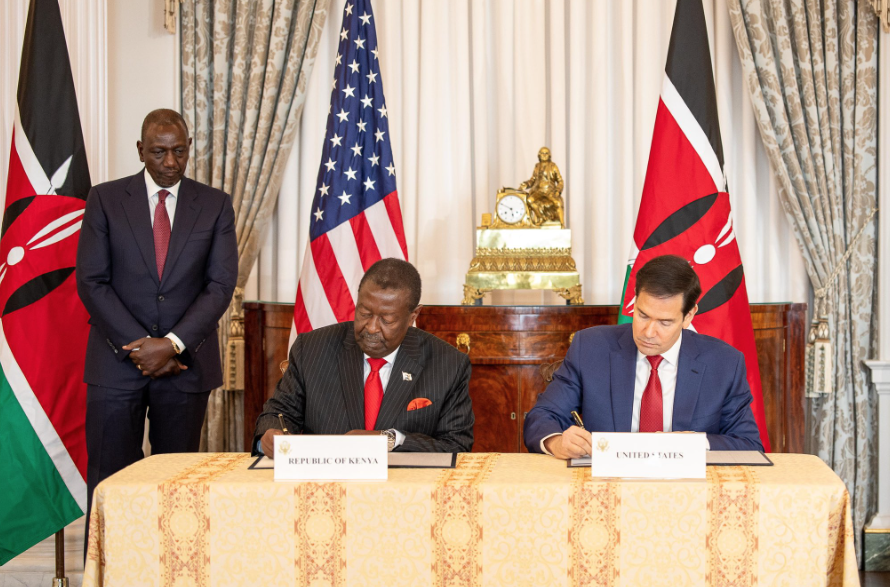
The recently signed Kenya–US Health Cooperation Framework has sparked debate on the scope of information to be shared with the United States, prompting the Kenyan government to issue swift clarifications.
Concerns over the confidentiality of personal medical records have been dominating public discourse, with some critics warning that sensitive health data could be compromised.
Health Cabinet Secretary Aden Duale moved quickly to reassure Kenyans, emphasising that their personal medical information will not be shared with the United States under the agreement.
Duale stressed that the framework strictly adheres to Kenya’s constitutional provisions on the right to privacy, the Health Act of 2017, and the Data Protection Act of 2019.
“The Kenya–US Health Cooperation Framework only permits the exchange of aggregated health data. No unique personal identifiers or individual medical files will be accessible to the U.S. government,” Duale stated.
The agreement, which will see the U.S. invest Sh208 billion to bolster Kenya’s priority health programmes, aims to reinforce the long-term sustainability of national health systems.
The investment is set to strengthen Kenya’s capacity to detect, prevent, and respond to emerging and existing infectious disease threats, benefitting both Kenya and the United States.
In a demonstration of transparency, the government released the full text of the Cooperative Framework on Health, signaling its commitment to openness and accountability in managing health partnerships.
“Kenya and the United States have signed a Cooperative Framework on Health, marking a new chapter in collaboration across priority health areas. In line with Article 35 on Access to Information, the full document is now publicly available for all citizens,” the Ministry of Health said in a statement.
The framework supports collaboration between the two governments to address major public health challenges, including HIV, malaria, tuberculosis, and other emerging infectious diseases.
It also seeks to strengthen Kenya’s health system, making it more self-reliant while simultaneously promoting US interests abroad.
A key component of the framework is a Data Sharing Agreement, which establishes the terms and conditions under which Kenya will provide health-related data derived from programmes supported through the partnership.
Data sharing, according to the agreement, refers to making information available for use, analysis, or decision-making.
The agreement specifies that only aggregate, non-identifiable data will be shared, ensuring that individual-level personal information remains protected.
“Kenya will avoid sharing personally identifiable information unless absolutely necessary. All data shared will focus on aggregated insights that support health program implementation,” Duale noted.
Under the agreement, both governments will jointly develop a list of Covered Data Systems, specifying which data will be provided, authorised users, types of access, and reporting tools.
The data-sharing arrangement will remain in effect for seven years from the date of signing, with strict confidentiality measures governed by Kenyan law.
The United States is required to take all reasonable measures to protect the data in accordance with U.S. federal standards and to notify Kenya immediately of any unauthorised access, use, or breach.
The Cooperative Framework also clarifies ownership rights. Kenya retains sole ownership of all data and intellectual property within the Covered Data Systems.
Any publications or research utilising Kenyan data must include Kenyan co-authors and obtain the requisite approvals.
Unauthorised use of data for purposes outside the framework constitutes a breach of the agreement, and Kenya reserves the right to restrict or halt data sharing should U.S. funding for supported programs be reduced or terminated.
Beyond data-sharing safeguards, the deal is expected to bring direct benefits to Kenyans.
The partnership will improve access to medical services, enhance healthcare infrastructure, and provide opportunities for training health professionals.
Laboratories, hospitals, and clinics across the country will see upgrades in equipment and technology, while investments in workforce capacity aim to strengthen disease surveillance, outbreak response, and public health management.
The framework also emphasises multi-sectoral assessments of Kenya’s early warning, surveillance, and response systems, including border and migration health procedures, pathogen sample collection, transport, storage, testing, and disposal.
These interventions are expected to bolster Kenya’s preparedness for emerging disease threats and pandemics, while simultaneously providing valuable insights for global health security.
Duale underscored that all aspects of the agreement comply with Kenya’s Digital Health Act, 2023, the Data Protection Act, 2019, and other applicable laws.
The framework ensures that data storage, archiving, and disposal will adhere to Kenyan regulations, with U.S. standards applied only in ways that do not conflict with local law.
Furthermore, all data systems will remain functional throughout the partnership, and the U.S. will be notified of any outages, updates, or disruptions that could affect access.
In addition to immediate public health benefits, the cooperation framework is expected to produce long-term gains. Strengthened health systems will enhance Kenya’s ability to manage infectious diseases independently, improve workforce health and resilience, and foster research and innovation in medical science.
Collaborative studies and interventions will also provide opportunities for Kenyan researchers to contribute to regional and global health knowledge.
In summary, the Kenya–US Health Cooperation Framework represents a landmark partnership, combining substantial financial investment with strict safeguards to protect citizen privacy.
The agreement promises both short-term improvements in healthcare delivery and long-term gains in resilience, workforce capacity, and research innovation, while maintaining Kenya’s sovereignty over its strategic health data.