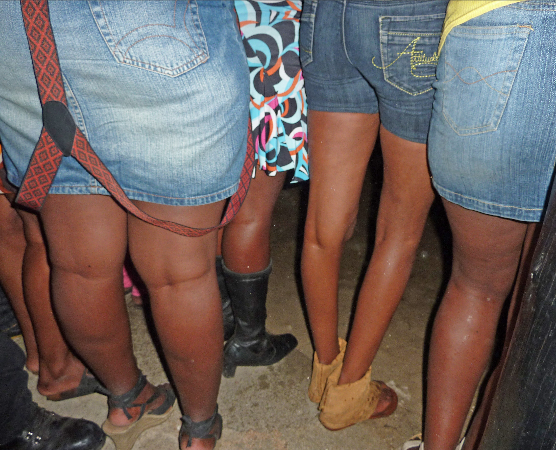
When VM wakes up each morning, she knows she must work hard to get the day’s bread.
For the past 18 years, the single mother of three has built her life around Nairobi’s shifting sex work hotspots: street corners, clubs, dimly lit alleys or hotels.
While the locations change, the risks don’t.
Her journey started in 2002 at the tender age of 17 when she became an orphan and a mother.
“My parents died five days apart. One was sick, the other just collapsed and died. I was left with the burden of providing for my siblings,” she recalls.
Clubs became VM’s lifeline. “It is actually the clubs that introduced me to sex work.”
Today, she moves between Nairobi CBD, Hurlingham and Buruburu depending on the concentration of clients.
“I may plan to work in town but end up somewhere else depending on the clients,” VM says.
Most days start like anyone else's, she says, but many nights stretch to dawn.
On a good day, she sees up to 10 clients, but on the flipside, she can go up to three days without one.
Surprisingly, most of her clients are married men and the youth.
HIV prevalence among sex workers in Kenya currently stands at 29.3 per cent, one of the highest among key populations, according to the National Syndemic Diseases Control Council (NSDCC).
VM says the reasons are painfully simple: condom shortage or bursts, clients offering more money for unprotected sex, poverty, stigma in health facilities, barriers to accessing post-exposure prophylaxis (Pep) and pre-exposure prophylaxis (Prep), criminalisation and violence.
“Right now, getting Pep, Prep or even condoms is difficult and because sex work is criminalised. sometimes we are raped and forced into sex without protection,” she says.
VM says many sex workers avoid public health facilities due to stigma.
“You experience a condom burst or rape, but you can’t go for treatment because you will be stigmatised. So most of us stay away.”
The stakes are high. If a condom breaks during sex, health experts recommend stopping immediately, replacing it and seeking Pep within 72 hours, something many sex workers are unable to.
VM now works with the Sex Worker Outreach Program (Swop) ambassadors, a community initiative that responds to violence, pushes for law reforms and connects sex workers to healthcare, counselling and economic support.
They believe sex workers deserve dignity and safety. They push for decriminalisation, better health access and economic empowerment.
But global funding cuts have hit hard.
“The friendly facilities we depended on were shut. We were left on our own. Public hospitals stigmatise us. Programmes such as Nyota project excluded us,” VM says.
She has called for decriminalisation of sex work, arguing it will help improve the economy.
Kenya has 1.37 million people living with HIV, with national prevalence at 3.3 per cent. But among key populations, the numbers are far higher: sex workers: 29.3 per cent, men who have sex with men: 18.2 per cent and people who inject drugs: 18.3 per cent.
Douglas Bosire, Acting CEO of NSDCC, says addressing new infections among sex workers is crucial for the entire nation.
“Who are the clients of these sex workers? The general population,” he said.
“If we don’t empower sex workers to protect themselves, we are allowing the virus to spread.
He says outreach teams distribute condoms, lubricants and public education even though they are often misunderstood as “promoting sex work.”
“We are saving lives,” he says.
“We are close to epidemic control but not there yet. The last mile requires targeted interventions for key populations, including sex workers,” said Nascop CEO Andrew Mulwa.
Some counties including Nairobi, Kisumu, Nakuru, Homa Bay, Migori, Siaya, Kiambu and Mombasa account for 51 per cent of all HIV cases.
Young people remain highly vulnerable.
In 2023 57 per cent of all new infections were among those aged 15–34. Young women (15–24) accounted for 31 per cent of new adult infections
UNAIDS reports that sex workers globally face HIV prevalence four times higher than the general population. The AIDS Healthcare Foundation (AHF) continues providing testing, treatment and prevention for sex workers, while advocating for removal of stigma and structural barriers.
Yet Kenya faces a financial hurdle. The HIV programme required Ksh 21.8 billion in 2023-24 for essential commodities but faced a S12.8 billion shortfall.
Domestic financing has grown only slightly, from 32 per cent in 2019 to 34 per cent in 2022.
Experts warn that without sustainable funding, Kenya risks reversing gains.
MV’s story mirrors the experience of thousands of sex workers across Kenya.
Their vulnerability is not inevitable; it is shaped by: criminalisation, stigma and discrimination, economic hardship, shrinking HIV funding, violence and unsafe working conditions, and limited access to prevention tools.
Protecting sex workers is protecting the nation.
The message from the community, activists and experts is clear: Decriminalise sex work. Fund prevention. End stigma. Empower those at the frontline of risk.
“We want to be safe. We want to live. We want to be protected like everyone else,” VM says.