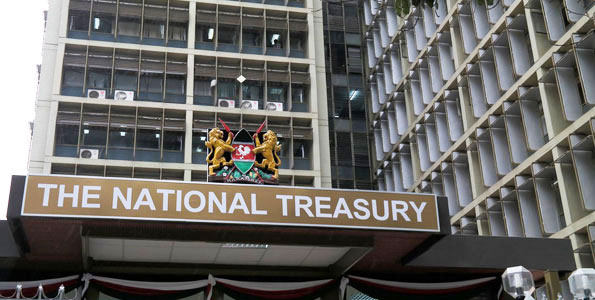
 The National Treasury/KNA
Auditor General Nancy Gathungu, in a review of loans borrowed between the financial year ending June 30, 2019, and June 30, 2023, said the exchequer blatantly violated the law that requires such borrowing to finance development projects.
The report further exposes a systematic failure in cash and debt management, showing that money meant to build infrastructure and drive economic growth was instead used for general government spending, with no tangible development projects to show for it.
The audit found that of the Sh2.97 trillion raised through Treasury bonds, Sh2.67 trillion was transferred to the government's main account.
From the amount, Sh558.87 billion was explicitly used to settle maturing domestic debt, while the remaining Sh2.11 trillion funded general exchequer releases to ministries.
“The audit could not verify what specific projects the Treasury bond proceeds were expended on,” Gathungu said.
“Utilisation of these proceeds to fund repayment of maturing Treasury bonds contradicts the Fiscal Responsibilities Principle, Section 15(2) (c) of PFM Act, 2012, that provides that the national government's borrowings shall be used only for the purpose of financing development expenditure and not for recurrent expenditure,” the report tabled in Parliament reads.
When questioned, the National Treasury defended the practice, saying debt repayment is a first charge on the Consolidated Fund.
Treasury further argued that “because of the fungibility of money, the moneys were used exchangeably to fund priority exchequer requests instead of lying idle in the Treasury bonds accounts.”
“It was also explained that, provided that at the end of the financial year the budget was fully funded, there should be no problem,” the report adds.
However, the Auditor General flatly rejected the justification, stating that it contradicts the fiscal responsibilities principles outlined in the Public Finance Management Act.
The report concludes that, as a result, it was impossible to verify what specific development projects, if any, the bond proceeds were spent on.
“A number of infrastructure bond prospectuses indicate the purpose of Treasury bonds to be general and not specific to a particular infrastructure project, making it difficult to confirm utilisation of the proceeds to specific projects,” the Auditor General said.
Compounding the misuse of borrowed funds was a finding that there was chronic under-investment in development during the period under review.
The audit revealed that the national government's development expenditure averaged a mere 13.95 per cent of the total budget over the last three years.
This is less than half of the legal threshold of 30 per cent that is set in public finance laws and regulations to ensure sustainable growth.
This means that not only was money borrowed for development not used for that purpose, but also that the government failed to allocate resources to development as required by law.
For instance, out of the total national government allocation, only 15.9 per cent was allocated to development in the financial year 2020-21, 14.3 per cent the year 2021-22, and 11.61 per cent in the fiscal year 2022-23.
The report warns that the events directly threaten the implementation of President William Ruto’s Bottom-Up Economic Transformation Agenda (BETA), which is heavily reliant on capital-intensive projects.
“The implementation of this agenda is likely to face delays due to delayed funding,” the report states.
Gathungu’s review has unearthed several other critical failures, painting the picture of a Treasury in crisis.
It cites ineffective cash management, which has seen the National Treasury fail to fully meet its budgetary obligations. Over the three years, a cumulative budget shortfall (under-absorption) of Sh785 billion was recorded.
It further reveals that the National Treasury illegally maintained an average overdraft of Sh59.5 billion at the Central Bank at each year's end, instead of repaying it, leading to unnecessary interest costs.
“The overdraft facility for the period under review was observed not to have been settled at year-end due to insufficient funds. As a result, the long outstanding overdraft balances lead to increased interest as a cost of borrowing,” Gathungu said.
The audit further established that the entity relies on basic spreadsheets for critical cash forecasting, increasing the risk of error.
The Auditor General also raised concerns that Treasury has failed to fully operationalise a Treasury Single Account for clear visibility of government cash.
“There is inadequate visibility of the government balances, cash inflows and cash outflows due to incomplete operationalisation of a Treasury Single Account (TSA).’
She held that the non-adherence to fiscal principles "may weaken investor confidence and development of markets for government securities."
In essence, the government's failure to use borrowed funds as promised could make it harder and more expensive to borrow in the future.
INSTANT ANALYSIS
The Auditor General recommends further staff training to improve understanding of the cash management function and the use of modern cash management tools and techniques to enhance accountability. She further wants Treasury to maintain reliable debt data to ensure they are within the guidelines and risk parameters of the country’s debt strategy.