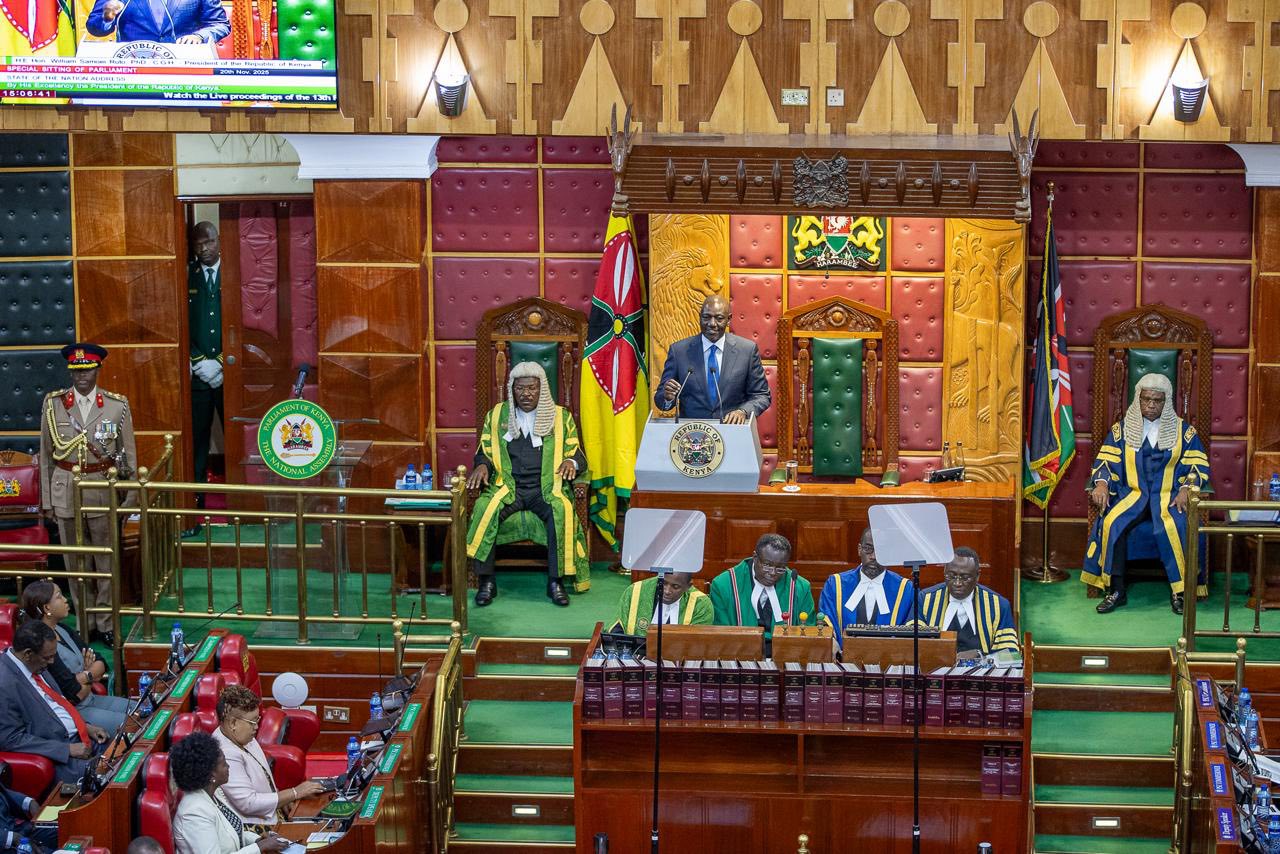
In a bold State of the Nation Address, President Ruto framed the vision as the “defining task for his administration and the current Parliament."
His message was unmistakable, delivered with deliberate emphasis: “IT. CAN. BE. DONE.”
He outlined a Sh5 trillion blueprint hinged on four pillars, urging MPs to consider a funding model for implementing the ambitious ventures without overburdening the taxpayer.
Arguing that “Kenya punches below its true weight”, the President asserted that the transformation would follow after the Asian Tigers that were Kenya’s peers at independence but are now first-world economies.
“The task before us, therefore, is unmistakably clear. If Kenya is to grow at scale, we must raise our ambition," he declared amid jubilant cheers by members of the two Houses.
He detailed the four national priorities through which the grand plan would be attained, citing education, agriculture, energy, and transport infrastructure as the key pillars.
President Ruto also unveiled a comprehensive infrastructure plan, including the dualing of major highways and the construction of 28,000km of roads over the next decade.
He used the occasion to announce the launch of the dualing of the Rironi-Naivasha-Mau Summit highway, as well as the planned expansion of the Standard Gauge Railway.
“This work is already progressing,” President Ruto said, adding that he was certain that the gridlock on the stretch would be a thing of the past.
The gridlock that paralyses these roads every day, especially on weekends and holidays, will soon be history, he said of the road whose works have serious political ramifications.
The SGR will be extended from Naivasha to Malaba, with a branch line to Kisumu, starting January 2026.
For the roads, the President said his administration would lay the foundation for the dualisation of more roads across the country, including Nairobi’s Kiambu Road, Bomas-Karen, Ongata Rongai-Kiserian, Ngong-Isinya, and Athi River-Namanga roads.
Others in the list are Machakos Junction-Mariakani, signalling the death of the Mombasa Expressway project, as well as the Makutano-Embu-Meru-Maua roads.
“These four projects are our national imperatives; commitments we must embrace without hesitation. Not because they are easy. Not because they are cheap. But because they are absolutely necessary,” Ruto said.
He told lawmakers that the answer to funding the much-touted plan lies in the National Infrastructure Fund and the Sovereign Wealth Fund whose instruments are under consideration by the National Assembly.
The National Infrastructure Fund is to be established after the signing of the Government-Owned Enterprises Bill.
The fund will ring-fence all proceeds from the privatisation of state assets and use them to attract long-term investment from pension funds and private equity.
"For every shilling invested from privatisation proceeds, we aim to attract ten shillings," the President explained.
The Sovereign Wealth Fund will be created to ensure intergenerational equity.
It would be powered by royalties from natural resources and a share of privatisation proceeds, and serve as a national savings pot.
The President also committed to raising the national research fund from 0.8 per cent of the country’s Gross Domestic Product to two per cent.
He announced plans for expanding irrigation to boost food production and cut imports as among the steps to realise the grand dream.
President Ruto pledged that his administration would build 50 mega dams and thousands of smaller ones nationwide, with a view to bringing 2.5 million acres under irrigation.
To drive industrialisation, the President set a target of generating an additional 10,000 megawatts of electricity within the next seven years.
He said the massive energy expansion would help drive digital expansion and help Kenya realise its technological aspirations.
President Ruto, who was joined by his deputy Kithure Kindiki as well as members of the Cabinet and Judiciary, began his address by highlighting the achievements of his administration.
He emphasised how his team has steered Kenya from the brink it faced in 2022, listing economic indicators to support his claim.
"At a time like this in 2022, Kenya was in distress," he stated, listing how inflation shot to double-digits, a shilling on a free fall, and imminent debt default.
Ruto, while asserting that he past three years have not been easy, exuded confidence that he was on the right path to changing the story.
He cited how inflation has been tamed and the Kenyan shilling stabilised against the US dollar and other major currencies.
“We instilled fiscal discipline, strengthened revenue collection and placed our country on the path of recovery.”
Citing IMF figures, he announced that Kenya's economy had grown from $115 billion in 2022 to $136 billion, elevating the country to the sixth largest economy in Africa, up from eighth.
“The steep rise is not by accident but by deliberate choices, disciplined execution, and strategic reforms that have strengthened the economy,” President Ruto said.
The President dedicated significant portions of his speech to showcasing reforms in key sectors, positioning them as the foundation for the journey ahead.
In agriculture, he highlighted the registration of over 7.1 million farmers on a digital platform, with 21 million bags of subsidised fertiliser distributed.
This, he said, boosted maize harvests from 44 million bags in 2022 to a projected 70 million this year, driving down the price of a 2kg packet of flour from Sh250 to Sh130.
Similar success stories were cited for tea, coffee, and edible oils, all thanks to his strategy of "subsidising production, not consumption."
On healthcare, President Ruto reported that 27 million Kenyans are now registered under the new Social Health Authority, a leap from the NHIF era.
He praised the impact of 107,000 deployed Community Health Promoters, crediting them with care for millions of Kenyans at the first point of care.
He also announced an enhancement of the cancer benefits package from Sh550,000 to Sh800,000 from December 1, 2025.
The President also spoke on progress in the affordable housing project, saying 230,000 homes are now in the pipeline.
He further revealed that the Nairobi River Regeneration Programme alone is set to employ up to one million Kenyans at its peak next year.
The President called Kenyans to action, saying the country must strive to “reject mediocrity”.
“Let history record that this generation refused to be timid. That we chose ambition over fear, action over excuses, and progress over the false comfort of low expectations."
In a swipe at his critics, President Ruto said his team would remain focused on delivering the promise to Kenyans.
“Our critics, the high priests of pessimism who tear down without alternatives, will want you to believe that the economy is going in the wrong direction,” he stated.
“But while everyone may speak their mind, no one is entitled to manufacture self-service falsehoods and traffic them as facts. What I present here today is clear, verifiable and undisputed. I am convinced that this is only the beginning,” the President said.
INSTANT ANALYSIS
The address, which also saw the formal submission of constitutional reports on national values, international obligations, and state of security, sets a high-stakes agenda for the remainder of the President's term. It frames the coming years as a critical moment to finally turn the long-held promise into a reality.