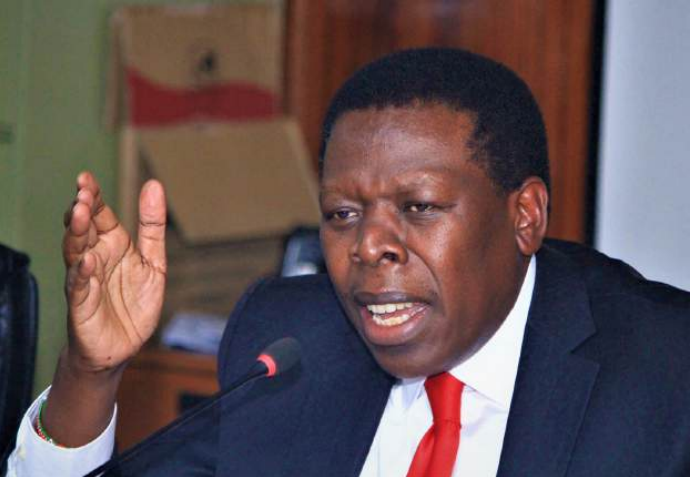
DAP-K leader Eugene Wamalwa has maintained the opposition remains united, amid recent clashes among leaders in the United Opposition camp.
Speaking to the Star in an interview, he admitted that differences exist, just like in any family set up, but are being managed through dialogue and established mechanisms.
“Even those doubting our unity can now see from these by-elections: we have been able to agree beginning with Malava, where we had many candidates,” Eugene told the Star.
"DCP agreed to withdraw their candidate Edgar Busiega, to support Seth Panyako, the DAP-K candidate, which is a big boost for the opposition to show we can compromise for the sake of the bigger picture and agenda, which is achieving opposition unity to make William Ruto a one-term president."
Responding to the confrontation between DCP party leader Cleophas Malala and his deputy in the party Governor George Natembeya (Trans Nzoia), Eugene said the matter will be addressed by respective principals.
He said the clash between Natembeya and Malala over the Kisa East ward by-election was triggered by the delayed decision on how to proceed between DAP-K and DCP.
“We had agreed it would be subjected to the same yardstick [opinion policing among parties] but we had not concluded the opinion polling and identifying between the DAP-K and the DCP candidates, who was stronger. DCP had requested that since they had withdrawn in Malava, that DAP-K withdraws in Kisa East. The matter is still being sorted out,” he said.
He said they had agreed within the camp that the principals should speak to their deputies so they calm down “and let the focus remain on not fighting each other but fighting Kenya Kwanza and broad-based candidates, so that we win jointly as a team”.
On the uneasiness between former Deputy President Rigathi Gachagua and former Interior CS Fred Matiang’i, Eugene noted that it would be unfair to expect everything to be seamless.
“I think it was James Madison who said if men were angels, we wouldn’t need government. We are not angels. We are human beings coming from different backgrounds, parties, communities and regions. Ultimately, what binds us is the greater good for our nation, our country and our future," he said.
“We are not a praise and worship choir that must sing the same thing and dance the same way. We might differ on several issues, but that does not mean we part ways. We are democrats. We have the resilience to take any shocks and bumps along the way without falling apart."
The former Defence minister, however, reiterated that it is only through unity that the opposition stands a chance to dislodge President Ruto from power.
Recalling the elections of 1992 and 1997, Eugene warned that divided, they will give Ruto a smooth ride back to State House.
“We must not make the mistake of dividing the opposition—like in 1992, when [Kenneth] Matiba and [Mwai] Kibaki went for it and lost. Again in 1997—my late brother Kibaki, [Charity] Ngilu, Raila [Odinga] went, all went and they were divided," Eugene said.
"It is only in 2002 that [George] Saitoti said there comes a time when the country is bigger than the individual. That is the path we must follow in 2027—to say the country is bigger than all of us, to sacrifice so that we give the best candidate.”
While the United Opposition has largely compromised on the by-elections, the jostling within has in the recent past sent signals of divisions within the camp.
Regarding the fight over the control of DAP-K, Eugene reaffirmed the party’s democratic structures for resolving disputes, stating, “We have strong internal dispute resolution mechanisms that can sustain any issues arising internally".
He also dismissed speculation about Natembeya potentially deputising Wiper leader Kalonzo Musyoka as premature, noting that political ambition is natural but should be communicated transparently.
On his qualifications for the presidency, Eugene highlighted his experience as former Minister for Justice, Devolution and Defence, roles that positioned him to strengthen the rule of law, defend devolution, promote inclusive development and national security.
As Minister for Defence, he emphasised his familiarity with national security challenges and regional threats.
“No one is better qualified to be the next commander-in-chief,” he said, while reiterating his willingness to support the opposition’s eventual presidential candidate if he is not selected.
The detailed interview will be published in the Star Political newsletter and website on Sunday