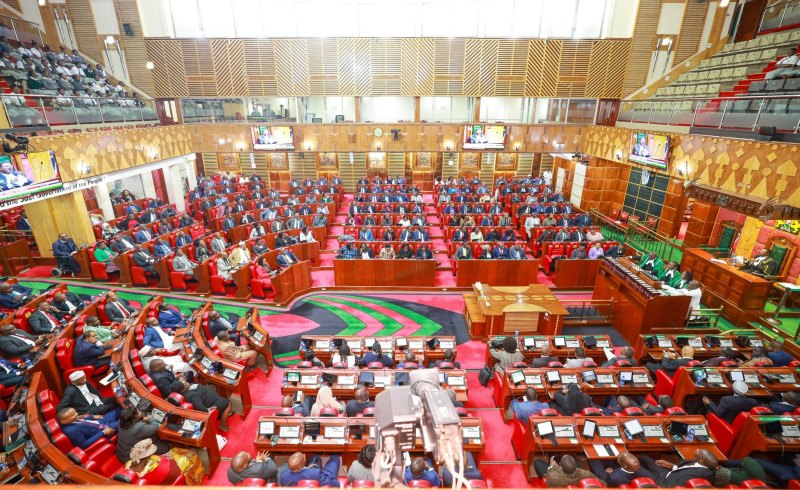
 Uasin Gishu Senator Jackson Mandago. /FILE
The Ministry of Health and private hospitals have joined forces to oppose a Senate proposal seeking to criminalise the detention of patients and corpses over unpaid medical bills.
In submissions to the Senate Health Committee, which is scrutinising the Health (Amendment) Bill, 2025, the Ministry argued that detaining bodies and patients should not be treated as a criminal offence.
“Mortuary services are billable and subject to applicable fees as per an institution’s approved rates. Charging for these services cannot, therefore, be criminalised,” the Ministry said.
It added that hospital and mortuary services are already covered under tariffs set by the social health insurance scheme, and that non-payment of fees should be handled “administratively.”
However, the committee — chaired by Uasin Gishu Senator Jackson Mandago — dismissed the Ministry’s position.
“We have resolved to reject the proposal by the Ministry of Health and the Aga Khan Hospital,” Mandago said.
The committee insisted that the Bill targets the act of detaining a patient or body for non-payment, not the charging of fees, noting that such detentions have already been outlawed by the High Court.
Nominated Senator Tabitha Mutinda urged the Ministry to prioritise the registration of Kenyans into the Social Health Authority (SHA) to curb cases of detention.
The Bill, sponsored by Nyamira Senator Okong’o Omogeni, explicitly bars health facilities from holding patients or bodies as collateral for unpaid bills.
Facility administrators who violate the law would face fines of up to Sh2 million, and hospitals would forfeit any deposits or partial payments made by families.
It further empowers the Health Cabinet Secretary to recover funds paid to facilities that unlawfully detain patients or bodies, and to issue regulations governing the recovery of medical fees.
The proposed law is anchored on growing public outrage over hospitals — especially private ones — detaining patients and bodies when families cannot pay.
Many Kenyans have been forced to take loans, sell property, or organise fundraisers to secure release of their loved ones.
In its submission, Aga Khan Hospital criticised the Bill, saying it protects patient rights but neglects the property rights of health facilities.
“While patient rights are in the primary legislation, health facility rights are relegated to subsidiary regulations, creating a hierarchy that devalues provider interests,” the hospital said.
The hospital added that private facilities operate without subsidies and depend entirely on patient payments for salaries, equipment maintenance, medicine, and emergency readiness.
But the committee rejected calls to exempt private facilities, saying it would create a two-tier standard for constitutional rights.
“Constitutional rights are universal and cannot be selectively applied based on facility ownership. The WHO position is clear — detention should be prohibited in both public and private facilities,” the committee said.
For their part, the Council of Governors rejected the provision giving the Health Cabinet Secretary the absolute power to make regulations governing the recovery of fees charged by health facilities.
They said the provision would allow the CS to micromanage counties, yet health is a devolved function.
The governors, however, agreed with the provision outlawing detention of patients and bodies.
Cases of detention remain common. In 2017, a police officer whose twins died after birth was held at a Nairobi hospital over a Sh3 million bill.
Senator Okong’o said detention over unpaid bills violates fundamental rights enshrined in Kenya’s Constitution and international law, including the right to dignity (Article 28), freedom of movement (Article 39), and protection from arbitrary detention (Article 29).
He also cited global human rights instruments prohibiting imprisonment for debt.
“Kenyan courts have consistently ruled that detaining patients for unpaid bills is unlawful, arbitrary, and unconstitutional,” he said.
INSTANT ANALYSIS
Senators remain deeply concerned that financially distressed families —
particularly in private hospitals — continue to face the detention of patients
and bodies. Many are forced into debt, property sales, or public fundraising to
clear medical bills, underscoring the urgency for legislative intervention.