SHIQUO, a social mediasensation with at least 1.2 million followers on TikTok, imports and sells almost everything households need online and at her shop within the Nairobi Central Business District.
Thousands of customers throng her page, buying all manner of items from electronics, clothes, car accessories, spoons, plates, cloth hangers, to portable shelves and even combs at much affordable prices.
Her booming business has inspired thousands of such ventures, promising quick profits for operators and better deals for customers.
Foreigners, mostly from China and the UAE, have noticed the high demand, setting up even bigger shops, riding on economies of scale to sell those accessories at much lower prices.
“Imagine buying a set of cups, spoons, and plates for less than Sh1,000? These online shops selling imported items are really coming through for us in this tough economy. Although quality is not guaranteed, a man must live,’’ Sophie Kihara, a regular online trader, told the Star.
Pauline Migarusha says that she furnished her house at a much lower cost and faster, thanks to Chinese-owned stalls and cheaper online import options.
“I bought beds, convertible chairs, utensils and even dustbins on Ubuy and AliExpress while seated in my compound in Kakamega. My friend who was visiting Dubai bought other accessories for me. I had everything to my liking within four months of ordering,’’ she said.
Berly Wanjiku, a trader who has since opened three stalls in Nairobi, Thika and Eldoret, says that the high demand for affordable kitchenware pushes her to ship at least once every two months.
"The business is good, I can't complain. I have been in this business since 1998. Buying from local producers was costly and marred by production delays. Import business is affordable and convenient. You just submit a sample and production is real-time,'' she told the Star in a virtual interview.
This trend has seen a huge shift in Kenya’s trade flows toward Asia, with the latest data showing a surge in imports from China and the Gulf while exports to traditional African partners contracted sharply in the first quarter of 2025.
According to the Kenya National Bureau of Statistics (KNBS), Asia accounted for 68.3 per cent of Kenya’s total imports in the first three months of the year, equivalent to Sh445.6 billion.
“This marks a notable expansion from the previous year due to a sharp rise in shipments from China, Saudi Arabia, and the United Arab Emirates (UAE),’’ the government statistician says.
Imports from China alone jumped to Sh148.6 billion, up from Sh126.0 billion a year earlier, driven by machinery, electronics, and manufactured goods.
The Gulf states recorded even steeper growth, with imports from Saudi Arabia doubling to Sh19 billion and those from the UAE rising by 37.4 per cent. Other East and Southeast Asian economies also strengthened their position: imports from Indonesia climbed 50.6 per cent, and those from Japan rose 12.8 per cent.
While such ventures are birthing business opportunities for thousands of locals and bridging prices for consumers, they are slowly killing thousands of cottage businesses, artisans, and hurting suppliers across all economic sectors.
This is now a major concern to state policy formulators, economists, and local trade lobbies.
In 2023, traders in Nairobi took to the streets to protest what they called China’s takeover of their businesses.
They claimed that Chinese retailers have infiltrated the Kenyan market, causing them to lose business. They accused foreign retailers of selling goods at lower prices, undercutting local traders and making it difficult for them to compete.
Paul Mwathi, an international trade expert, is worried that most African countries, including Kenya, may not realise their manufacturing potential as they have turned into an easy market for global traders.
“The balance of trade continues to widen against Africa. The continent is consuming more than it is producing. As the buying power continues to drop, the quality of products coming in worsens. A big dumping place is in the making,’’ Mwathi said.
He calls on governments to tighten trade policies to protect local producers. “It is sad when a country like Kenya, which gave the world M-Pesa, imports cups and spoons in 2025.”
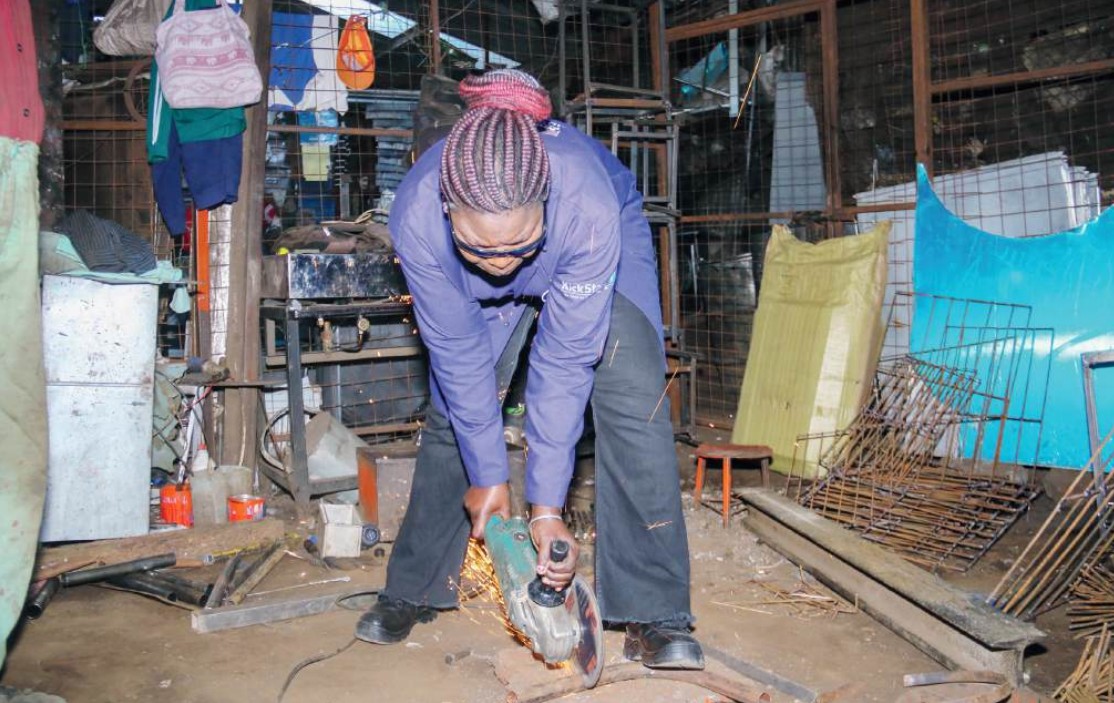
The Confederation of Micro and Small Enterprises Kenya Chapter and Juakali Association are calling on President William Ruto to act with speed to rescue local producers, especially artisans who are now competing with plastics and other cheap products from China, the UAE and Malaysia.
John Kihiu, national chairman for the Confederation of Micro and Small Enterprises Kenya chapter, says that most of his members have been forced to close shop, with thousands across the country now fighting depression, debts, drugs and in abject poverty.
He wonders how Kenya’s manufacturing sector will contribute 15 per cent to GDP by 2027 from the current 7.6 per cent if the government allows importation of basic commodities, including spoons and toothpicks.
“We are calling on the government to remember us. Kenya can’t attain the first economy status if small traders who contribute 80 per cent of the workforce and contribute nearly 40 per cent of the country's GDP are sidelined,’’ Kihiu told the Star.
His lobby has welcomed the government’s move to ban furniture importation, saying that the country has many experienced artisans who are producing some of the world's best beds, chairs, and tables.
Kihiu is now calling for even tougher scrutiny of items entering the country, saying that plastics, disguised as more efficient products, are pushing wood and metal artisans out of the market while worsening the environmental eyesore.
Munyiri Mutitu, national treasurer, National Juakali Federation, echoes his sentiments, asking the government to rethink its import policies to align with changing trade dynamics and protect local producers from cheap imports.
“Local production can be much cheaper if the government creates the necessary environment. It is just to lower the cost of production by reviewing tax policies, harmonising business permits, creating necessary infrastructure to lower the cost of raw materials, power and transport,’’ Munyiri said.
He said that local producers saved the country from an FX crisis in the 1990s, insisting that Jua Kali sector guarantees job creation and has multiplier effects on other sectors like agriculture and education.
He thanked President William Ruto for ensuring that local talent sustains the state’s affordable housing project, calling for more long-term policies that will keep the vibrant sector alive.
“The country has close to 17 million small traders who are contributing immensely to the economy. The death of this key sector can have devastating effects on this nation. When it thrives, Kenya shines.”
Cooperatives and MSMEs Development CS Wycliffe Oparanya has pledged the government’s support to small traders, saying that, apart from protecting the sector from direct competition from imports, it is working on collaborative policies, especially in marketing and access to credit.
Oparanya told the Star at the just concluded East Africa Micro Small and Medium Enterprises Trade Fair in Nairobi that from the Husler Fund to the current Nyota Fund, the government is keen to empower the Jua Kali sector, which formal creditors had long sidelined.
He disputed the notion that the state was allowing unnecessary imports into the country, saying that there is a fairly balanced trade environment that caters to all local traders.
The CS said that the President's vision extends beyond housing construction; it encompasses the engagement of the Jua Kali sector to provide locally manufactured items. “This not only supports local businesses but also fosters a sense of community and self-sustainability.”
Last year, Prime Cabinet secretary Musalia Mudavadi said that Sh4.4 billion in cash had gone directly into the sector since the Affordable Houses Programme started.
He called on the Jua Kali sector to harness new and emerging technologies to reach higher levels of efficiency in production and consumption.