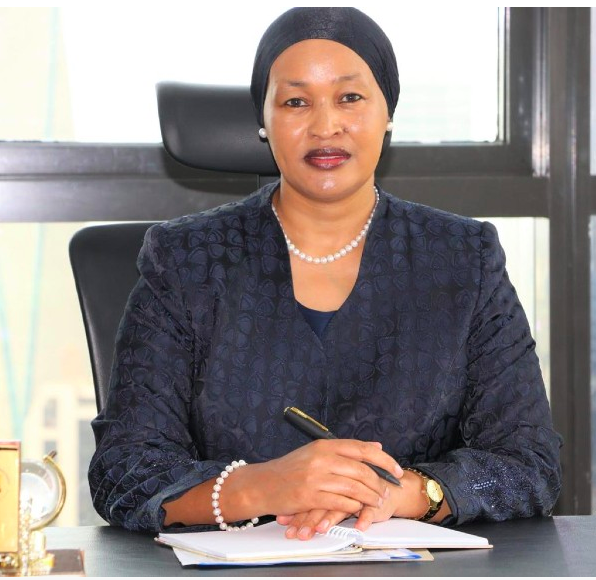
 National Land Commission CEO Kabale Tache/Handout.
The National Land Commission (NLC) is a constitutional agency established under Article 67 (1) of the Constitution of Kenya 2010.
It was operationalised by the NLC Act, 2012, the Land Act,
2012, and the Land Registration Act, 2012.
The commission is mandated by the constitution to manage
public land on behalf of the national and county governments and recommend a
national land policy to the national government, among other roles.
This week, seven out of the nine commissioners are set to
exit NLC following the expiry of their term. Commission’s chief executive
officer Kabale Tache talks to the Star about NLC achievements.
The NLC chairperson and members of the commission are appointed for a single term of six years and shall not be eligible for reappointment.
How has the journey
been for the last six years?
The last six years have been marked by remarkable progress,
resilience and transformation for the commission. When the current team of
commissioners assumed office in November 2019, the NLC faced significant
expectations—to rebuild public trust, enhance accountability and deliver on its
constitutional mandate of managing public land on behalf of Kenyans.
During this period, the commission has evolved into a more transparent, responsive and data-driven institution.
What are some of the
notable achievements that the commission has made?
We have processed over 31,000 tenure regularisation
requests, facilitated 182 allocations to public institutions and completed 508
lease renewals.
These efforts are all aimed at securing tenure rights and
promoting equitable access to land.
The commission has also supported the national government by
facilitating 118 compulsory acquisition projects, covering over 49,000 hectares
(121,081 acres) of land and enabling compensation to thousands of Project
Affected Persons.
These demonstrate that NLC has matured administratively and
operationally, with a clear focus on service delivery to the citizens.
Administratively,
what stands out as some of the significant achievements of NLC between 2019 and
2025?
As a commission, we have focused on strengthening our internal
systems, investing in people and improving efficiency.
The Strategic Plan 2021–2026 that the commission developed
and implemented has provided a crucial and solid framework for aligning
institutional objectives with national priorities such as Vision 2030 and the
Bottom-Up Economic Transformation Agenda.
There has been notable growth in the number of staff, from
500 to 850, during this period. The majority of our staff are young
professionals, reflecting a deliberate investment in human capital development.
NLC also prioritised performance management and
accountability.
Over the years, we have disbursed over Sh66 million to
persons affected by projects. In
addition, we have handled 1,286 dispute cases, many resolved through Alternative
Dispute Resolution and Traditional Dispute Resolution mechanisms, promoting
peace, fairness and justice.
NLC has deepened intergovernmental partnerships with the Executive,
Judiciary, Parliament and all 47 county governments.
This has enhanced collaboration and reduced bureaucratic delays in land administration. The administrative milestones have positioned NLC as one of the most credible and efficient constitutional institutions in the country.
The outbreak of Covid-19
presented challenges. How did the commission manage to adapt?
The Covid-19 pandemic was one of the most testing periods
for the NLC—and indeed for the world.
It disrupted traditional work processes, halted physical
meetings and introduced new operational risks. Yet, it also became a moment of
great innovation and resilience.
We quickly adopted a business continuity plan that allowed
for remote work while safeguarding staff and clients. We embraced virtual
platforms for hearings, stakeholder consultations and commission meetings,
ensuring essential services continued without interruption.
Despite mobility restrictions, land acquisition,
compensation and dispute resolution processes continued. This is due to the
fact that we leveraged technology to communicate decisions, publish advisories
online and engage with stakeholders virtually.
The outbreak began as a crisis, but it presented an
opportunity for us to reimagine public service delivery through innovation,
flexibility and teamwork.
If anything, the outbreak left us stronger, more efficient and better prepared for future disruptions.
NLC recently developed a natural resource atlas and geoportal. What role did the latest technologies and innovations play?
Technology and innovation have been at the heart of our
transformative journey as the commission.
As the CEO, I’m very proud of the achievement, particularly
the development of the Kenya Natural Resources Atlas and the National Land
Commission Geoportal.
The two are valuable resources at the disposal of planners, investors and the general public.
The Atlas provides a detailed, interactive inventory of
Kenya’s natural resources—forests, water bodies, minerals and ecosystems.
The Geoportal, on the other hand, enables real-time access
to geospatial data on land and natural assets. These tools have enhanced
transparency, improved decision-making and made reliable data accessible to
both government and citizens.
We have also digitised our internal processes. The compensation
records, correspondence and project tracking are now managed through digital
systems, a move that has helped improve turnaround time and accountability.
We also collaborated with counties to support spatial
planning through digital mapping tools.
Technology has transformed the commission from a paper-based institution to a modern, data-driven public agency that delivers faster, more transparent and people-centred services.
How is the relationship between the secretariat and commissioners?
The relationship between the commissioners and the secretariat
has been one of mutual respect, shared vision and professionalism.
The commissioners provided strategic and policy leadership,
while the secretariat, under my office, ensured efficient execution of the commission’s
decisions and programmes.
What made the relationship effective was clarity of roles, open communication, and a shared commitment to institutional integrity. The commissioners consistently supported the secretariat’s efforts in human resource development, automation and partnership building, while the secretariat ensured decisions were informed by data, research and professional advice.
What are some of the lessons the next commission will learn from the current one?
The next commission will inherit a strong and well-grounded
institution.
One of the important lessons is the embrace of technology to
drive transparency and efficiency. The use of digital tools such as the
Geoportal and the Atlas has demonstrated that data-driven governance is the
future. Building a digital public land inventory should be a priority for the
next commission, as it is crucial for enhanced management of public land in
Kenya.
Building strong partnerships across national and county
governments, as well as with constitutional commissions and the private sector,
is also crucial. Land governance is collaborative by nature and partnerships
are crucial for success.
Investing in human capital is also crucial. The commission
has been in a position to register the strides made as a result of a dedicated,
professional and youthful workforce. Supporting their continuous development
will ensure institutional sustainability.
There is also a need to institutionalise resilience. The Covid-19
experience taught us that flexibility and innovation are essential in public
service.
There is also a need to accelerate the resolution of historical
land injustices. The commission made great strides in addressing long-standing
grievances, but the journey must continue until every deserving case is
concluded.
We managed to receive 3,742 claims of historical land injustices,
out of which 2,582 did not meet admissibility criteria and 1,160 met the
criteria. Some 523 claims have been determined and are being released, while
600 are still pending and will be finalised by the next commissioners.
What does the future
of land governance in Kenya look like?
The future of land governance in Kenya is bright—and with the foundation we have laid, the next commission is well-positioned to take the National Land Commission to even greater heights of impact and credibility.