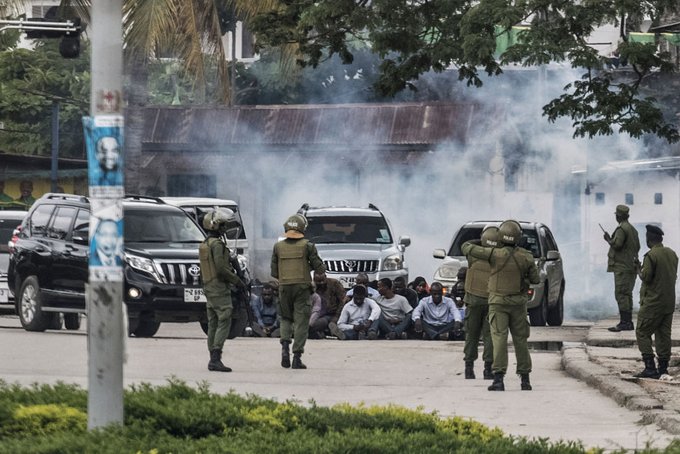
 Heavy police presence as Tanzania residents protested over elections / FILE
A Kenyan caught up in the election chaos that gripped Tanzania during last week’s polls has recounted living in fear as gunfire and teargas filled the air.
Ashley Kosgey, who was in Dar es Salaam for the holidays, says she was forced to stay indoors for over three days for fear of her life.
The situation worsened when the government announced a curfew and mounted blockades on major roads, including those heading to Julius Nyerere International Airport.
“I have been indoors except Friday, when I went to get supplies. It was a ghost town. I drove around and couldn’t get a kibanda open, and the one I found operating barely had vegetables. Supermarkets were closed and opened only to shoppers for non-perishable goods,” she said.
The first two days were marked by loud bangs of gunfire that denied her sleep. This was compounded by an internet shutdown that cut off information flow.
She described non-stop gunfire and running battles that raged from Thursday to Sunday.
“We were out of water and not sure how long the food supply would last, since you don’t know what’s happening beyond your door. Imagine hearing loud bangs day and night and not knowing if you will be safe.”
Movement from one region to another had been restricted, except for essential services such as medical emergencies or food supplies, and you show your ID and state where you’re going and for what purpose.
“Imagine being Kenyan and outside after it’s been alleged, even by the head of state, that Tanzanians are peaceful and protestors are foreigners, and you are outside not knowing how police will react to you showing a Kenyan passport and not a Tanzanian ID with that notion,” Ms Kosgey said.
Driving to look for food, go to the hospital, or for essential work was a major challenge as civil servants were asked to work from home, schools closed, and private companies advised to work from home if they could.
“But Friday, my area was like a ghost town with a few people walking with paper bags, hoping to find a kiosk that’s open and has food. Most only had non-perishables,” Ms Kosgey, who was staying in the Mikocheni area near Mwenge in Dar es Salaam, where a gas station was burnt on Thursday night, states.
Comparing Kenya’s infamous June 2024 Gen Z–led uprising, she remarked: “Back home with the Gen Z protests, we had information. You were updated by Kenyan media plus online clips here and there, and knew areas to avoid if you had to leave. Here you are just in the dark. It was nerve-wracking not knowing if you were okay.”
Tanzania partially restored the internet yesterday as President Samia Suluhu Hassan was inaugurated at a military facility in the administrative capital of Dodoma.
“TikTok is yet to be restored here because that’s where we got information on protests,” she says, adding that Kenyans living and working in Tanzania are apprehensive that they may be targeted after Suluhu and police blamed foreigners for plotting the chaotic scenes.
The Tanzanian government is yet to release data on casualties, with international organisations and opposition groups saying over 1,000 people were killed.