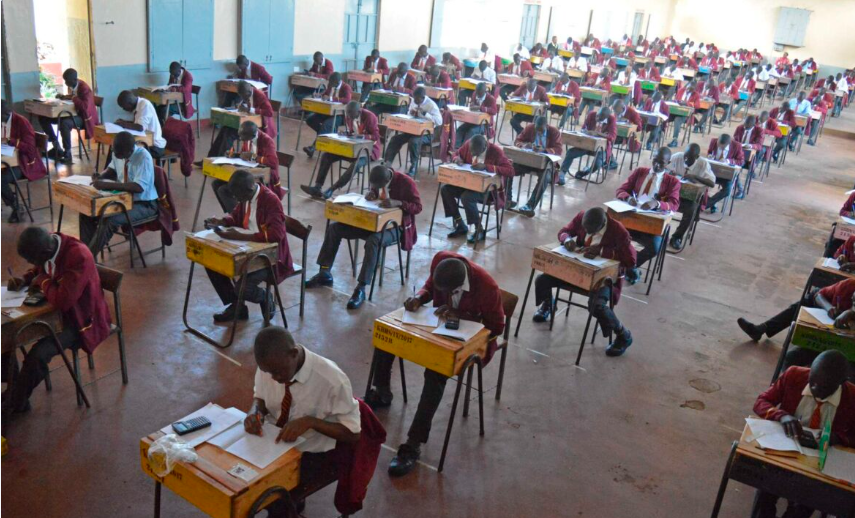
 Candidates sitting for KCSE. KCSE will phase out giving out in KCBE in 2028/FILE
Kenya’s education system is set to reach another milestone in 2028 with the introduction of a new national examination, the Kenya Certificate of Basic Education (KCBE).
According to ReviseKenya, this will be the first national exam under the Competency-Based Education (CBE) system, replacing the Kenya Certificate of Secondary Education (KCSE) that had been in place since 1989.
The first KCBE will be administered to learners who have just concluded the Kenya Junior School Education Assessment (KJSEA) at the end of Grade 9.
These learners will progress through Senior School, Grades 10, 11 and 12, before taking the KCBE in 2028.
The Kenya National Examinations Council has already piloted the KJSEA and is finalising preparations for the KCBE rollout, including curriculum alignment, teacher training and infrastructure development.
The change marks the full phase-out of the 8-4-4 system, which was replaced by the 2-6-3-3-3 education structure under CBE.
There are only three more KCSE sittings before the transition.
The final KCPE exam was conducted in 2023, closing a chapter in Kenya’s examination history.
What is KCBE?
The Kenya Certificate of Basic Education is the final written national examination that learners will take at the end of Grade 12, marking the completion of basic education.
It will be administered by the Kenya National Examinations Council (KNEC), the same body that has been responsible for managing national exams since independence.
Unlike the KCSE, which emphasised theoretical knowledge and content recall, KCBE is competency-based, assessing how well learners can apply the knowledge and skills they have acquired from Pre-Primary through Grade 12.
ReviseKenya stated that the exam is designed to evaluate a learner’s mastery of core competencies such as communication, collaboration, creativity, digital literacy and critical thinking, which form the backbone of the CBE curriculum.
Why is KCBE different?
KCBE departs from the rigid memorisation style of the old 8-4-4 exams.
Instead, it seeks to produce graduates who can think critically, solve problems and adapt to real-life situations.
Some of the key focus areas include critical thinking, where learners are expected to reason logically, make informed decisions and offer innovative solutions.
Under digital literacy, technology use and digital competence will be integrated into learning and assessment, and group projects and teamwork will be an essential part of assessment.
Learners will be required to demonstrate the ability to design, create and innovate, ReviseKenya noted.
Additionally, KCBE will test how well learners apply classroom knowledge in real-world contexts.
This shift aligns with the country’s national goals to develop a workforce equipped with 21st-century skills, as outlined in the Kenya Vision 2030 and the National Education Sector Strategic Plan.
According to the Ministry of Education, the CBE model—also referred to as Elimu Thabiti—is rooted in community consultation and aims to make education more inclusive, practical, and responsive to the needs of the 21st-century learner
KCBE will be the only official basic education certificate issued under the CBE system.
Learners will move through the education pathway including Pre-Primary (PP1–PP2), Primary School (Grade 1–6), Junior School (Grade 7–9) and Senior School (Grade 10–12).
At the end of Grade 12, learners will sit for the KCBE to signify the completion of basic education, after which they can transition to university, tertiary institutions, or technical and vocational education (TVET) based on their chosen career pathways.
Structure and administration of KCBE?
KCBE will be administered at the end of Grade 12 and will cover subjects based on the learner’s chosen pathway in Senior School.
Under the CBE framework, students specialise in one of three pathways, including STEM (Science, Technology, Engineering, and Mathematics), Social Sciences and Arts, and Sports Science and Performing Arts.
Each pathway includes core subjects and electives tailored to the learner’s interests and career aspirations.
The KCBE will assess both core competencies and pathway-specific knowledge.
As the CBE system emphasises practical learning, preparation for KCBE requires a shift in mindset from traditional cramming to continuous, skills-based learning.
Teachers, schools, and parents also play a vital role by encouraging creativity, curiosity and critical thinking rather than exam-oriented learning.
When will learners sit for KCBE?
The first KCBE will be conducted in November 2028, targeting the first cohort of learners who began the Competency-Based Curriculum in 2017.
KNEC will oversee the administration of the examination nationwide, ensuring uniformity and credibility, much like previous national exams.
Results will be used to determine eligibility for post-secondary opportunities within the country’s education framework.
KCBE and the future of learning in Kenya
KCBE represents a major transformation in the country’s education philosophy, from a system that prioritised grades to one that values skills, creativity, and adaptability.
Education experts say this reform will better align Kenya’s education outcomes with the job market, fostering innovation and entrepreneurship.
It also responds to global calls for education systems that prepare learners not just for exams, but for life.
As the countdown to 2028 continues, learners, parents, and educators alike should embrace the change.