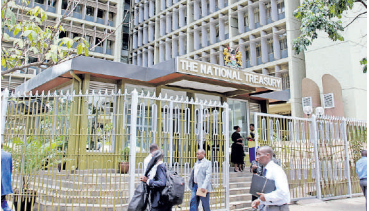
The findings, part of a broader audit review covering the financial years 2020-21 to 2022-23, raise serious questions about the credibility of the country’s public financial management and the enforcement of professional standards among those entrusted with billions of public funds.
The National Treasury and Economic Planning, the nerve centre of the country’s fiscal management, has been flagged as a repeat offender.
Over the three-year period under review, the entity consistently received a qualified audit opinion, indicating persistent material misstatements in its financial reporting.
More alarmingly, the individuals who signed off on the statements were confirmed by ICPAK to be not in good standing as of June 2025.
This means at the time of the review the senior officials were not compliant with the professional and ethical requirements for practising accountants in Kenya.
The presence of signatories who are not in good standing directly undermines the integrity of the financial reporting process.
ICPAK’s professional standards require members to adhere to continuous professional development, ethical guidelines, and timely renewal of membership.
Failure to maintain good standing can indicate a lapse in these commitments, potentially affecting the quality and reliability of an accountant’s work.
“The presence of signatories not in good standing raises concerns regarding adherence to professional standards, as it may affect the credibility and quality of financial reporting,” the ICPAK report states.
Treasury’s audit issues, as flagged by Auditor General Nancy Gathungu during the referenced years, were not minor.
They included lack of a fixed assets register, long-outstanding salary advances, and unapproved expenditure on share purchases, wasteful court awards, and failure to account for promotional materials.
The fact that these issues recurred year after year, under the watch of professionally non-compliant signatories, points to a deep-seated culture of impunity and weak accountability.
The problem, however, extends far beyond the Treasury, with the report flagging the Education ministry as also implicated.
It emerged that the accountant at the Basic Education department was not in good standing. At the time, the department had issues of unconfirmed capitation funds for free primary and secondary education.
The ICPAK review, which analysed audit reports for 53 to 59 MDAs each year, found that a significant number of financial statement signatories across government were not in good standing with their professional body.
While the report confirmed that all signatories were members of ICPAK, a legal requirement, their standing status was often in violation of the Accountants Act.
The analysis, albeit, showed a slight decline in the proportion of members in good standing, from 34 in 2020-21 to 30 in 2022-23.
Entities such as the State Department for Planning, the Ministry of Environment, Climate Change and Forestry, and the State Department for Roads all had signatories who were not in good standing during the period under review.
In the case of the State Department for Roads, the same signatory who was not in good standing signed the financial statements for all three years.
In those years, the departments which have the largest budgets, grappled with unsupported payments and salary disbursements made outside the official payroll system.
While the Department of Planning showed improved audit opinions, its statement was signed by accountants who were not in good standing.
The Environment ministry received qualified opinions for the two years under review, over irregular payment of allowances, signed by an accountant who was ineligible.
At the Public Works department, the two signatories were not in good standing, and the issues of incomplete fixed registers were flagged.
The same situation played out at the Industrialisation department, where three accountants – all signatories- were not in good standing.
The Interior Department was also led by an ineligible accountant, in the departments of Post Training, Shipping, and ICT. The signatories for the two years were not in good standing.
State departments of TVET, Higher Education, Basic Education, Health, and Judiciary also consistently received qualified or adverse opinions over the three years.
JSC’s accountant was also not in good standing as of June 2025, and the entity had recurring pending bills.
For the experts, the credibility gap fuels a cycle of poor financial management.
The review identified several cross-cutting issues directly linked to weak accounting leadership, including recurrent and unresolved audit queries, weak oversight and governance structures, inadequate internal controls, and persistent pending bills.
Poor accounting standards have been cited by MPs at the Public Accounts Committee as among the key issues affecting accountability.
In their latest report, MPs at the Butere MP Tindi Mwale-led committee observed that despite the accounting units being staffed by ‘qualified accountants’, there was rampant non-compliance with the law.
“This points to incompetence or resistance. The breaches included inaccuracies in financial statements and failure to reconcile accounts. The situation was most prevalent in donor-funded projects,” the committee report reads.
MPs asked the Treasury to conduct periodic training for all accounting officers across government on their responsibilities and adherence to international accounting standards
“The committee also recommends that ICPAK enforce compliance with standards and mete out sanctions against officers found to be willfully failing to discharge their functions,” MPs said.
ICPAK has called for urgent action. Among its key recommendations is a directive to the Office of the Auditor General to “reinforce the requirement that preparers of public financial statements are qualified and members of ICPAK in good standing.”
The report also proposes amending the Public Finance Management Regulations to explicitly require that all financial statement signatories be ICPAK members in good standing, a move aimed at providing a legal backbone to enforce professional compliance.
Furthermore, ICPAK wants Parliament to enforce feedback mechanisms on the implementation of audit recommendations.
As a result, ICPAK has proposed a comprehensive “strategy towards zero fault audit reporting”.
To achieve this, the regulator wants agencies to institutionalise functional audit committees, digitise financial systems, enforce accountability for audit failures, and mandate continuous professional development for public sector accountants.
The regulator emphasises that financial preparers and signatories are the first line of defence in safeguarding public funds and ensuring value for money.
When they themselves are not in compliance with the basic tenets of their profession, that defence crumbles.
INSTANT ANALYSIS
The fact that the National Treasury - the very institution tasked with overseeing the nation’s purse- has operated for years with professionally non-compliant signatories is an indictment of the system’s oversight mechanisms. It suggests that the rules in place are either too weak or are being ignored without consequence. The report serves as a critical reminder that transparency and good governance begin with the individuals holding the pen. Ensuring that only eligible, compliant, and ethically sound professionals are authorised to sign off on public funds is not just a matter of procedure; it is a fundamental prerequisite for public trust.