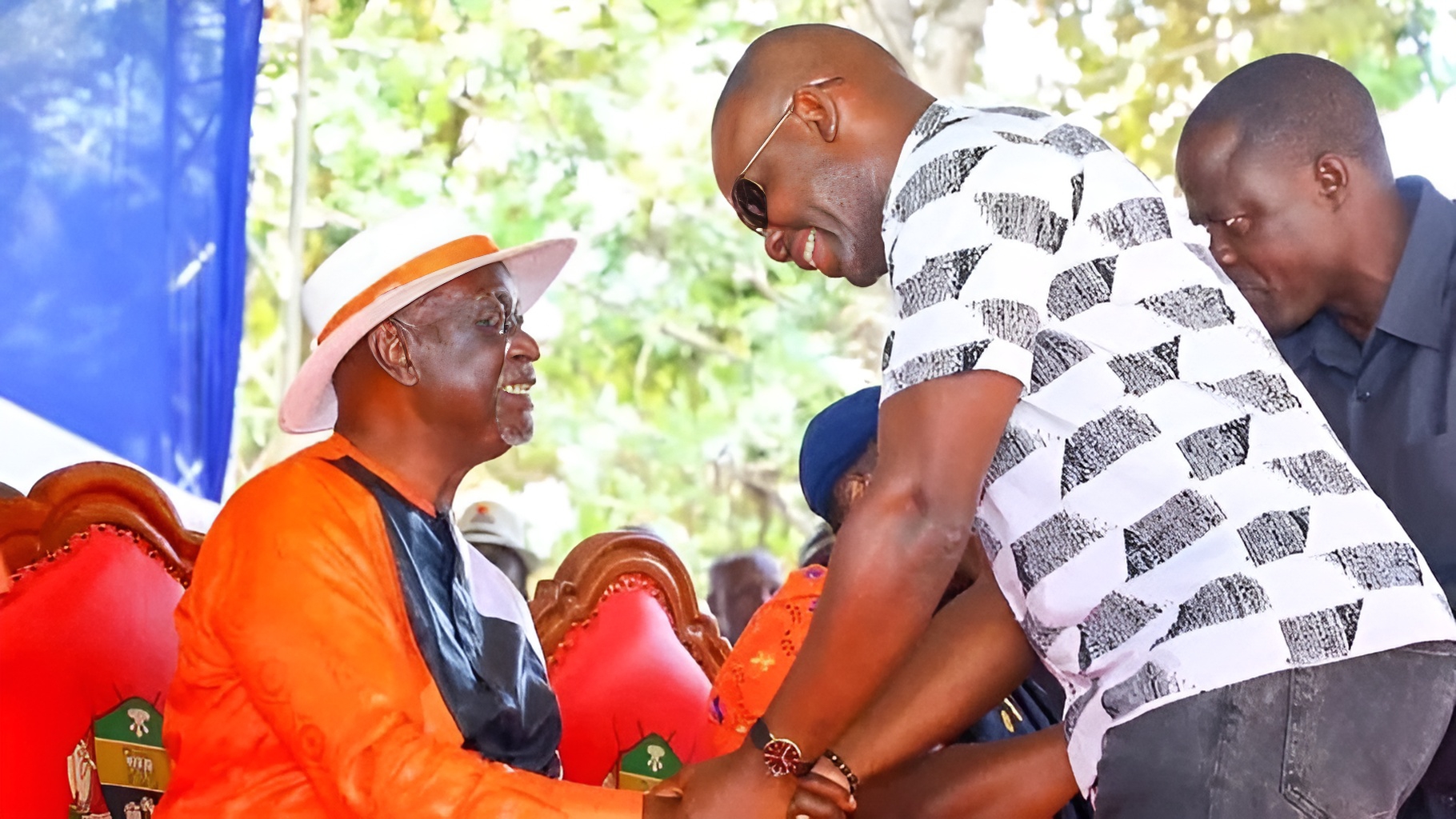
 New ODM party leader Senator Oburu Odinga
Political parties in Kenya coalesce around personalities and not ideologies; hence, they do not survive for long after its founders either die or exit from office.
The parties also mutate into different identities every election cycle, unlike other countries where parties have lived for decades or even centuries.
For instance, in Tanzania, Kenya’s neighbour to the south, the ruling Chama Cha Mapinduzi (CCM) has outlived its founder Mwalimu Julius Nyerere, and continues to hold grip in the country’s politics. This is attributed to its strong grassroots network.
In the United Kingdom, Kenya’s colonial master, the Conservative and Labour parties continue to dominate their politics while in the United States, the Republican and Democrats remain formidable due to their ideological foundation.
In South Africa, the ruling African National Congress (ANC) still remains strong despite challenges from splinter parties 31 years after leading the country to self-rule under Nelson Mandela.
Critics state that parties in Kenya are not corporate entities but are mobilised and organised around personalities and their strengths depend on the personal attributes, organizational skills, and charisma of their leaders. This therefore, makes them lack succession plans.
Now with ODM leader Raila Odinga’s death on the October 15, questions are emerging if the party that is celebrating its 20th anniversary will survive and remain strong or will it follow cue and become a shell after 2027 polls.
Kenya’s independence party Kanu, though has survived, remains an insignificant player in the country’s politics after Daniel Moi’s retirement in 2002 and its subsequent loss in that year to the joint opposition under NARC.
Kibaki was re-elected in 2007 on PNU party, which has since vanished to oblivion just like others before.
Uhuru Kenyatta, who was Kanu’s candidate did not run in 2007 opting to support incumbent Mwai Kibaki and then when he chose to run in 2013, he acquired The National Alliance (TNA) with which he entered into a coalition with URP of William Ruto who had equally decamped from ODM.
Both URP and TNA were disbanded to form the Jubilee Party which remains a former shell of itself after Uhuru’s retirement.
The ODM party and Ruto’s UDA are currently the most dominant going by their numbers in Parliament, Council of Governors and county assemblies.
But with Raila’s demise, there are fears that the ODM party will follow the trajectory of others before it as the country heads to 2027.
“The history of Kenyan politics is littered with parties that faded once their founding icons left, Ford Kenya, Kanu, NARC, Jubilee, and PNU, among others. ODM risks the same fate if it fails to institutionalise its operations.What kept ODM afloat longer than most was Raila’s deliberate effort to infuse a corporate structure into its organs — the National Governing Council, National Executive Committee, and Central Committee,” Political analyst Billy Mijungu says.
Even during his life, ODM was struggling with internal dissent with some members openly rebelling against the broad-based government and possibility that ODM was planning to endorse Ruto’s second term bid as opposed to fielding a candidate.
In one of the last public events, Raila sough to calm the fears when he said in a meeting of MPs that ODM’s deal with Ruto was up to 2027.
Former Attorney General Justin Muturi, who is also the Democratic Party leader says that Kenyan parties lack ideology hence they don’t outlive their founders either when they die or leave power.
Parties, according to Muturi are kind of ‘Special Purposes Vehicles’ which fold up as soon as the political transaction is done. “That will happen when as a country we abandon transactional politics.”
According to university don Herman Manyora, parties in the country that belong to individuals are likely to die as soon as the owners exit.
“Once the owner is not there, the party will disintegrate. However, ODM is a little bit luckier since they have structures in the country to make it survive beyond Raila. If they don’t bicker and one community thinks the party is theirs and chase others away, then they are likely to survive,” Manyora says.
Busia Senator Okiya Omtatah foresees a weakened ODM without Raila whom he described as the ‘the institution and glue’ that kept the party together.
“Raila’s charisma is what propelled ODM and held it together. It’s the wind that sailed the ship called ODM. In the absence of that, I am not a prophet but doing analysis it’s difficult to see emergence of a replacement who is charismatic. I am not saying it will collapse immediately and go but it will require extra-ordinary efforts to have it united,” he says.
Omatatah cited recent remarks and contradicting statements by individuals who depended on Raila for their survival on ODM position in the government.
“Those sentiments betray insecurity at a personal career in politics and also uncertainty of the party’s future. ODM hasn’t distinguished between unity and uniformity and even inviting Ruto to lead them may not help,” he says.
Makadara MP George Aladwa who is the Nairobi branch ODM chairman says the ability of his party to accommodate divergent views while forging for unity will determine its future.
“If the party official show respect among themselves from the national office to the grassroots, then the party will remain united. ODM is a strong party to be allowed die,” he says.
Aladwa cautions that as much as ODM is in a working relationship with the ruling UDA, any future arrangement must ensure the distinct Orange colours are reserved.
“Even if we support President Ruto’s re-election given baba left us in government, we must retain the ODM as an identity. It can’t be weakened or dissolved,” the MP said adding its imperative for ODM to confirm Oburu Odinga as its party leader.
“Its either Oburu and if not him, Ida Odinga, and if not her, Raila Junior or Winne Odinga. The name Odinga must remain as a unifying factor of our party.”
ODM insiders revealed that as it is currently, the party does not have substantive leaders in most positions which include party leader Oburu, the three deputies Abdulswamad Nassir, Simba Arati and Godfrey Osotsi and party chairman Gladys Wanga.
The only substantive leader in the hierarchy of the top seven officials is Secretary General Edwin Sifuna and Treasurer Timothy Bosire.
Since the five were nominated by the party’s National Executive Council (NEC), their positions must be ratified by a higher organ like the National Governing Council (NGC) in line with both the ODM constitution and political parties act.
“As at now, ODM has not filed any returns to the office of Registrar of Political Parties to formally effect the changes. So, the five top honchos are only operating in acting capacity,” one of the MPs said.
Nyando MP Jared Okello remains optimistic that ODM will remain intact even as he acknowledged Raila’s death leaves a huge void in the movement.
The MP said fears of internal competition to control the party influenced the decision to install Oburu as interim party leader to avert a situation where youthful leaders bickering divides it.
“Baba was the glue and he had a way with everybody and everyone. That’s why we chose Oburu being a family member, founder of ODM and walked with Raila the longest, his role as an elder is to calm things. We are confident with Oburu’s age, stature, wisdom and experience he will steer the party to remain strong. The ship will not capsize in his hands,” Okello added.
Analysts warn that the absence of Raila’s leadership may reshape realignments, test internal loyalties within ODM, and redefine the party’s strategy ahead of upcoming elections.
The fears of disintegration are aid to have informed the party’s panic that led to an emergency meeting just a day after Raila’s death that named Oburu as Interim Party leader in the morning the country was awaiting the arrival of his body from India.
Raila’s death leaves a large political vacuum. He had led the ODM since its creation in 2005 and had served as the party’s presidential candidate in every general election it contested.
Still, Kenya’s longer-term political outlook just got a lot murkier, as the scramble to win over Raila’s supporters will intensify in the months ahead,” the Times Magazine wrote in one of its publication headlined ‘Why Kenya Now Faces an Uncertain Future’.
The fear that ODM faces a bleak future with Raila’s absence was captured on Mashujaa Day by Kisii Governor Simba Arati, one of the party’s deputy leaders, when he publicly appealed to President Ruto to consider ‘returning to ODM’ and help it navigate the political waters ahead of 2027.
“The President yesterday said he is going to ensure that ODM remains the party it is. I want to urge him today, Mheshimiwa Ruto — you were a founding member of ODM. How I wish that you come back to your former party,” Arati said.
Arati’s statement cajoling Ruto to came back to ODM and have him as their flag bearer, exemplifies the orphan tag most parties carry when their leaders exit.
“We commit to carrying Baba’s dream forward. Raila was our north, our compass in times of challenges; his vision will forever be the foundation upon which we build Kenya’s future. As the deputy party leader of ODM, I’m determined to ensure ODM remains the biggest party in the country,” he said adding; “We will form the government either as a party or as a coalition. We will no longer remain in opposition.”