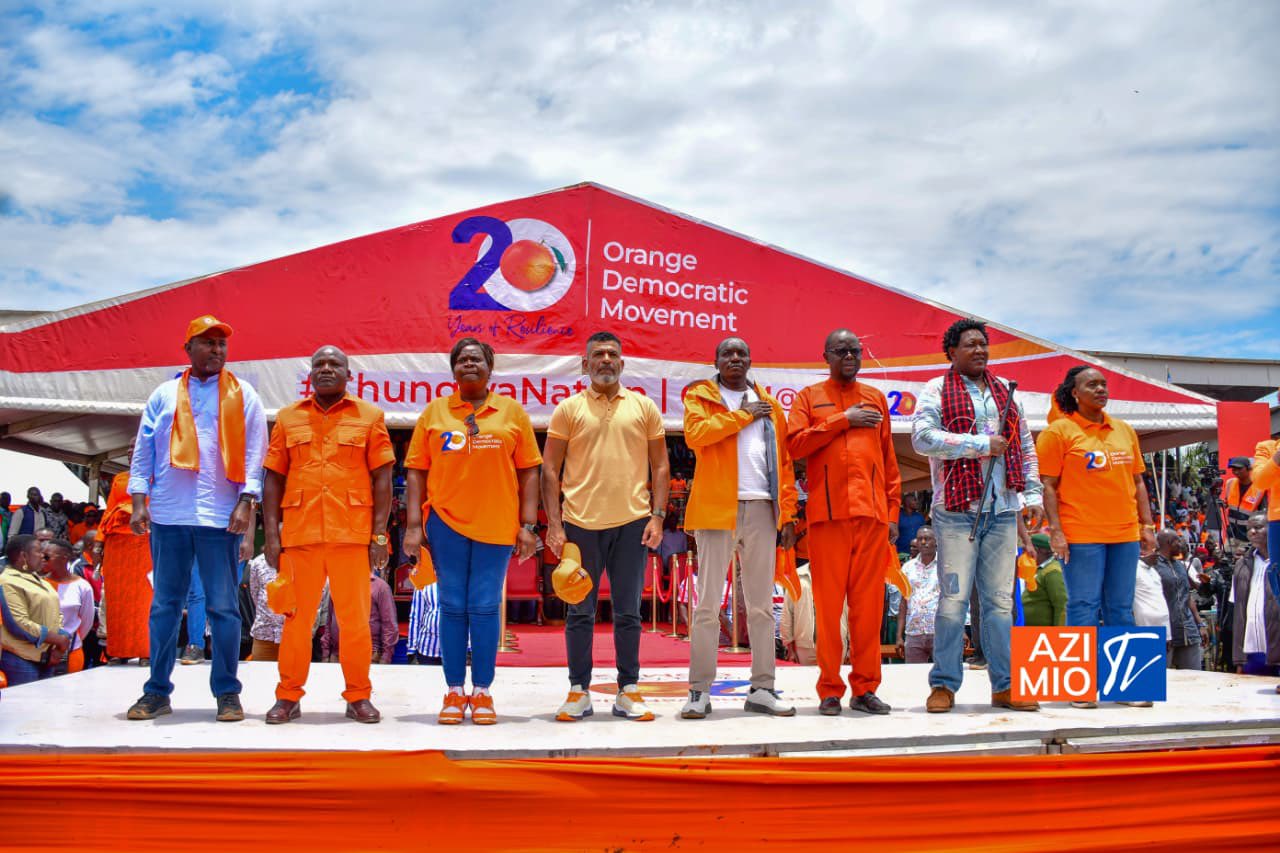
The passing of former Prime Minister Raila Odinga has plunged the Orange Democratic Movement (ODM) into a moment of reckoning, one that will test not just the party’s cohesion but also Kenya’s wider political balance.
For more than two decades, ODM was indistinguishable from its founding leader.
Raila’s voice defined its message, his ideals gave it direction, and his charisma held together an often fractious coalition of reformists, loyalists, and regional power brokers.
Now, as the country mourns, his party faces its most existential question yet: Can ODM outlive Raila Odinga?
The Vacuum and the Voices
Since Raila’s funeral in Bondo, ODM leaders have spoken in competing tones, some invoking his spirit of resistance, others emphasizing reconciliation and continuity within President William Ruto’s “broad-based government.”
ODM Secretary-General and Nairobi Senator Edwin Sifuna has emerged as the moral center of the moment, urging the party to listen before it acts.
“Baba alikuwa anasikiliza wananchi,” Sifuna said during a memorial gathering.
“I want to encourage ODM members to listen to what the people are saying. ODM is one of Baba’s greatest legacies, and I will do everything in my power to keep this party together.”
Sifuna’s message, measured, introspective, and loyal, resonated with those calling for ODM to pause before it fragments under the weight of competing ambitions.
Government-Friendly Wing
But not all voices within ODM are striking the same chord. In the days after Raila’s death, ODM’s deputy party leaders, Hassan Joho and Wycliffe Oparanya, both of whom joined Ruto’s Cabinet, sought to interpret Raila’s supposed political wishes in ways that aligned with their current positions.
Joho, now Cabinet Secretary for Mining, Blue Economy, and Maritime Affairs, said the party’s principles remained intact despite shifting political realities.
“The values of ODM have been imparted to me by Baba Raila Amollo Odinga,” Joho declared.
“Whoever imagines they can destroy ODM — they are the ones who will leave. The party will remain.”
Oparanya, the Cabinet Secretary for Cooperatives and MSMEs, was more direct.
He recounted private conversations with Raila, claiming that the ODM leader had encouraged cooperation with Ruto’s administration.
“Baba said we shall remain in the broad-based government and support President William Ruto,” Oparanya told mourners. “That is where we shall stay.”
His remarks reflected a growing faction within ODM that sees collaboration with government not as betrayal, but as strategic positioning, a recognition of the political fatigue that prolonged opposition has brought to the party’s base.
The Loyalty Camp
Still, other voices within ODM remain deeply skeptical of what they view as opportunistic realignment disguised as respect for Raila’s legacy.
Suna East MP Junet Mohamed, one of Raila’s closest political allies, offered a sharp rejoinder to those drifting toward government patronage.
“ODM will hold its head high,” he said.
“We will keep it strong, and in 2027, we will either form the government or be in a coalition that forms government. It will not be a coalition that abused Raila when he was alive. Those who insulted Baba to build their careers are now finished.”
Siaya Governor James Orengo and Kisii Governor Simba Arati have echoed similar sentiments, warning against diluting ODM’s identity under the pretext of political unity.
To them, Raila’s legacy must remain rooted in accountability, social justice, and constitutional reform, not accommodation.
Wandayi’s Balancing Act
Ugenya MP and former Minority Leader Opiyo Wandayi, who also joined the broad-based government as Cabinet Secretary for Energy, struck a tone somewhere between loyalty and pragmatism.
In a speech that drew wide attention, he thanked President Ruto for according Raila a state funeral with full military honours, a gesture that symbolized a new political détente between former rivals.
“Even Jaramogi Odinga, the first Vice President, was never accorded such an honour,” Wandayi noted. “President Ruto has honoured not just Baba, but the entire community.”
Yet Wandayi also affirmed ODM’s continued participation in the broad-based government “now and beyond 2027,” saying Raila left the party “as a people in government.”
His remarks illustrated ODM’s internal balancing act, between maintaining its independence and navigating new alliances that could define its future.
Ruto’s Calculated Embrace
President William Ruto, for his part, has played his cards with characteristic precision. At Raila’s funeral, he paid glowing tribute to his longtime rival, calling ODM “an essential pillar of Kenya’s democracy.”
Ruto’s message was both conciliatory and strategic: by embracing ODM rather than confronting it, he projects magnanimity while also consolidating legitimacy in regions that long opposed him.
“What I will not allow,” Ruto said in Bondo, “is for those who want to gamble with ODM in the opposition to succeed. ODM must remain strong, because strong political parties make strong democracies.”
Analysts see this as a deft political move, one that frames Ruto as the custodian of unity while subtly drawing ODM’s moderate wing into his orbit.
By incorporating key ODM figures into the government, Ruto has managed to blur the traditional lines between ruling party and opposition, potentially weakening Kenya’s two-party dynamic.
The Path Ahead
Within ODM, attention is now turning to the National Delegates Conference expected in early 2026, a gathering that could redefine the party’s leadership structure and ideological identity.
Veteran figures such as Siaya Governor James Orengo, Kisumu Governor Anyang’ Nyong’o, and Siaya Senator Oburu Oginga, who is serving as interim party leader, are expected to provide stability during the transition.
But the party’s long-term survival will depend on generational renewal. Leaders like Edwin Sifuna, Homa Bay Governor Gladys Wanga, and Mombasa Governor Abdulswamad Nassir represent a younger, more diverse future for ODM.
They carry the challenge of transforming the Orange movement from a personality-driven vehicle into a modern, issues-based political institution.
As ODM navigates this delicate transition, the stakes extend beyond its own survival.
The party’s reorganization will shape the future of Kenya’s democracy, testing whether opposition politics can evolve beyond the orbit of a single, towering figure.
Raila Odinga may be gone, but the story of the movement he built is far from over.
The real question now is not just who leads ODM, but what ODM will stand for in a Kenya that Raila helped imagine but never got to govern.