President William Ruto has announced plans to establish National Infrastructure Fund aimed at mobilising resources to support Kenya’s transformation into a developed economy.
The fund will channel public and private capital into major infrastructure projects across the country.
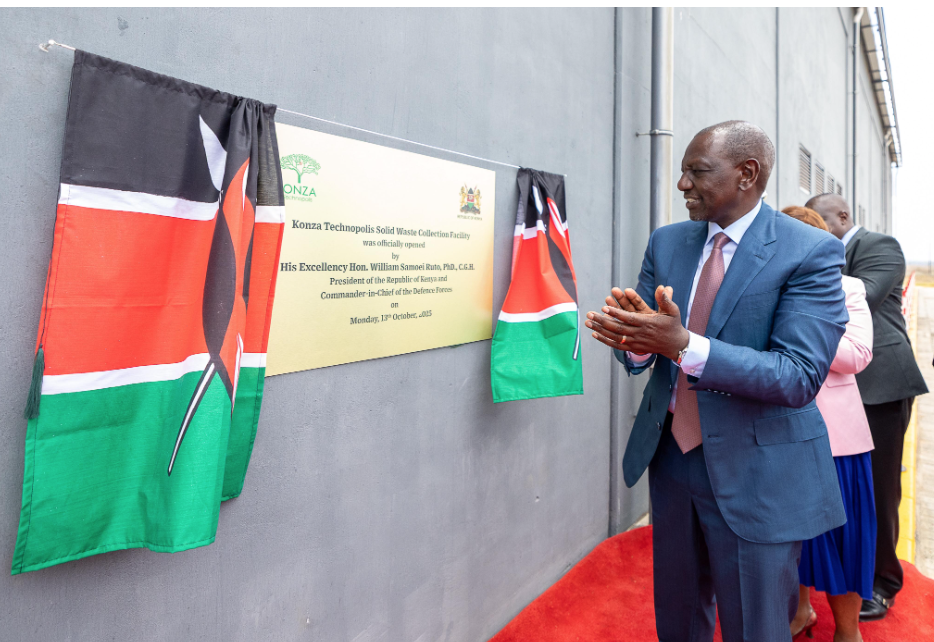
Speaking on Monday during the commissioning of Phase One Horizontal Infrastructure at Konza Technopolis, Ruto said the fund will be a game-changer in powering industrial growth, improving food security, and enhancing regional connectivity.
“Putting together resources from our budget, building resources from the private sector, and resources from the privatisation, we will create a big pool of resources that we can use in an innovative manner just as other countries have done,” said the President.
To match Kenya’s growing industrial ambitions, Ruto revealed that the country will need more than Sh1 trillion to expand electricity capacity from 2,300MW to 12,000MW within the next 5–7 years.
In the agriculture sector, Sh1.5 trillion will be invested in the construction of 50 mega dams, aiming to irrigate over two million acres and reduce Kenya’s dependency on food imports — currently costing the country KSh500 billion annually.
On road infrastructure, another Sh1.5 trillion is needed to build 1,000km of dual carriageways, pave 10,000km of roads, extend the Standard Gauge Railway (SGR) to neighbouring countries, and modernise the Jomo Kenyatta International Airport.
“We have stabilised our food security, but that is not enough. We need to stop importing food,” said Ruto.
Ruto pointed to South Korea as a model of economic transformation.
“Kenya and South Korea had the same GDP when Kenya became independent in 1963. But today, South Korea's GDP is 20 times bigger than Kenya's,” he noted.
He urged Kenyans to embrace difficult but strategic reforms that would propel the country to similar levels of development.
Ruto reiterated the government’s commitment to transforming Konza into Africa’s premier smart city and a hub of innovation.
Phase One of the infrastructure — now complete — includes smart features such as an Artificial Intelligence-driven operations centre and a wastewater reclamation plant that recycles 90 per cent of used water.
To further support Konza’s growth, the government will dual the Machakos Junction–Emali section of the Mombasa highway, extend water supply through the Northern Collector Tunnel and Nolturesh pipeline, connect Konza to the SGR line for direct linkage to Mombasa Port and establish a vaccine production facility to boost Kenya's biomedical capabilities.
“We will continue to mobilise resources, attract investors, and strengthen partnerships to make Konza Africa’s smartest city and the beating heart of the Silicon Savannah,” Ruto said.
The commissioning event was attended by top government officials, including Cabinet Secretaries William Kabogo (ICT) and Alice Wahome (Lands and Housing), and Governors Mutula Kilonzo Jnr (Makueni), Joseph ole Lenku (Kajiado), and Wisley Rotich (Elgeyo Marakwet).
Also present were ICT Principal Secretary John Tanui, South Korean Ambassador to Kenya Kang Hyung-shik, and Italian Deputy Ambassador Lorenza Maria Gambacorta.