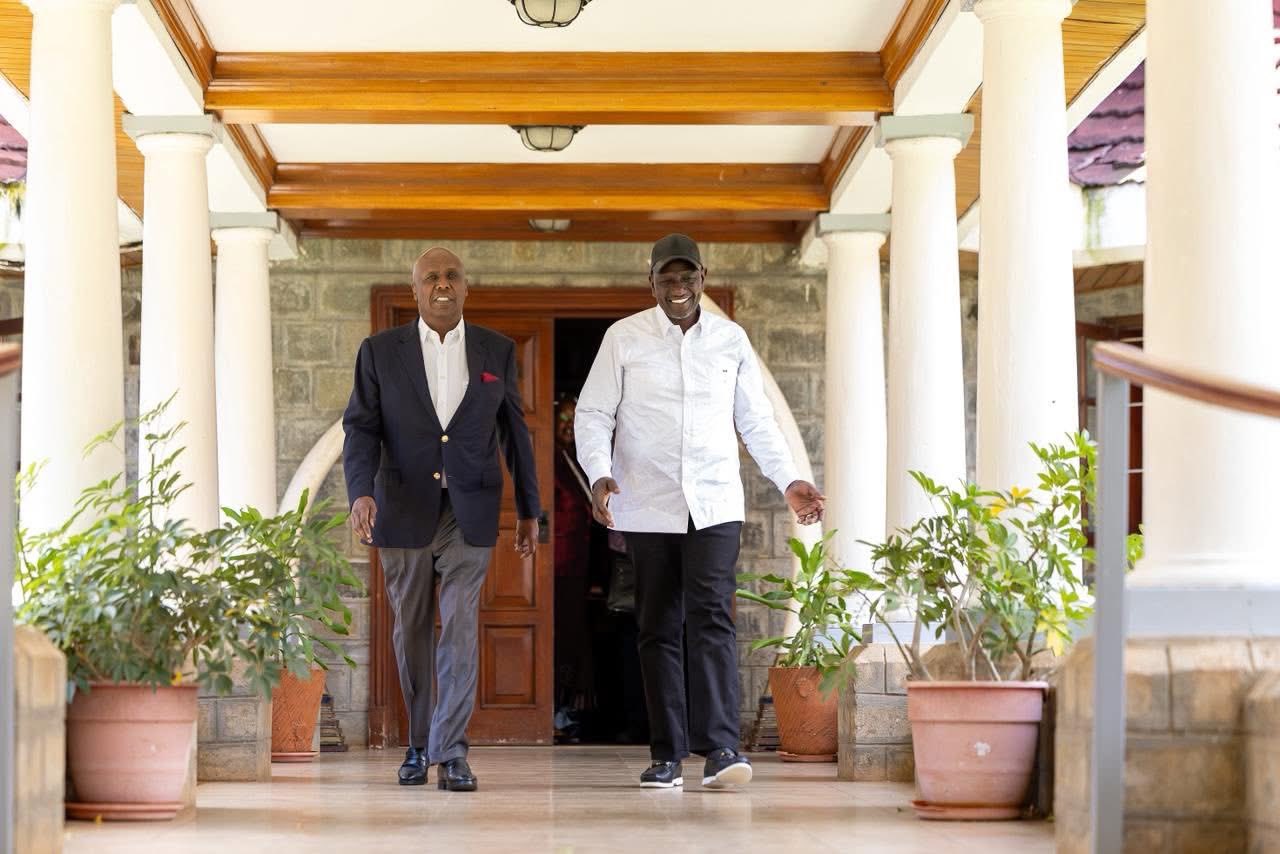
 Kanu chairman Gideon Moi and President William Ruto in Kabarak on Friday
Cabinet secretaries are on edge over the looming mini-reshuffle by President William Ruto to accommodate Kanu chairman Gideon Moi into the broad-based government.
The deal, which is seen as part of the President’s broader strategy to consolidate his Rift Valley political base ahead of 2027, has sparked concern among sitting CSs over imminent reshuffles as happened following Ruto’s deal with ODM leader Raila Odinga and retired President Uhuru Kenyatta.
Ruto sealed a unity deal with Gideon at Kabarak on Friday, officially bringing the Independence part, Kanu, into the “broad-based government” fold.
The deal is linked to Gideon’s withdrawal from the Baringo Senate by-election, which he was reportedly the frontrunner in, against the government candidate, Vincent Chemitei.
Gideon had failed to stop the UDA wave in the Rift Valley in the 2022 elections, losing the Senate seat to William Cheptumo, now deceased. Cheptumo garnered 141,777 votes, while Gideon came second with 71,408 votes.
Sources close to the ongoing consultations said intelligence warned Gideon was on pole position in the race, which would have heavily dented and embarrassed the President in his backyard, necessitating the outreach.
One of the major bargaining chips was thus business interests and possible inclusion of Kanu’s leadership in key government positions.
“When the President reached out, Gideon agreed to step down, but certain conditions were set. And to deal with the backlash, Moi told the President that he goes to the people and addresses them directly,” the source said, explaining the Kabarak meeting.
Some grassroots members in Baringo and legislators such as Naisula Lesuuda had expressed displeasure with the move, saying the party mishandled the communication, particularly about Gideon’s withdrawal and the deal, leaving them feeling sidelined.
Addressing Kanu grassroots leaders, Ruto described the outreach as essential for “national unity” and called for political differences to be set aside.
“I looked for Gideon because national cohesion is bigger than our differences. I have talked to my brother [Gideon] so that he can assist me in building the nation. To make this country develop to First World, I have asked for more hands, broader goodwill and that’s why we established the broad-based government so that we can together push Kenya’s priorities forward,” the President said.
He also told party officials that Kanu would play a formal role in his government.
“I want us to agree that we have a formal engagement so that Kanu is part of the government of Kenya. So we will expand this broad-based government, have Kanu at the centre and plan Kenya’s affairs together,” he told the Kanu delegates in Kabarak.
With the President’s announcement of the inclusion of Kanu in the government, ministers and PS s are reportedly anxious about who will be dropped or reshuffled to make room for new appointees or for allies loyal to Gideon.
The constitution limits the number of CS s to a minimum of 14 and a maximum of 22.
Some fear their portfolios may be the price of political accommodation, as happened with the reshuffle to accommodate Raila's “experts” and Uhuru’s allies.
The source disclosed to the Star that consultations have been underway to give at least one Cabinet slot, some PSs, and ambassadorial appointments to Kanu.
“As we saw in the past two cases, some will obviously be dropped. Some have not measured up in their dockets, some are invisible, and those who have questionable loyalty will be candidates for removal. While one may be left to go, another CS is being considered for a diplomatic posting,” the source said.
Among those who might be targeted are CSs who are not going all out to sell the government agenda as they play safe for their 2027 political ambitions.
Following the dismissal of the Cabinet after the Gen Z demos, various CS s were dropped, while others were offered a soft landing in the foreign service. These include Ababu Namwamba (Unon and Unep), Susan Nakhumicha (UN-Habitat) and Florence Bore (Namibia).
In December, Ruto named Prof Margaret Ndung’u (ICT) and Andrew Karanja (Agriculture) to serve as envoys to Ghana and Brazil respectively, having served in their dockets for barely half a year. Ndung’u declined the job.
Ruto on Sunday said he had reached out to Uhuru, Raila and now Gideon in his bid to forge unity for national development and that he would continue approaching other leaders.
The opposition has on several occasions said attempts have been made to reach out to Wiper leader Kalonzo Musyoka.
Former Interior CS Fred Matiang’i also indicated similar attempts, even as he denied reports linking him to the possibility of joining the Kenya Kwanza government ahead of the 2027 elections.
“Sometimes I get annoyed when I see this nonsense in the newspapers that I am going to work with these people. That I will work with some people whose names I don't even want to mention their name. How can that be? You don’t know these people; I know them very well and the stuff they are made of,” Matiang’i said.