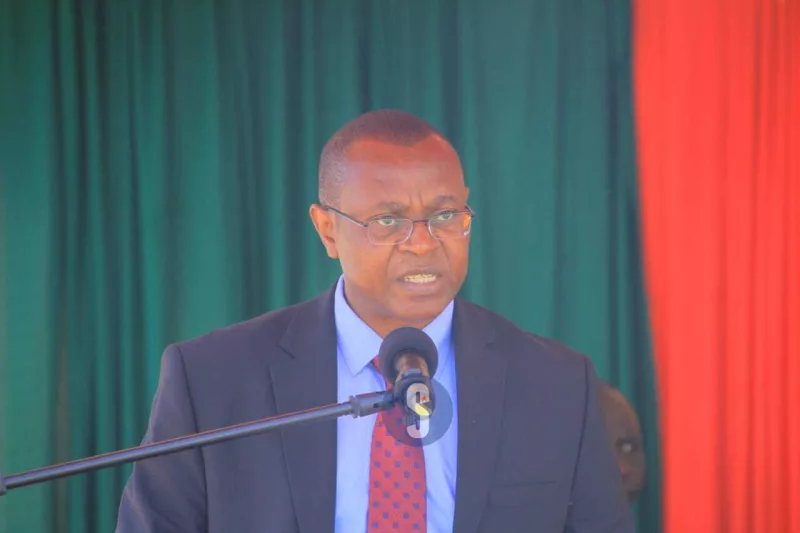
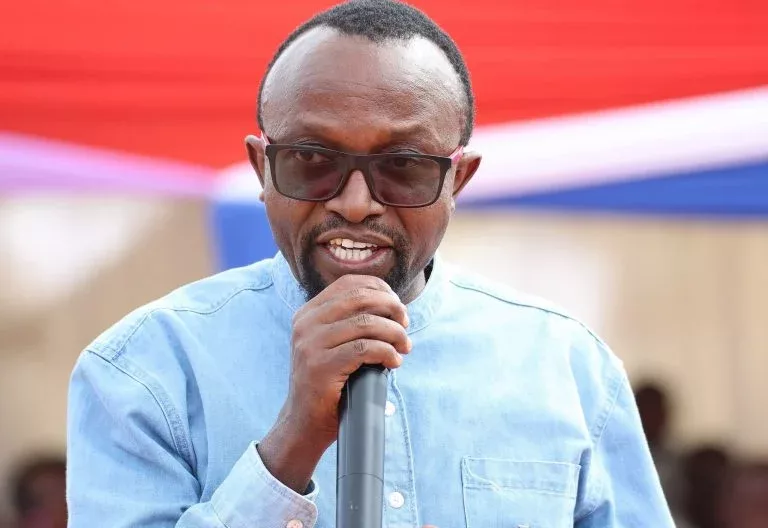
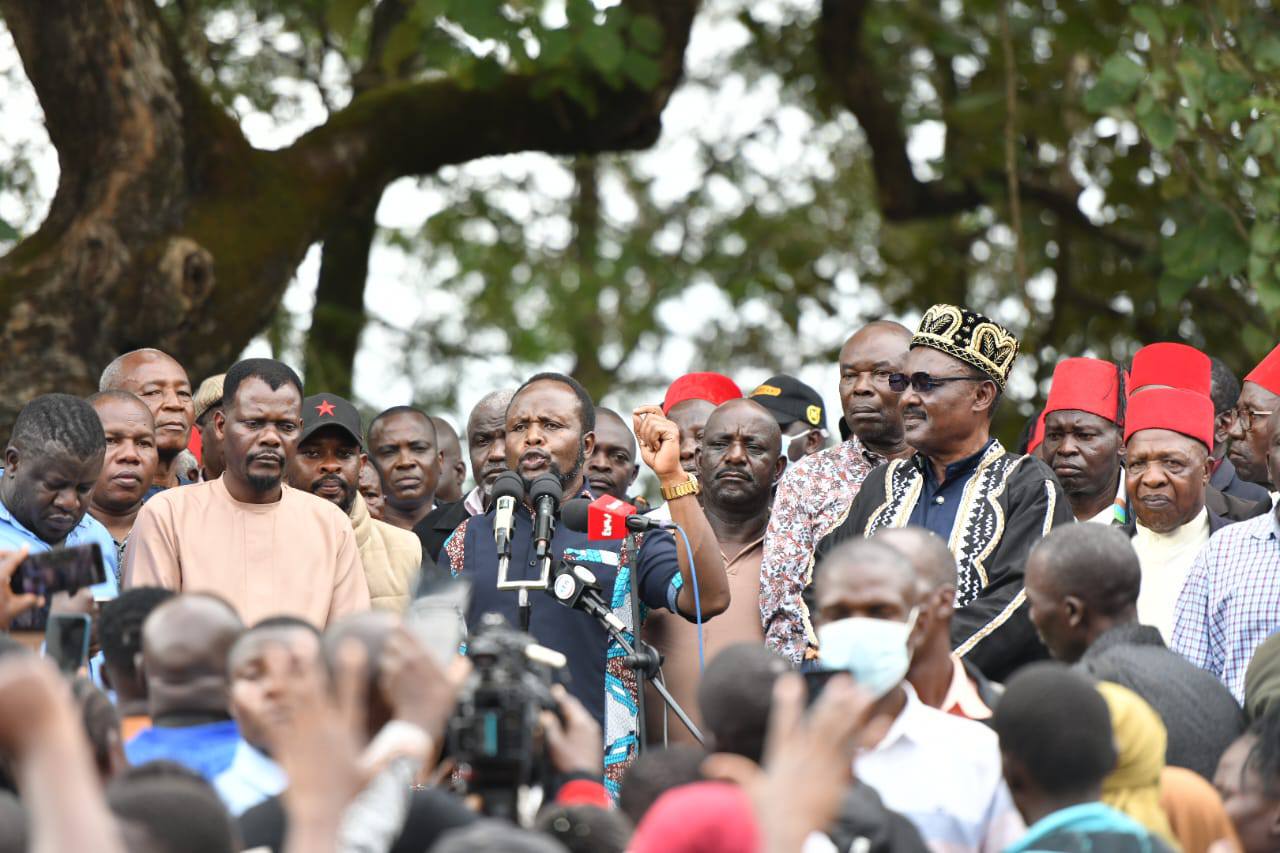
 Trans Nzoia Governor George Natembeya/COURTESY
His whirlwind tour of the region has rattled the status quo, stirring both admiration and resistance, with political observers and leaders now grappling with one central question. What is Natembeya’s ultimate game plan?
Photos of a recent meeting involving Natembeya, former Interior Cabinet Secretary Fred Matiang’i and former Agriculture CS Peter Munya sent social media into a frenzy, fuelling speculation about an emerging political alliance.
While Matiang’i tweeted that the gathering was merely to condole with Munya following the death of his grandmother, many Kenyans weren’t convinced.
To some, this meeting was more than just a condolence visit—it was a coded message.
Some said it was a signal that Natembeya is not just content with county-level leadership, but is inching toward the national stage.
Natembeya’s rise has been further fuelled by recent endorsements from cultural elders, which have made him to be seen as the rightful spokesperson of the Mulembe nation.
On October 4, the Wanga Council of Elders in Matungu, Kakamega county, installed him as an elder. Prior to this, he had received similar endorsement from a section of elders in Vihiga county.
However, not all elders are on board. A rift quickly emerged within the Vihiga Council of Elders, with one faction accusing the other of impersonating ‘real’ elders.
The division laid bare the divisions within the community — but also highlighted just how disruptive Natembeya’s political rise has become.
The former administrator is also seen to be challenging the political dominance of seasoned politicians like Prime Cabinet Secretary Musalia Mudavadi and National Assembly Speaker Moses Wetang’ula.
Both men have held significant sway in national politics, having backed President William Ruto under the Kenya Kwanza Alliance in the 2022 election.
Mudavadi was even installed as the Luhya spokesperson in December 2016, a symbolic crowning that many thought would settle the region's political leadership question.
But now, with Natembeya’s assertive entry and growing popularity, the crown appears up for grabs once again.
Political analyst Albert Kasembeli sees the governor’s cultural ceremonies as strategic political moves.
“Those meetings are not just cultural ceremonies but political signals to the established order in Western led by Mudavadi and Wetang’ula,” he said.
“He is executing what we call a master stroke and asserting his route.”
Kasembeli argues that for a long time, Natembeya was seen as an outsider within the Luhya community due to his administrative background.
“But now he is telling people, ‘I am not just from Trans Nzoia, I am one of you,’” he added.
“It is harder to dismiss him now. Mudavadi and Wetang’ula should not be sitting pretty as their supremacy is being challenged, their power is being diluted and western is beginning to have alternatives.”
Despite growing speculation, the Trans Nzoia governor has not publicly declared whether he intends to vie for the presidency, seek a running mate slot, or simply rally the Western bloc behind a different candidate.
Kasembeli believes the governor is still playing a long game.
“He is strategically positioning himself for big things, 2027 and beyond. He also might turn out to be a kingmaker.”
Ayub Savula, the Kakamega deputy governor and DAP-K deputy leader, however, offered a more critical view.
“Going round and being crowned an elder here and there is not significant,” he said. “Western has the highest opportunity to be president in 2027. He poses a strong challenge and is appealing to other regions.”
He, instead, called on Natembeya to reduce his meetings with elders and instead start engaging with the youth.
“Some of the elders he is meeting might not be there in 2027. He should just focus on Gen Z and urge them to register as voters.”
The Independent Electoral and Boundaries Commission is seeking to register 6.3 million new voters, 70 per cent of whom are youth.
Several political voices suggest that Natembeya is filling a longstanding leadership vacuum in the Luhya community — one left since the passing of Michael Kijana Wamalwa, Kenya’s former vice president and Masinde Muliro, a revered independence hero.
These two are the only leaders who truly managed to unify the Western vote, transcending sub-tribal divisions.
Caleb Burudi, a founding member of DAP-K, supports the idea that Natembeya is rekindling that unity.
“For the first time that voice is coming from Natembeya. He is pushing what we call unity of purpose,” he said.
“It is still not yet clear whether he will be going for president, running mate or seek reelection as governor but once he has the Luhya community behind him, he will make the decision.”
Chris Barasa, a DAP-K national executive council member, believes Natembeya should go all in for the presidency.
“He is taking charge of the original Luhya leadership style. He is bold and has a strategy of addressing problems bedevilling Western and indeed the country. He is starting his journey for the top seat at home because we know politics is local.”
Barasa is critical of past leaders, accusing them of lacking commitment to the region.
“They may be high ranking but they seem to not have the Western at heart, and people believe they abandoned them,” he said.
At the heart of Natembeya’s rising star is the Tawe movement — a grassroots political and social platform he founded to champion integrity, service delivery and accountability.
Tawe, derived from Luhya slang meaning ‘no more’ or ‘enough,’ speaks volumes about the movement’s mission to reject entrenched political stagnation and demand better governance.
The movement, according to insiders, is already galvanising support from young people, first-time voters and disenfranchised citizens who are tired of the empty promises that have long defined the region’s political fortunes.
The movement’s core message resonates well in a region that has witnessed the collapse of major economic institutions such as Pan Paper Mills and the struggling Nzoia Sugar Company — all under the watch of previous leaders.
While it remains unclear whether Natembeya will officially declare his bid for the presidency in 2027 or wait for a more opportune time, one thing is certain — he has disrupted western Kenya’s political chessboard.
The governor is seen to be walking a political tightrope: balancing cultural legitimacy, political strategy and national ambition, all while facing the formidable presence of Mudavadi and Wetang’ula.
Whether he emerges as the unifier, the kingmaker, or the candidate, his journey has already shifted conversations about the Luhya community's place in Kenya’s politics, according to Barasa.
“In life, you do not get what you deserve, you get what you negotiate,” Barasa insisted.
Murang’a Senator Joe Nyutu said Natembeya is coming out as a Luhya kingpin, one who is independent and can't be compromised. He said Kenya Kwanza does not want the Luhya community to have a kingpin because of the impact it would have on the 2027 election.
He added that the ruling coalition would rather have Mudavadi and Wetang’ula where they are since they can manage them.