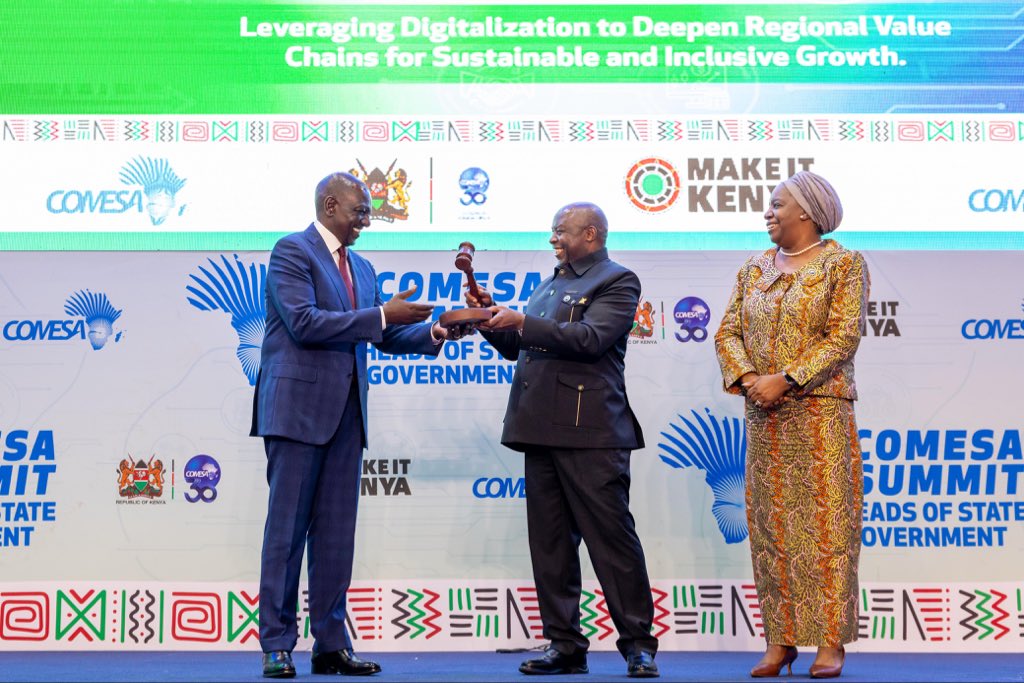
President William Ruto assumed the chairmanship of Common Market for Eastern and Southern Africa (Comesa) at the bloc’s 24th Heads of State and Government Summit, with Nairobi hailing it as a vote of confidence of its regional leadership.
However, it will be a full in-tray for Ruto in revitalising Comesa, coming at a time it faces various challenges.
Comesa’s core mandate is to achieve regional economic integration and development through market access and trade facilitation for its member states. Among the responsibilities in the President’s in-tray towards this goal include enhancing regional security and stability, reviving political commitment to regional integration and removing non-tariff barriers and harmonising trade procedures.
Ruto will also have to convince counterparts to ease free movement of people in the bloc through visa exemptions, push for implementation of digital trade systems which he passionately addressed and reaffirm Comesa’s relevance in the crowded and overlapped regional membership landscape.
Deliberations at the meeting brought to the fore these bottlenecks, which the President will be tasked to unlock.
For instance, discussions in the Ministerial and Heads of State and Government sessions centred on regional security, particularly in countries such as the Democratic Republic of the Congo, Libya, Sudan and Somalia and the upcoming elections in Burundi and Egypt.
Leaders reviewed the implementation of Comesa programmes on governance, peace, and security, which have an implication on regional stability.
The instability in the states that face ongoing conflicts and governance crises has destabilised their own populations, thus hindering economic activities and disrupted regional trade routes — for instance in the DRC — and cooperation.
The crises have also disrupted Kenya’s exports such as tea to Sudan, which banned the export over allegations of meddling in the conflict. Stakeholders have warned that the industry faces financial losses exceeding Sh6.5 billion annually following Sudan's continued ban on Kenyan tea imports, at a time earnings have dropped drastically at home.
President Ruto, in his acceptance speech, said any trade and investment reforms must be based on a strong foundation of peace, security and stability.
“There can’t be development and investment without stability. We must therefore strengthen our collective capacity to prevent conflicts, manage disputes peacefully and uphold democracy, good governance and rule of law. This must remain our highest and most sacred duty,” he said.
Comesa remains a top destination for Kenyan exports taking up as much as 72 per cent, with imports linked to the bloc standing at 28 per cent.
And while President Ruto said he was ready to be a collaborative partner in working towards attaining the Comesa vision, he has a huge task of revamping the commitment from member states. Notably, out of the 21 member states, only six heads of state and government attended.
These were Presidents Azali Assoumani (Comoros), Emmerson Mnangagwa (Zimbabwe) and Evariste Ndayishimiye (Burundi), Prime ministers Abiy Ahmed (Ethiopia), Russell Mmiso Dlamini (Eswatini) and Mustafa Madbouly (Egypt). Uganda sent her vice president, while the rest sent ministers, ambassadors and other senior government officials. The low turnout of regional leaders raises questions about the political momentum behind Comesa’s integration agenda.
Despite more than three decades of institutional development, Comesa has struggled to convert its ambitious vision into results due to various barriers that Ruto needed to be dealt with such as visas, which limit the free movement of people.
To improve intra-African trade from the negligible 14 per cent — which contributes a mere three per cent to the global trade — the President challenged African governments to remove visa requirements among Africans.
“The reason why we are not trading with ourselves is because we have unlimited barriers. The EU with 26 countries has a single visa, and their people can move much more freely. In Comesa, with the tripartite agreement, we have 27 countries and 27 visas. How are we going to catch up with the rest of the world,” Ruto said.
The President also raised issue with trade barriers, in which he said that the “beautiful agreements” that have been signed have not ensured real movement of goods and people on the ground.
“We must move from competition amongst ourselves to cooperation and collaboration, from exporting raw materials to building value chains that retain wealth within our borders,” he added.
Despite the challenges facing Comesa, Kenya has emerged as the most regionally integrated country within the bloc, according to the latest African Integration Report 2025.
Kenya scored 0.712 on a composite scale measuring infrastructure development, institutional alignment, trade facilitation and policy harmonisation—the highest among Comesa members.
The report also ranks Kenya top in the East African Community (EAC) integration — which it chairs — with a score of 0.87, ahead of Rwanda (0.85), Tanzania (0.80) and Uganda (0.78). Kenya’s strong institutional capacity, infrastructure investments, and consistent political commitment to regional objectives have positioned it as a leading force for integration.
By contrast, mid-ranking countries such as the DRC (0.59) and Burundi (0.58) show moderate engagement, while Somalia (0.51) and South Sudan (0.48) lag behind, hindered by governance, security and implementation challenges.