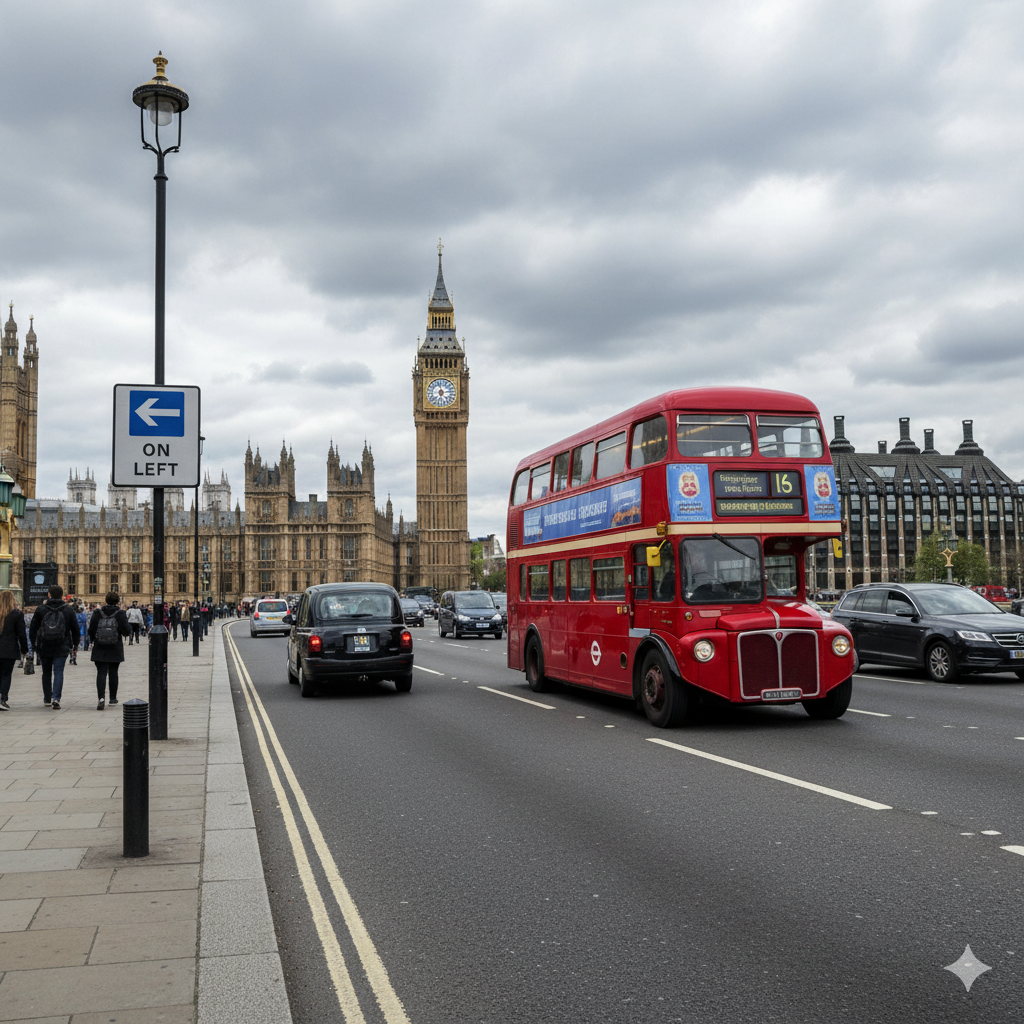
For many visitors to the United Kingdom, one of the first surprises upon arrival is seeing cars driving on the left side of the road, with steering wheels on the right.
This arrangement, while uncommon globally, is deeply rooted in history and law, reflecting traditions that stretch back centuries.
The origin of left-hand travel goes back to the age of horseback riding.
Historians at the UK’s National Motor Museum note that, because most people were right-handed, riding on the left allowed travellers to keep their sword or dominant hand free to greet, defend, or challenge those coming from the opposite direction.
Passing on the left meant a rider’s right arm, the one used for combat or greetings, was closest to a potential opponent or ally. This custom, already widespread by the Middle Ages, became a practical norm across much of England.
When horse-drawn carriages became common in the 18th and 19th centuries, the tradition persisted.
Coach drivers often sat on the right-hand side of their seats to gauge the distance between their carriage and oncoming traffic, making left-side driving safer and more convenient.
The British government later formalised this long-standing habit into law through the Highways Act of 1835, which required all vehicles in the United Kingdom to keep to the left.
The rule has remained ever since, forming the legal basis of modern British road use.
While Britain was standardising its “keep-left” system, the rest of Europe began shifting in the opposite direction.
In France, before the Revolution of 1789, the wealthy classes typically kept to the left when riding or driving, while commoners used the right.
After the Revolution, the new leadership promoted keeping to the right as a symbolic act of equality.
Napoleon Bonaparte later extended this right-hand rule across the territories he conquered, from Spain to Germany and Italy. As a result, continental Europe became largely right-hand driving.
Britain, which Napoleon never conquered, retained its left-side rule.
Over the following century, as the British Empire expanded, its road customs spread throughout its colonies and territories.
Countries such as India, Australia, New Zealand, South Africa, Kenya, Uganda, Tanzania, and Malaysia all adopted left-hand driving and continue to maintain it today.
Even nations that were never British colonies, such as Japan and Thailand, later adopted the system due to British engineering and transport influence during the early modernisation of their infrastructure.
By contrast, many nations in continental Europe and the Americas followed the Napoleonic and later American example. Countries such as France, Germany, Italy, Spain, Portugal, the United States, Canada, Brazil, Argentina, and China drive on the right-hand side of the road.
According to transport data compiled by Statista and the World Standards Organization, around 174 countries and territories now drive on the right, compared with about 78 that drive on the left.
That means roughly two-thirds of the world’s countries, and nearly 70 percent of its population, live in right-hand-driving regions.
Some of the most populous left-hand-driving nations are India, Indonesia, Pakistan, Japan, and the United Kingdom, which together account for more than two billion people. The rest of the world, including most of Europe, the Americas, and China, drives on the right.
Switching from one side to another is extremely rare because it requires extensive reconfiguration of vehicles, road signs, intersections, and driver training.
The best-known example of a successful transition is Sweden’s switch in 1967, known as Dagen H (short for “Högertrafikomläggningen,” meaning “right-traffic diversion”). On that day, Sweden changed from left- to right-hand driving to align with its neighbours Norway and Finland.
The event was the result of years of preparation, public education, and overnight changes to road markings and signage.
The BBC and Sweden’s national archives record it as one of the most ambitious public safety operations in Europe’s post-war period.
A more recent change occurred in Samoa in 2009, when the island nation switched from right-hand to left-hand driving.
The government made the move to align with Australia and New Zealand — its main vehicle import sources, since most cars arriving from those countries are built for left-side roads. Samoa’s change remains the only national switch of the 21st century so far.
Globally, the choice of which side to drive on continues to influence car manufacturing and trade.
Automakers produce two versions of most vehicles, right-hand-drive models for left-side countries and left-hand-drive models for right-side ones.
Changing a nation’s driving side would therefore also affect imports, exports, and road safety standards.
In essence, Britain drives on the left because of deep historical, cultural, and legal roots that were formalised in the 19th century and exported throughout its empire.
Europe’s right-side driving stems from revolutionary and Napoleonic standardisation.
The modern global map of driving habits is therefore a reflection of centuries of political influence — from the swordsmen of medieval England to the soldiers of Napoleon’s Europe.
Today, about one-third of the world still drives on the left, following Britain’s old tradition, while the rest drive on the right, following the Napoleonic model.
The division endures not because of stubbornness or nostalgia, but because each system is deeply embedded in a country’s infrastructure, identity, and history.