At least Sh332 billion in unclaimed financial assets belonging to Kenyans remain outside the custody of the state agency mandated to safeguard and return them.
A special audit has revealed the problematic situation, exposing critical failures in the system the country has employed for managing lost and forgotten wealth.
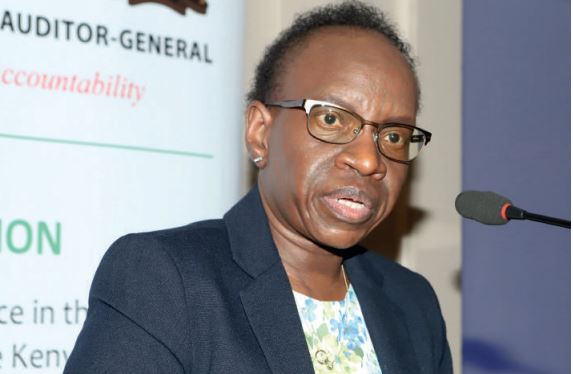
Auditor General Nancy Gathungu, in the performance audit report covering the period from 2018 to 2024, has put the Unclaimed Financial Assets Authority on the spot.
The report dated August 2025 exposes an institution choked by inefficient systems, legal bottlenecks and a severe lack of capacity.
The situation has left rightful owners separated from their assets and the nation is missing out on potential socio-economic benefits when the funds are released to the beneficiaries.
A 2018 baseline survey estimated that holders were sitting on Sh397 billion in unclaimed financial assets.
But as of August 2024, the UFAA had managed to secure only Sh65 billion, accounting for a mere 16.4 per cent of the estimated total.
“This indicates a relatively low compliance rate among holders in surrendering unclaimed assets,” Gathungu said.
UFAA was established to act as a trustee, receiving these assets from holders like banks, insurance companies, universities and courts.
It is also required to safeguard the referenced assets and work to reunite them with their ‘apparent owners’.
However, the audit reveals a huge gap between UFAA’s mandate and the reality on the ground.
It is emerging in the report that many holders are not voluntarily surrendering the assets they hold.
“Review of data from sampled law courts, learning institutions and water companies confirmed that none of the institutions had submitted unclaimed financial assets to the authority,” the report reads.
Unclaimed Financial Assets are funds and properties that have been presumed abandoned.
They include dormant bank accounts, unclaimed dividends and insurance benefits, forgotten utility deposits, uncollected court cash bails, caution money from colleges and universities and even shares and safe deposit boxes.
These assets typically become ‘lost’ due to untimely deaths, migration, outdated contact details, or simply a lack of public awareness.
While the UFAA has tried sensitisation campaigns, interviews revealed that 59 per cent of sampled holders were unaware of their obligations.
To uncover hidden assets, the UFAA conducted 134 compliance audits, identifying a further Sh12.2 billion that should have been remitted, yet the recovery rate has been extremely poor.
At the time of the audit, 77 per cent of these identified assets remained unremitted, a failure attributed to the authority's inability to ‘close’ these audits.
Furthermore, auditors established that the imposition of hefty penalties has backfired.
In 15 out of 20 sampled audit reports, penalties exceeded 50 per cent of the value of the identified assets.
In one extreme case, Carbacid Investments faced a penalty of Sh30.8 million on unclaimed assets of just Sh1 million—a penalty rate of 2,870 per cent.
Moi University's retirement scheme had Sh29 million in unclaimed assets, Sh40 million at Maseno University, Sh30 million at Egerton University and Sh171 million at Moi University.
Equity Bank had Sh286 million, Sh1.5 billion at CIC Group, while the University of Nairobi had Sh2.3 billion in unclaimed financial assets, and WPP Scan Group held Sh93 million.
Other big portfolios were held by Pioneer Assurance (Sh246 million), Unaitas Sacco (Sh119 million), Unga Group (Sh62 million), Geminia Insurance (Sh48 million) and Sh28 million at Airtel Kenya.
“Such punitive measures have discouraged holders from coming forward, leaving audits unresolved and assets unrecovered.”
Public institutions are among the worst offenders, with the report indicating that 12,460 institutions potentially held unclaimed financial assets.
The audit found that not a single public university, law court, or water company had surrendered any unclaimed assets, despite holding millions in unclaimed cash bails, caution fees and utility deposits.
The use of cash-based accounting in the public sector was cited as a key reason, as it does not require entities to account for liabilities like unclaimed refunds.
Even the assets that do make it to the UFAA face a bleak prospect of being returned, with the report showing how little has been done on reunification.
As of June 2024, the authority held Sh29.6 billion in cash assets and 1.2 billion units of shares.
Only Sh2.1 billion (7.1 per cent) of the cash and a tiny fraction of the shares and safe deposit boxes had been returned to their owners.
Gathungu cited reasons, including reporting forms that holders use being outdated, capturing minimal contact information.
The audit found that holders often have more details, like email addresses and phone numbers, but are not required to submit them.
In a disturbing illustration of the problem, assets worth Sh307 million were listed under names like "not known," "no name," or simply left blank, making reunification nearly impossible.
The auditor has further red-flagged the claim process as a significant barrier.
For a claim of Sh100, a claimant must still pay for a lawyer to commission forms (approx. Sh500) and physically visit the original holder to obtain a confirmation letter.
With 81.6 per cent of all asset records being for amounts below Sh500, the cost and effort simply deter people from claiming what is rightfully theirs.
A proposal from December 2022 to simplify the process for low-value claims, which removed the barriers, is gathering dust at the National Treasury, awaiting approval.
Staff shortage is also cited amid findings that the UFAA has only 32 staff against an approved establishment of 112.
The report details a seven-year bureaucratic standoff to get its human resource instruments approved, leading to staff stagnation and key positions remaining vacant.
A skeleton team is overwhelmed by the task of verifying and processing the claims running into thousands.
While the UFAA has successfully invested Sh22.3 billion of the cash it holds in government securities, generating Sh13.1 billion in income, two major issues persist.
First, it has no mechanism to physically safeguard non-cash assets like shares.
Some 1.7 million units of shares remain with their original holders because the law does not allow the UFAA to operate a Central Depository account to receive them.
Second, Sh9.6 billion of the investment income lies idle in the Trust Fund. The 2008 task force that led to the UFAA's creation envisioned this income being used for long-term socio-economic development.
The audit notes that other countries use such funds for education, healthcare and community development.
The Sh9.6 billion, the report points out, is almost enough to build a facility like the Kenyatta University Teaching and Referral Hospital.
However, the lack of a legal framework for its utilisation means the potential public benefit remains untapped.
INSTANT ANALYSIS
The report makes a series of recommendations, including amending the law to simplify the claims process, updating reporting forms, capping penalties, strengthening collaborations and finally staffing the authority adequately. Until these fundamental issues are addressed, the promise of reuniting Kenyans with their lost financial assets will remain largely unfulfilled, representing a significant failure in the protection of property rights and a missed economic opportunity for the nation.