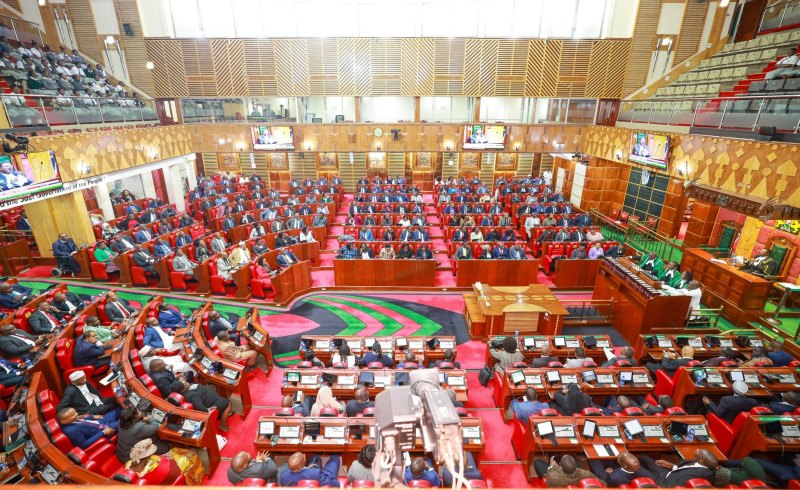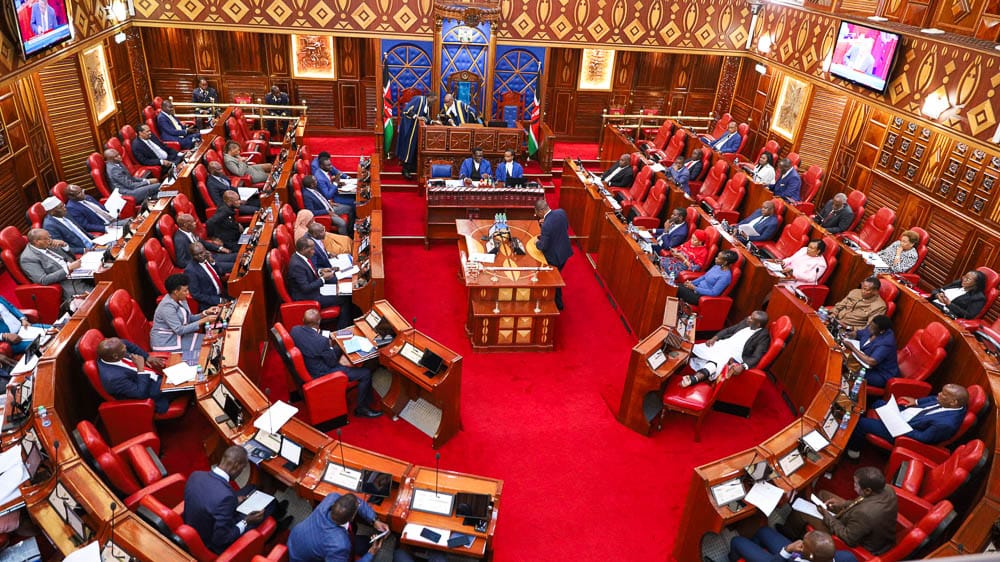
Severe sanctions loom for county governments and their officers who operate irregularly or fail to declare bank accounts held in commercial banks.
In a radical move, senators are recommending changes to the law to punish devolved units and officials who open or maintain unauthorised accounts or fail to disclose their existence to oversight institutions.
The proposed changes would also require the Controller of Budget, Auditor-General and Central Bank of Kenya to be granted real-time access to all county-operated accounts.
These are part of far-reaching measures proposed by the Senate’s Devolution and Intergovernmental Relations Committee following its probe into the proliferation of unauthorised bank accounts by counties.
Concerns have been mounting over the ballooning number of illegal accounts, with the latest report by CoB Margaret Nyakang’o revealing that counties are operating more than 5,400 such accounts.
This has raised fears of illegal transactions that could put billions of shillings in public funds at risk.
In its report, the Senate committee—chaired by Wajir Senator Mohamed Abass—recommended a review of the Public Finance Management (National Government) Regulations, 2015, to grant the CBK, CoB and Auditor-General unrestricted system access to all county bank accounts.
The committee also proposed that the revised law include clear sanctions for non-compliance.
“This is aimed at strengthening oversight, enhancing transparency, and safeguarding public resources,” the report reads.
Additionally, the committee directed the Auditor-General to audit all county commercial bank accounts, close inactive ones, and transfer the balances to the County Revenue Fund.
“Within six months of the adoption of this report, the Office of the Auditor-General shall conduct a comprehensive audit of all commercial bank accounts operated by county governments,” the report states.
The inquiry was triggered by recurring Auditor-General reports citing discrepancies, non-disclosure and weak regulation of county commercial accounts — issues that have long cast doubt on the completeness and accuracy of county financial records.
According to the committee, while the Public Finance Management (PFM) Act, 2012 mandates county treasuries to open, operate and close county government bank accounts, this leeway has been widely abused.
Sections 119(1) and 119(2) of the Act empower county treasuries to authorise such accounts, while also requiring them to establish a County Treasury Single Account at the CBK or another approved bank for all county payments.
This, the committee said, was intended to allow legitimate commercial accounts under Treasury supervision — not to create loopholes for illegal accounts.
However, some counties have bypassed these procedures, resulting in several undisclosed accounts and exposing public money to the risk of loss.
“This discrepancy indicates instances of non-disclosure of bank accounts to the Auditor-General and the Controller of Budget, thereby posing a risk to the existence of a reliable and verified inventory of all commercial bank accounts held by county governments,” the report warns.
The committee further attributed the problem to inconsistencies in the PFM legal framework, compounded by donor conditions that often require separate project accounts.
A key conflict lies between Regulation 82(1)(a) of the PFM (National Government) Regulations, 2015 and Regulation 82(1)(b) of the PFM (County Governments) Regulations, 2015.
The national regulations allow exemptions for donor-funded projects, situations where the CBK lacks branches, and certain revenue collection activities in approved banks.
In contrast, county regulations permit only petty cash imprest accounts in commercial banks—limiting counties’ ability to manage donor and operational funds effectively.
“The inconsistencies in the PFM regulations disadvantage counties, particularly in managing donor funds and operational needs,” Siaya Senator Oburu Odinga said.
The committee found that many counties have opened multiple commercial bank accounts to facilitate the operations of public funds, health facilities, technical and vocational education and training centres, municipalities and donor-funded projects.
It directed the National Treasury and county treasuries to set clear banking rules and maximum balance limits for all authorised accounts, in line with Regulation 82(5) of the PFM (County Governments) Regulations, 2015.
“Where such balances appear likely to be exceeded, the responsible officer shall promptly consult the County Treasury on the appropriate action to be taken – thereby enhancing cash management, minimising idle balances, reducing wasteful expenditure, and promoting accountability,” the report adds.
In her budget implementation report for the year ending June 2025, CoB Nyakang’o revealed that counties continue to open accounts in commercial banks without her office’s approval, in clear violation of the PFM Act.
She said county treasuries are required to seek authorisation and register all commercial bank accounts with her office – a legal requirement many have ignored.
“As of June 30, county governments were running 5,476 accounts with commercial banks,” Nyakang’o reported. “Most treasuries have failed to submit authorisation letters for these accounts as mandated by the PFM Act, exposing public funds to mismanagement and theft.”
The report revealed wide disparities across counties. Kitui led with 350 unauthorised accounts, followed by Bungoma and Nakuru (over 300 each), Baringo (280), Kwale (240), Machakos (231), and Embu (222).
Others included Kericho (245), Kisumu (190), Nairobi (174), Uasin Gishu (160), Nyamira (157), Elgeyo Marakwet (160), Kirinyaga (140), Trans Nzoia (135), Marsabit (120) and Vihiga (121).
Smaller figures were reported in Kiambu (75), Meru (71), Isiolo (68), Busia (57), Kajiado (52), Makueni (45), Nyeri (32), Laikipia (32), Taita Taveta and Lamu (37 each), Mandera (30), Samburu (24), West Pokot (24), Garissa (26), and Turkana (26).
Tharaka Nithi and Tana River each had 16, Siaya 15, Murang’a 20, and Nandi 10. Data for Kilifi and Narok were not disclosed.
INSTANT ANALYSIS:
Controller of Budget Margaret Nyakang’o warned that the proliferation of unapproved accounts leaves devolved funds “highly vulnerable” and undermines fiscal discipline. She reminded counties that Regulation 82(1)(b) of the PFM (County Governments) Regulations, 2015 requires county accounts to be opened and maintained at the CBK—except for imprest, petty cash and revenue collection accounts. Regulation 82(4) demands written authorisation from the county treasury before opening any commercial account, while Regulation 82(5) requires that copies of the authorisation letters be forwarded to her office.