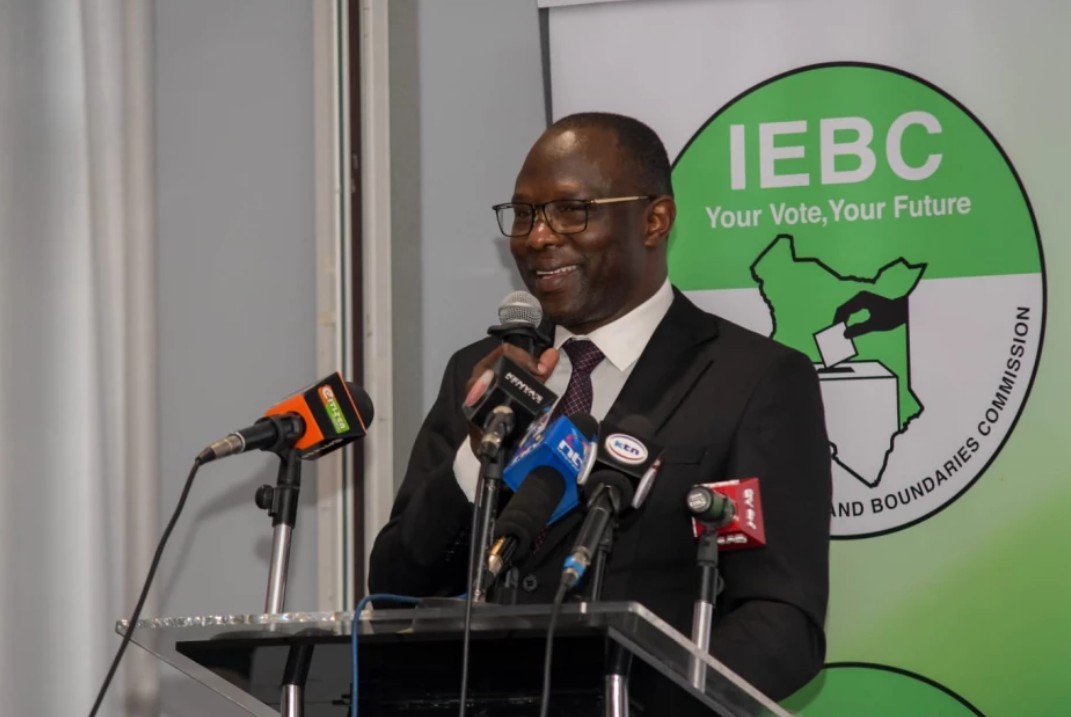
The Independent Electoral and Boundaries Commission has unveiled a Sh57.3 billion budget for 2027, rekindling debate on the runaway cost of conducting elections in Kenya.
The commission’s CEO Hussein Marjan on Thursday defended the budget that is making the next polls one of the most expensive electoral undertakings in the region.
Comparisons with 2022 polls show an upward spiral of Sh21.3 billion more for the exercise, despite promises of reforms and technologically-driven interventions.
The country coughed Sh36 billion for the August 9, 2022 general elections.
This means the agency spent Sh2,000 per individual for the 22,120,258 registered voters in the last elections.
Globally, India, with the world’s largest number of voters (910.5 million), as of 2022 spent an average of Sh1,000 for every voter, while the UK spent an average of Sh480 per voter during the two countries’ recent elections.
In 2017, the commission spent Sh55 billion to conduct the exercise, including the repeat presidential elections ordered by the Supreme Court.
In the 2013 general election, Kenya spent Sh24.2 billion, amid concerns of massive technological failure.
Appearing before the National Assembly’s Constitutional Implementation and Oversight Committee, Marjan said the initial budget was Sh61.7 billion which was then reviewed downwards to Sh57.3 billion.
The review, he noted, was occasioned by a directive to all government agencies to reduce their spending.
So far, Treasury has allocated Sh49.75 billion, translating to Sh7.63 billion budget gap.
“The deficit in funding of the 2027 general election will affect the commission adversely in conducting the election,” Marjan told the team, chaired by Suba South MP Caroli Omondi.
“The main area that will be affected by the inadequate funding is payment of wages to election officials.”
IEBC argues the budget is necessitated by technology acquisition, upgrade of systems, voter education and personnel costs and the expected rising number of voters.
During a session with Parliament, commission chairperson Erastus Ethekon said they are targeting 6.3 million new voters to add to its register.
In a budget tabled before Caroli-led committee, the electoral agency plans to spend Sh8 billion for the continuous voter register.
The exercise will be launched at Mashuuru Primary School in Kajiado county and will kick off in all the 290 constituencies and Huduma Centres countrywide.
“The registration will be launched on Monday, we will then register Kenyans in all the 290 constituencies and Huduma Centers,” Ethekon told MPs.
From the budget, the commission will also spend Sh9.8 billion to pay wages of election officials and another Sh7.6 billion to replace the ageing Kenya Integrated Election Management Systems.
Printing ballot papers will cost the agency Sh5.9 billion, a figure Ethekon noted would drastically reduce—if done locally.
“The day we will call ourselves as Kenyans and rethink that we can print the ballots at home or even government printer, then that day we will celebrate. But as things stand, we have a trust deficit,” he said.
The poll body will spend Sh1.6 billion to register Kenyans living in diaspora, airtime and security services.
Transport of personnel as well as election materials will account for Sh4.1 billion of the budget.
IEBC also intends to spend Sh3 billion for training, Sh1.1 billion for meals, Sh 3.5 billion for election materials and Sh1 billion for legal reforms.
Stakeholders’ engagement will cost Sh2.4 billion, media campaign (Sh1.4 billion), upgrade and maintenance of system (Sh2.4 billion) and simulation (Sh1 billion).
Other budget lines include nominations (Sh426 million), tallying centres (Sh750 million), election security arrangement programme and risk registration (Sh426 million), boundaries e-GPS (Sh32.7 million), research (Sh232 million), disposal/tendering process (Sh198 million) and dispute resolution at Sh177.8 million.
The commission also intends to spend Sh49 million on the National Elections Conference, Sh408 million for legal petitions and Sh330 million for recruitment and team building.
Also in the budget is Sh260 million for staff welfare, Sh327 million for maintenance of motor vehicles and Sh241 million for purchase of motor vehicles.
The budget has triggered disquiet within Parliament and civil society, with critics questioning whether the commission is inflating figures in the absence of stronger accountability.
Treasury, faced with biting fiscal constraints, has also raised red flags, hinting that the commission may be forced to trim its proposal.
National Treasury CS John Mbadi in July hinted at compelling IEBC to reuse ballot boxes and other materials procured for the 2022 general elections, as a cost-cutting measure in the upcoming by-elections and the 2027 polls.
“There are things that you buy and you don't dispose of immediately. Why do you buy them every election cycle? Every election cycle, you want new things. Even support boxes?” Mbadi posed, referencing reusable items such as ballot boxes and surveillance equipment.
“We are asking tough questions. The IEBC must be efficient. The cost of elections in this country is simply too high. We don’t have an option.We must run elections in 2027 and also the by-elections. So we’ll have to realign our budgets. I know IEBC is complaining, but they must be more efficient.”
Mbadi spoke when he appeared before the Senate Standing Committee on Devolution and Intergovernmental Relations.
INSTANT ANALYSIS
The cost of elections has been a hot potato, something that has been a matter of debate with Kenyans raising questions on the necessity of the budget lines especially on technology that, sometimes, stalls during the process. While the poll’s body has defended its spending, there is general feeling that the budget can still come down to avoid overburdening taxpayers from ‘unnecessary’ budget lines.