 In many political jurisdictions across the world, sitting presidents enjoy immunity from prosecution.
In many political jurisdictions across the world, sitting presidents enjoy immunity from prosecution.
Shielded by the privileges of office, they are often beyond the reach of the courts.
But the tide frequently changes once they step down or are forced out and crimes and atrocities committed during their reigns come under scrutiny.
Often times, the same 'invincible' leaders who once controlled state apparatus find themselves standing in the dock.
Some have used their influence and networks to continue evading justice, either through sympathetic successors or by fleeing into exile.
Others, especially in countries with stronger democratic and judicial traditions, have found it far harder to manoeuvre their way out of accountability.
Outwitted and cornered, a few have sought refuge abroad, only for their cases to be tried in absentia.
For those unable to escape, jail sentences have spelled the ultimate fall from grace to grass.
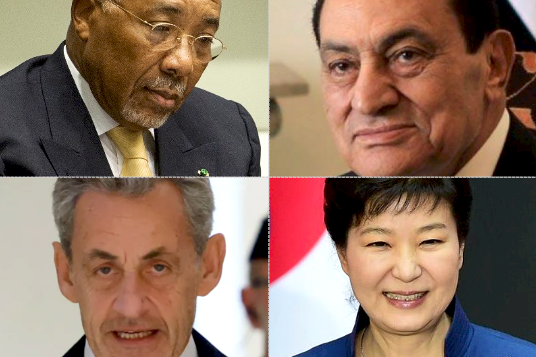
The latest among this lot is Nicolas Sarkozy, the former French president who was on September 25 sentenced to five years in prison.
He was found guilty of criminal conspiracy in a case tied to millions of euros of illicit funding from the late Libyan leader Muammar Gaddafi.
In exchange, the prosecution alleged Sarkozy promised to help Gaddafi combat his reputation as a pariah with Western countries.
The Paris criminal court acquitted him of all other charges, including passive corruption and illegal campaign financing.
The 70-year-old, who was president from 2007-12, said the verdict was "a scandal" and "hatred".
“What happened today … is of extreme gravity in regard to the rule of law, and for the trust one can have in the justice system.”
Sarkozy vehemently denied all wrongdoing and announced that he would appeal, but the ruling marked a dramatic downfall for a leader once seen as a central figure in European politics.
Charles Taylor — Liberia
In May 2012, the Special Court for Sierra Leone sentenced former Liberian president Charles Taylor to 50 years in prison for aiding and abetting rebels who committed atrocities during Sierra Leone’s civil war.
Taylor was found guilty of supplying arms and support in exchange for so-called “blood diamonds”.
He maintained his innocence, described himself as “no threat to society,” and urged the court to consider his age. He was 64 at the time.
Taylor also alleged serious misconduct by the prosecution, accusing them of having “paid, coerced and in many cases threatened witnesses if they did not give statements.”
He expressed sympathy for the victims in Sierra Leone, though he stopped short of a full apology.
Taylor is serving his sentence in the United Kingdom, the first former African head of state to be convicted by an international tribunal since the Nuremberg trials.
Hissène Habré — Chad
Hissène Habré, who ruled Chad with an iron fist from 1982 to 1990, was convicted in Senegal in 2016 of war crimes, crimes against humanity and torture.
He was sentenced to life imprisonment for atrocities that included mass killings and systematic sexual slavery.
The trial was hailed as a landmark for African justice, showing that former leaders could be held accountable on the continent.
Habré died in custody in 2021.
Alberto Fujimori — Peru
Peru’s Alberto Fujimori was sentenced to 25 years in 2009 for human rights abuses committed during his decade-long rule.
A court found him responsible for death squad killings that took place under his leadership in the 1990s.
Fujimori was later granted a humanitarian pardon in 2017 due to ill health, though the pardon was annulled and reinstated at different times as legal challenges played out.
His case remains one of Latin America’s most prominent examples of justice catching up with a once-powerful leader.
Hosni Mubarak — Egypt
Hosni Mubarak, Egypt’s long-time president, was sentenced to life imprisonment in 2012 for his role in the killing of protesters during the Arab Spring uprising of 2011.
His conviction, however, was later overturned on appeal, and after several retrials he was eventually freed.
Mubarak’s case illustrated the challenges faced by post-revolution Egypt in holding former rulers accountable.
Luiz Inácio Lula da Silva — Brazil
In 2018, former Brazilian president Luiz Inácio Lula da Silva was jailed after being convicted in the sprawling Operation Car Wash corruption scandal.
He served more than 500 days in prison before his release in 2019 while appeals were pending.
In 2021, the Supreme Court annulled his convictions, paving the way for his political comeback and eventual return to the presidency.
He was sworn in as the new president of Brazil on January 2, 2023 - marking his third stint at the helm of the country's highest office after he defeated Jair Bolsonaro in October 2022 elections.
The veteran left-wing politician, known widely as Lula, also led the country between 2003 and 2010.
In his first speech, Lula vowed to rebuild a country in "terrible ruins".
Efraín Ríos Montt — Guatemala
Guatemala’s former military ruler Efraín Ríos Montt was found guilty of genocide and crimes against humanity in 2013 for the massacres of indigenous people during the country’s brutal civil war.
He was sentenced to 80 years in prison, but the conviction was later overturned on procedural grounds.
Ríos Montt remained embroiled in retrials until his death in 2018, leaving an incomplete but historic judicial reckoning.
Joseph Estrada — Philippines
Joseph Estrada, the populist former president of the Philippines, was convicted of plunder in 2007 and sentenced to life imprisonment.
The dramatic conviction was short-lived: just six weeks later, he was pardoned by his successor, Gloria Macapagal Arroyo.
Estrada later returned to politics, showing the enduring influence of his personality in Filipino public life despite the stain of conviction.
Viktor Yanukovych — Ukraine
Ukraine’s ousted president Viktor Yanukovych was convicted in absentia of high treason in 2019 for his role in inviting Russian intervention during the Maidan uprising and subsequent annexation of Crimea.
He was sentenced to 13 years in prison but has lived in exile in Russia since fleeing in 2014.
The sentence remains unenforced but serves as a stark legal judgment against his legacy.
Zine al-Abidine Ben Ali — Tunisia
Tunisia’s former strongman Zine al-Abidine Ben Ali was convicted in absentia in 2011 on charges ranging from corruption and theft to unlawful possession of foreign currency and jewellery.
He was handed sentences totalling more than 35 years.
Ben Ali lived in exile in Saudi Arabia until his death in 2019, never serving a single day of his prison terms.
Moncef Marzouki — Tunisia
Moncef Marzouki, Tunisia’s president from 2011 to 2014, was sentenced in absentia in two separate rulings.
In 2024, he was given eight years for allegedly undermining state security, and in 2025, he was handed 22 years for charges of incitement.
Living in Paris, Marzouki dismissed the rulings as politically motivated, part of a wider clampdown on dissent under the current Tunisian administration.
At the time of his eight-year imprisonment in absentia in February 2024, Marzouki was 78 years old.
His mitigation was largely through public statements rejecting the legitimacy of the trials.
He argued that the rulings represented a political crackdown on opposition speech, asserting that the sentence illustrated “the hardening of the political line taken by the government against opponents.”
He claimed that speaking out should not be criminalised, and asked, “Is it normal in a democratic country for someone to be prosecuted simply for having expressed an opinion and point of view on his country’s politics?”
Omar al-Bashir — Sudan
Sudan’s former leader Omar al-Bashir, ousted in 2019 after three decades in power, was convicted of corruption in December of that year and sentenced to two years in a correctional facility.
He has also been indicted by the International Criminal Court for genocide and crimes against humanity in Darfur, though he has yet to face trial in The Hague.
His custody has shifted between prison, hospital and military oversight amid Sudan’s continuing turmoil.
Park Geun-hye — South Korea
South Korea’s first female president, Park Geun-hye, was sentenced in 2018 to a combined 24 years for abuse of power, bribery and coercion following a corruption scandal that led to her impeachment.
She became a symbol of the country’s zero-tolerance stance on corruption among its leaders.
In December 2021, she was granted a presidential pardon, ending her imprisonment.
Lee Myung-bak — South Korea
Park’s predecessor, Lee Myung-bak, was convicted in 2018 of bribery, embezzlement and abuse of power.
He faced a sentence of up to 17 years after appeals confirmed the charges.
Like Park, Lee was later pardoned, in December 2022, as South Korea sought to close the chapter on successive presidents embroiled in corruption scandals.
At the time the Supreme Court confirmed his sentence in 2020, Lee Myung-bak was 78 years old.
His mitigation statements included denials of wrongdoing and assertions that his prosecution was politically motivated.
In particular, during the initial verdict, he denied that he was properly informed or implicated in some of the corruption charges and suggested that investigations and legal process were being used as tools of political “revenge.”
Jacob Zuma — South Africa
South Africa’s former president Jacob Zuma was jailed in June 2021 for contempt of court after refusing to testify in an inquiry into corruption during his presidency.
He was sentenced to 15 months, but after serving only two, he was released on medical parole. He was 79 years old.
His mitigation focussed on his age, his health, and the timing (during the Covid -19 pandemic), arguing that sending him to prison under those conditions was “the same as sentencing me to death.”
He also said that “my age and health condition and any other mitigating circumstances were not considered when the imprisonment was decided.”
His release triggered legal battles over its legitimacy, underscoring the tensions around Zuma’s enduring influence and the fragility of South Africa’s institutions.
The convictions of presidents and ex-presidents around the world expose both the reach and the limits of justice.
They demonstrate that even those who once held near-absolute power are not entirely immune to accountability once stripped of office.
The cases show a shifting landscape in global politics, where the aura of invincibility that once cloaked heads of state has weakened.
While impunity persists in parts of the world, the record of convictions suggests that the long arm of justice is, slowly but surely, catching up with the powerful even as some continue to exploit loopholes, secure pardons or find refuge in exile.