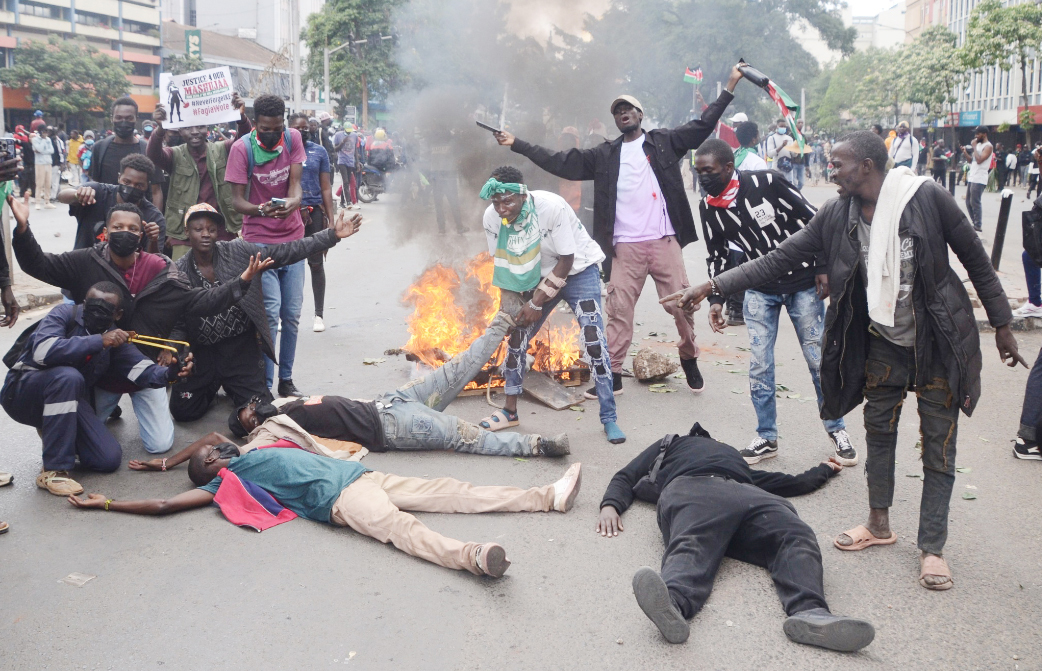
Jacinta Anyango, the mother of a 12-year-old boy, Kennedy Onyango, who was shot by police in Rongai in 2024 during protests against the Finance Bill, is inconsolable and hopeless.
Her son, who succumbed to eight bullets, had promised to treat his two anaemic siblings and educate them through his talent, painting.
In an exclusive interview with the Star, Anyango said she had placed all her hopes on Onyango — to get an education, find a steady job and one day provide for her — noting that she has no home in the rural areas to turn to.
“I believed he would support us as an adult. His other siblings are suffering from sickle cell and are most times sickly. One of my children, who suffers from sickle cell, was very close to Onyango. He is greatly affected by his death," Anyango said.
President William Ruto’s appointment of a panel of 18 experts to facilitate compensation of protest victims brought a glimmer of hope for Anyango, who even trekked to the swearing in of the panel at the KICC.
However, critics went to court and the High Court in Kerugoya temporarily suspended it.
“The ruling that halted functions of the panel cut my wound afresh. I’m hopeless, poor and bitter," Anyango said.
"Why would someone who is not feeling our pain block our justice? The team was to not only compensate but push for quick trials of those who killed my son."
Jacob Asembo, a 56-year-old carpenter who is taking care of a bed-ridden nephew at Kenyatta Hospital, hoped to use the compensation to find much better treatment for his elder sister’s son.
The college student was shot on both thighs in Githurai, Nairobi as he rushed home after participating in ant-government protests on June 25 last year.
“It is evil for rich people to abuse the court process and block justice. I welcome President William Ruto’s plan to compensate and ensure those who committed these heinous acts face the full force of the law. It is the least we can expect,’’ Asembo said.
Gillian Munyau, the mother of Rex Masai, who lost his life during the anti-Finance Bill protests in 2024, said the matter of compensating them gave her hope that the state had begun recognising their pain.
“I welcomed the move by the government to have us compensated. It is important because it recognises the pain and suffering we have been undergoing since we lost our loved ones. What is the interest of those blocking the process?” she asked.
Their views tell the frustrations faced by families of police brutality victims and those who lost property in various protests in the country. They are accusing a section of politicians, civil society groups and lawyers of standing in the way of justice.
LEGAL CHALLENGE
The government planned to compensate victims of protest-related violence dating from 2017 to 2025.
The court’s conservatory orders were prompted by a petition filed by lawyer Levi Munyeri, who challenged the formation of the panel and the framework established through a gazette notice on August 25.
It directed both the respondents and interested parties to file their responses in seven days and fixed the case for further directions on October 6.
The panel, chaired by Ruto’s senior constitutional affairs adviser Prof Makau Mutua, has since suspended its activities as directed but made an application asking the court to lift the orders.
“Our primary concern is the urgent need for justice for the victims. With a 120-day mandate, any significant delay risks rendering the entire process 'nugatory' as time will simply run out,’’ Mutua told the Star.
"We are hopeful the court will see the merit in allowing us to proceed with our work for the sake of the victims."
Although he respects the court’s ruling and the general judicial process, Mutua in his role as a lawyer wonders why wealthy and powerful politicians and greedy lawyers fight so hard to deny victims of protests and riots compensation from the state.
“The cynicism, callousness and hypocrisy of Kenya’s elites is truly galling. Shame on them!”
He terms as false dichotomy the debate around what should come first between compensations and criminal justice.
According to him, compensation is not a substitute for criminal accountability but a complementary form of justice.
“Our mandate for reparations exists alongside the ongoing legal obligations of institutions like the Independent Policing Oversight Authority (IPOA), the National Police Service (NPS), and the Office of the Director of Public Prosecutions (ODPP).”
He believes that acknowledging the harm through compensation is a step towards broader justice.
Mutua says that the process would be victim-centred, guided by global human rights norms.
“Should the court rule in our favour, our first immediate task will be to engage comprehensively with victims and their families.”
He promises that the identification process will be rigorous, transparent and multi-source.
It is the mandate of the panel, given through the gazzette notice, to authenticate data on eligible victims from authoritative sources, he said.
These sources include IPOA, KNCHR, the National Police Service, the Ministry of Health and civil society.
PRECEDENTS SET
Mutua says Kenya is not operating in a vacuum as it is borrowing from such-like processes in South Africa, Nigeria, Bolivia and more recently, Nepal.
“One of the panel’s tasks would have included conducting a comparative analysis of victims and protests and riots in the past year,” he said.
"It is in the public domain that countries like South Africa during the Marikana strike (2012), End SARS protests in Lagos, Nigeria (2020), and even in France, the Yellow Vest protests victims between 2018 and 2021."
For instance, in South Africa, 13 years after the Marikana tragedy, which resulted in the death of 34 miners in the mining village of Marikana in the North West Province,the Department of Justice revealed it had paid out R352 million in compensation to the victims ‘families.
In 2023, the Nigerian government was compelled to pay 10 million Naira to victims of the End SARS protests that left least 12 people killed and dozens injured in 2020.
The movement started in October 2020, when thousands of mainly young Nigerians took to the streets to protest against police brutality, particularly by the now-disbanded brutal Special Anti-Robbery Squad police unit.
The peaceful protest went on for days across major cities in the country until it was hijacked by hoodlums, leading to the involvement of the military, particularly in Lagos, which was the epicentre of the protest.
The Star spoke to tens of members of the public on the matter, with most supporting compensation and timely prosecution of perpetrators.
However, some like Migai Aketch, a professor of law and an advocate, argues that the constitution does not give the President the power to appoint bodies such as the so-called Panel of Experts on the Compensation of Victims of Demonstrations and Public Protests.
He says Ruto wrongly interpreted Article 129 as giving him such powers.
“Article 129 says, ‘Executive authority shall be exercised in accordance with the constitution.’ This is not authorisation to the President to establish any entity."
Human rights activist Goerge Muthama gives an analogy of a mother cutting off her child’s legs and offering to carry the baby on her back for several years.
“It is the government’s responsibility to protect its citizens. By forming the taskforce, Ruto technically accepts responsibility for police killings. It is sad that he expects to use our taxes to correct his government’s ills. It is unacceptable.’’
His views are shared by a boda boda operator, Dan Kamau, who insists that the compensation should be deducted from the salaries of top state officials, led by President William Ruto.
His colleagues are, however, fronting compensations
before prosecutions to help victims’ families cope with the tough
economy even as they await the long and time-consuming criminal justice.
ADVISORY GROUP
Although he supports compensations, former Deputy President Rigathi Gachagua poured cold water on the process, saying it was President Ruto’s attempt to appease the international community ahead of the UN Assembly, currently underway in the US.
“He is trying to hoodwink the international community by ordering Prof Makau Mutua to set up a team to compensate victims of extrajudicial killings,” Gachagua said.
“We accept it is good to compensate people, but that should be the tail end.”
He added that before compensation, the President must first admit they were extrajudicial killings and apologise to the nation and to the families.”
The panel’s mandate includes verifying and categorising victims, recommending compensation, engaging stakeholders for fairness, authenticating data and proposing legislative and institutional reforms related to protests and policing.
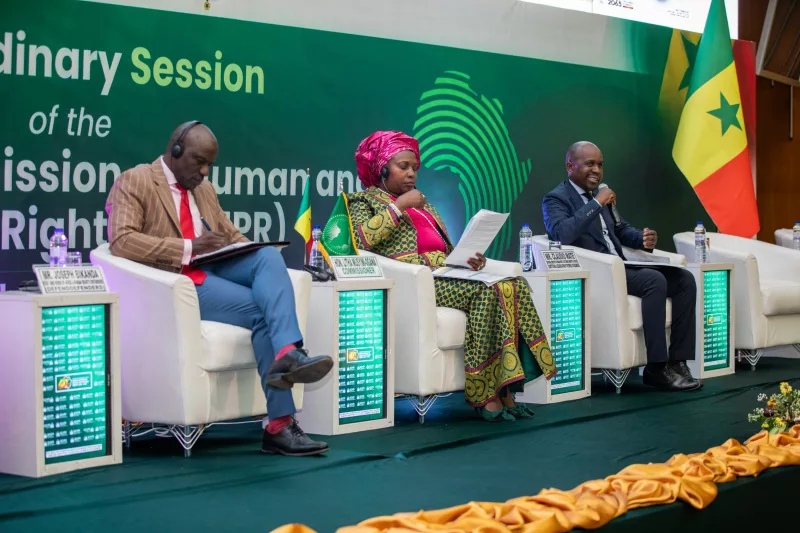
During the swearing-in ceremony, Mutua emphasised the panel’s goal of creating a framework for peaceful demonstrations, asserting that its role is advisory and supplementary, intended to bridge gaps between constitutional mandates and unresolved grievances.
It clarified that it is not a constitutional commission or statutory body but an ad hoc advisory group established under the President’s executive authority to coordinate government functions.
""The creation of this panel is a response to a national human rights issue, not a political one. Victims are not partisan. They come from every corner of the country and diverse political affiliations."
""The mandate of this panel is about perfecting our democracy, and in future, for the Article 37 rights without resorting to violence. Our work is guided by the principle of state responsibility and the constitutional rights of every Kenyan.""