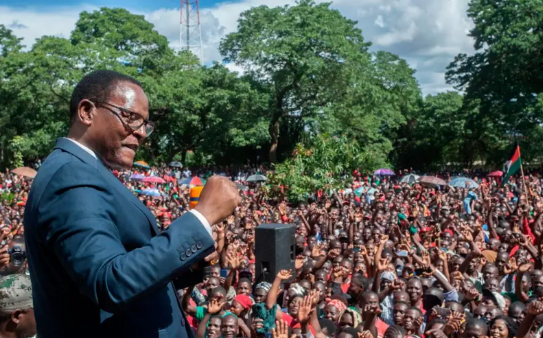
 Outgoing Malawian President Lazarus Chakwera during the campaigns./FILE
Malawian President Lazarus Chakwera on Wednesday conceded defeat and congratulated his successor and predecessor, Peter Mutharika, after the September 16, 2025 presidential election.
By Wednesday afternoon, partial results showed Mutharika had secured an unassailable lead of 66.7 per cent of votes from 24 of the 36 councils, surpassing the 50 per cent plus one threshold and avoiding a run-off.
Chakwera trailed far behind at 24 per cent.
Although the electoral commission delayed the official result until the evening, Chakwera acknowledged reality in a televised address from Kamuzu Palace in Lilongwe, declaring Mutharika the presumptive winner.
"It is only right that I concede defeat out of respect for your will as citizens and out of respect for the constitution,” he said.
His concession sparked wild celebrations in the capital, Lilongwe, as Mutharika’s supporters poured into the streets.
Chants of "adadi", meaning father in Chichewa, rang out as motorists honked, music blared, and pedestrians danced, some tearing down Chakwera posters along the way.
Although Chakwera’s party raised complaints of “serious anomalies” in the counting process, the electoral commission insisted it was taking time to ensure accuracy.
Chakwera himself accepted the outcome and promised a smooth transition.
"I am fully committed to facilitate a peaceful transfer of power," he assured Malawians.
But the question remains: why did Chakwera lose to the very man he unseated five years ago in a historic re-run?
When Chakwera unseated Mutharika in 2020 with 59 per cent of the vote in a court-ordered re-run, he embodied hope for a new era.
But within five years, corruption scandals, soaring inflation, and worsening poverty eroded that hope.
Mutharika, despite his advanced age and chequered past, emerged as the beneficiary of Malawians’ frustrations.
His return to power was more about a population desperate for relief from economic turmoil under Chakwera's reign, than nostalgia.
Chakwera’s inability to deliver stability cost him dearly, while Mutharika’s seasoned political instincts and record on economic management gave him the edge.
Corruption and Economic Turmoil
Corruption, a vice that dogs many African administrations, weighed heavily on Chakwera’s presidency.
His time in office was overshadowed by allegations of graft and, more critically, by worsening economic conditions.
Inflation under his rule surged to 30 per cent, even higher than levels recorded under Joyce Banda, fuelling anger among citizens struggling with rising prices.
Mutharika’s supporters argued that he had handled the economy far better in his earlier tenure, when inflation dropped from 24 per cent under Banda to single digits by 2020.
They pointed to the current high rate of 27 per cent as proof that Chakwera had mismanaged the economy, making a compelling case for Mutharika’s return.
Political experience or lack thereof appears to have also played a role in Chakwera's downfall.
The former theology lecturer and preacher only entered politics in 2013 when he became leader of the Malawi Congress Party.
By contrast, Mutharika’s résumé was far weightier.
The 85-year-old has run for the presidency four times and previously served from 2014 to 2020.
He spent decades abroad teaching in universities across the US, Tanzania, Uganda and Ethiopia before entering politics in 2004, when his brother Bingu wa Mutharika became Malawi’s president.
Mutharika served in his brother’s cabinet as justice minister, education minister and foreign minister before winning the presidency in 2014.
Whereas his rise to the top weas relatively calm, his career has not been without controversy.
He was once charged with treason after being accused of attempting to conceal his brother’s death in 2012 to engineer a succession, charges that were later dropped.
His supporters' attempts to install him as leader in defiance of the constitution would have easily been used against him by Chakwera as one who does not respect democracy and rule of law, but this episode appears to have not left a blemish on his political career.
By comparison, Chakwera’s record in government was less convincing.
His only major achievements included the reintroduction of train services after three decades and a push for road construction projects.
Yet these accomplishments did little to offset the sting of economic hardship.
But Chakwera’s downfall was not solely of his own making.
Natural disasters, including Cyclone Freddy and a punishing drought, compounded by dwindling foreign reserves, left many Malawians in deep poverty.
Still, Mutharika managed to exploit the situation politically, portraying himself as the leader who could rescue the country.
In one of his campaign speeches, he struck a chord with voters when he asked in Chichewa: "Munandisowa eti? Mwakhaula eti? (You miss me right? You have suffered, right?)".
Even concerns about his health, fuelled by his low visibility during the campaign, did not deter the electorate.
In fact, Mutharika triumphed even in Chakwera strongholds such as Lilongwe and Nkhotakota, underscoring the depth of discontent with his presidency.
The verdict from Malawians was clear: they preferred the familiar hand of an old leader to the unfulfilled promises of the preacher-president.