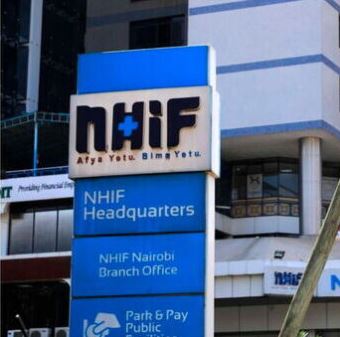
 The defunct NHIF./FILE
Controller of Budget Margaret Nyakango reports that collections from Facility Improvement Financing (FIF) were the saving grace for the troubled devolved health sector, far exceeding set targets.
“The collections received from FIF, totalling Sh24.59 billion, outperformed the annual target of Sh20.77 billion, achieving 118 per cent,” the budget boss notes in a new report for 2025.
This fund, collected directly by health facilities for services like laboratory tests and pharmacy sales, is fully retained and utilised at source to defray operational, management and capital costs.
Nairobi earned Sh1.4 billion despite not forecasting this income in its budget. Governor Johnson Sakaja attributed the performance to leadership changes at the city’s Level V hospitals.
“We restructured the board membership and created the position of CEO above the medical superintendent,” he said.
“There has been exceptional transformation in Level V hospitals, with service delivery improving significantly.”
At least 12 counties exceeded 100 per cent of their annual revenue targets, including Kisii, which collected 178 per cent (Sh982 million), with Mandera and Wajir both at 123 per cent.
Kirinyaga also delivered an exemplary performance. It targeted Sh218 million in FIF but collected nearly double that amount, Sh431.52 million, achieving 122 per cent of its target.
Other high flyers include Garissa (120 per cent of target), Homa Bay (101 per cent) and Meru (106 per cent), all of which not only met but exceeded their FIF collection goals.
Homa Bay collected Sh1 billion from health services, pushing its own source revenue to Sh1.5 billion. Kiambu collected Sh1.8 billion, Kisumu Sh1.6 billion and Nakuru Sh1.8 billion.
Kakamega made Sh894 million from health services, Bungoma Sh663 million, Makueni Sh773 million, Nyeri Sh769 million and Meru Sh758 million.
However, an analysis of the FY 2024-25 County Budget Implementation Review Report found significant disparities in how counties managed this vital resource.
This, as the Controller of Budget identified an “overreliance on the Facility Improvement Fund", which accounted for more than 50 per cent of revenue for many counties.
Collections by Nairobi, for instance, accounted for 66 per cent of the county’s total revenue target, underscoring the place of health in shoring up county revenues.
While some counties didn't dramatically exceed expectations, their reliable collection indicates a functioning and predictable FIF system.
The challenge for these counties is to ensure these collected funds are absorbed efficiently into development projects.
The report further details how counties are owed Sh5 billion by the defunct National Health Insurance Fund, the highest being in Nairobi, where Sh937 million is unpaid.
Other big portfolios are in Mombasa, where NHIF is yet to pay Sh562 million, followed by Nakuru at Sh412 million and Sh336 million for the case of Kisumu county.
Homa Bay is owed Sh267 million, Sh231 million in Nyeri, Sh200 million in Siaya and Sh176 million in Kakamega county.
Counties are also owed Sh7 billion in claims lodged with the Social Health Authority through the Social Health Insurance framework.
While county hospitals delivered services worth Sh19 billion, SHA paid Sh12 billion, with Kisumu and Homa Bay getting the highest at Sh1 billion each.
Among the highest gainers, SHA also paid Sh916 million to Mombasa, Sh639 million in Nakuru, Sh548 million in Nairobi and Sh608 million for the case of Nyamira county.
Of the outstanding amounts, Nakuru is facing the most severe strain, with a staggering Sh885 million in unpaid SHIF claims.
As the nation's capital and a major healthcare hub, Nairobi has Sh301.6 million in SHIF arrears. Compounding this problem is the largest historical NHIF debt of Sh937.4 million, creating a combined burden of more than Sh1.24 billion in unpaid insurance claims.
Another major urban centre, Mombasa, is owed Sh763.9 million by SHA. Combined with its NHIF arrears, its total health insurance debt exceeds Sh1.33 billion.
Kilifi's health facilities are waiting on Sh229.30 million from the SHA, a significant amount that impacts services in the Coastal region.
Other counties with notably high SHIF arrears include Homa Bay (Sh455.2 million), Kisumu (Sh334.2 million) and Bungoma (Sh236.43 million).
INSTANT ANALYSIS
For the new SHIF system to gain credibility and for county health facilities to function optimally, the national government and SHA must prioritise and expedite the clearance of these arrears. The sustainability of healthcare delivery in Kenya depends on a reliable and timely reimbursement system, which currently is not functioning as intended. The delay is not just a financial issue; it is a life-and-death matter for the healthcare system.