
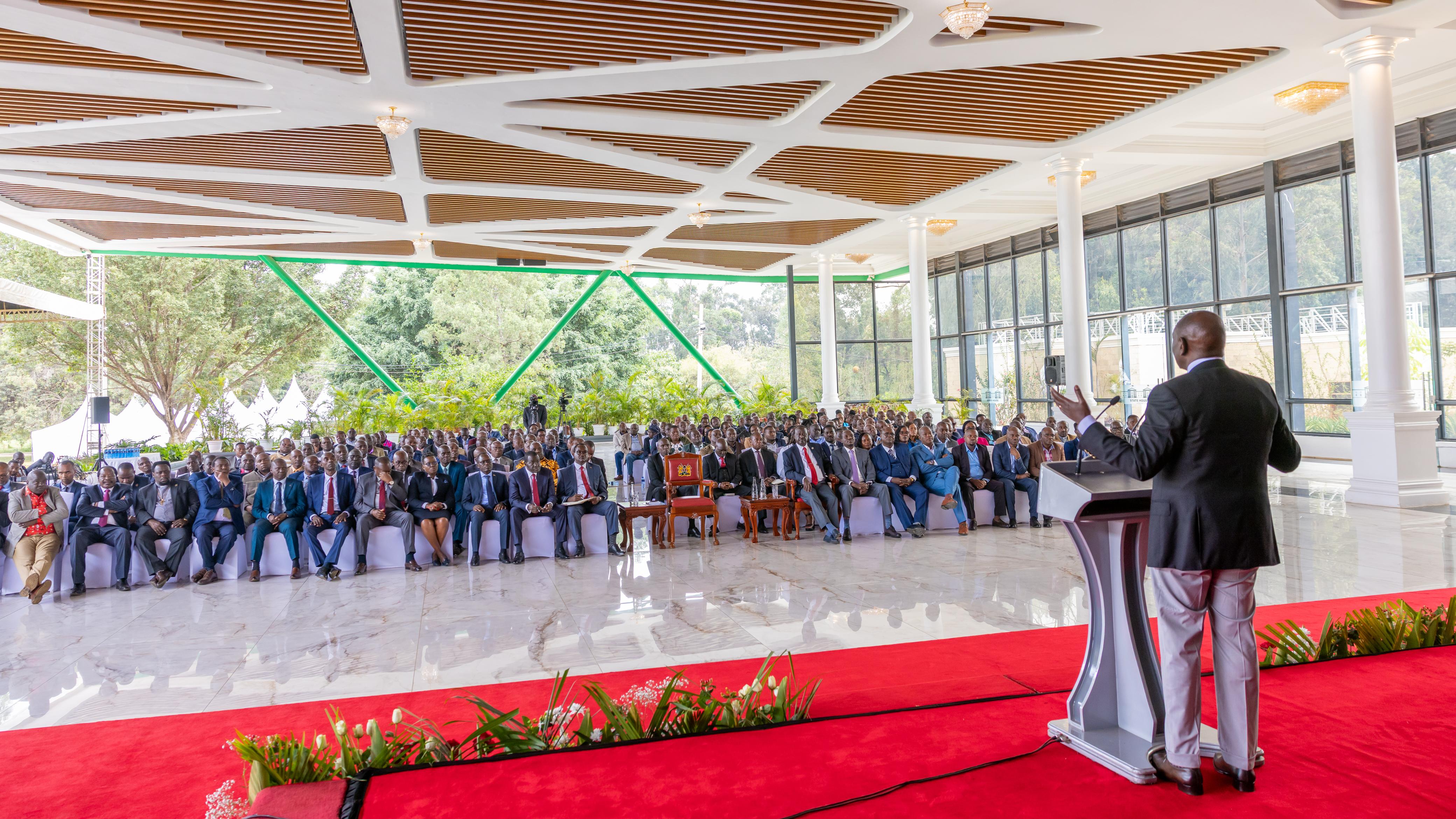
President William Ruto and Deputy President Kithure Kindiki on Friday put a strong defence against critics accusing them of turning State House and their official residences into early campaign podiums for the 2027 election.
The President made the sentiments when using the contested platform – State House, Nairobi, to unveil significant expansions of SHA – a flagship healthcare programme.
Kindiki also took on his critics while meeting health workers at his private residence in Irunduni, Tharaka Nithi, hundreds of kilometres from State House.
The two have hosted a flurry of meetings with groups from various counties, sparking grumbles from the opposition side.
At State House, the head of state welcomed guests, many of whom he said were visiting the prestigious compound for the first time.
His comments were a direct rebuttal to those who have criticised the frequent hosting of what they term ‘political delegations’.
“Thank you for accepting my invitation because we have a historic event happening in our country today,” the President said.
“I know some of you are coming to State House for the first time. You are permitted to come here because these facilities are for all Kenyans.”
In a speech laden with biblical references, Ruto said that the power to grant access was a privilege of his office, bestowed by the people and he had chosen to open the doors to ordinary citizens.
While holding that the delegations are in line with the philosophy of his administration’s bottom-up economic model, the President said, “Many are complaining that I have opened the doors of State House for ordinary Kenyans… For me, I want to assure you all that they don’t understand the teachings of Psalms.”
“To those complaining, I have reduced the respect for State House, let them know I have taken the respect for Kenyans higher. God lifts the humble and gives them a seat at the table of kings… we are all equal before the constitution.”
Hosting delegations is emerging as a characteristic of the country's political software.
Ruto, ahead of the 2022 election, was known for hosting huge delegations at his Sugoi home and Karen residence. His predecessor, Uhuru Kenyatta, also hosted huge delegations at State House during his tenure.
Meanwhile, the DP hosted more than 6,500 community health promoters from Meru county at his private Irunduni home, a meeting that followed a similar engagement with delegates from Embu.
Kindiki launched a fierce defence of his choice of venue, dismissing his detractors.
“There are people insulting us for hosting meetings at our residence. Is there a problem if I call them to my residence?” he said.
“Let them look for something else to do. We have gone away with the prize. Those insulting us should tell us what they are doing to sacrifice for Kenyans.”
He challenged other leaders to host their constituents, asking, “Has anyone stopped them? I have been to many areas in Kenya, and I have been welcomed; is it wrong for me to do the same for my guests?”
The president, for his part, made the remarks while addressing citizens at the launch of the Social Health Authority sponsorship programme, to help realise the universal health coverage agenda.
President Ruto announced that the state would now pay the health insurance premiums for more than 2.2 million vulnerable and indigent Kenyans, ensuring they have access to outpatient and inpatient care free of charge.
At least 558,000 households are targeted in the drive, adding that private sector players would also cater to some of the identified households.
“We made an irrevocable commitment to deliver universal health coverage for all Kenyans, regardless of their economic status. Today, we have taken another significant step in fulfilling that pledge,” he said.
“Health is not a privilege of those who can afford it but a right for every citizen of Kenya. We are going to make it possible for those who don’t have the means so that even them will be beneficiaries of the highest standards of health.”
He promised that the government would continue identifying more vulnerable families to bring them into the SHA fold, aiming for a “robust, responsive, and truly equitable” healthcare system.
Back to Irunduni, chants of two-term played out, detailing the mix of politics and governance in the gatherings.
Amid chants from the crowd, Kindiki grounded the meeting in the government’s development agenda, particularly healthcare.
He explained that hosting groups from the region was because “charity begins at home,” and the residents were best placed to “show them the way.”
The DP hailed the SHA programme as “historic and momentous.”
He detailed the government’s ambitious enrollment targets: 30 million Kenyans by December last year, 45 million by the end of 2026 and 55 million by the end of 2027, building on the current 26.4 million already registered.
Kindiki placed the CHP at the very centre of this mission, calling them “the engine of Taifa Care’s success” and “heroes” in fulfilling the constitutional right to health.
“For health services to be truly universal, for every part of Kenya to access medical care, we need the community health promoters to be available in every village,” he said, pledging continued government support for the 107,000-strong force.
He outlined a comprehensive support system for the CHPs, including the modernisation of hospitals to handle referrals, improved supply chains for medicines, and a digitisation drive for medical records to prevent fraud.
“When history is written, the story of the community health promoters of Kenya will have a place in the history of the transformation of our health system.”







