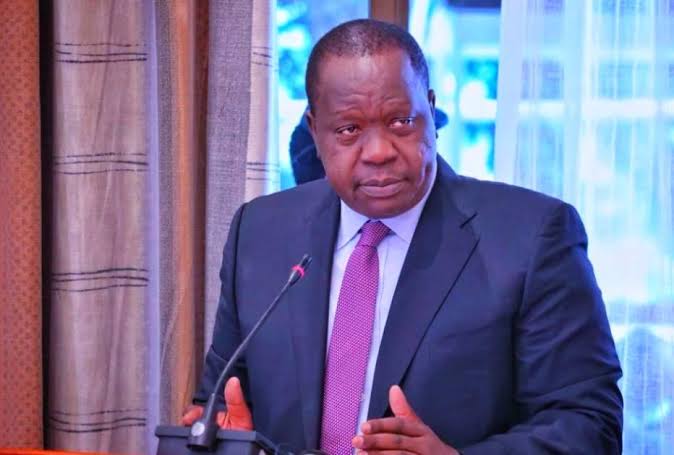
Former Interior Cabinet Secretary Fred Matiang’i has publicly challenged President William Ruto’s administration for failing to fulfill his promised inquiry into alleged ‘state capture’.
He dismissed the probe, which was among Ruto’s campaign
pledges, as a “phantom” and “one of the big lies” Kenya Kwanza honchos used to
gain power.
Making his first major remarks on the aborted investigation,
Matiang’i expressed frustration that three years after Kenya Kwanza accused the
previous Jubilee government of operating a ‘deep state’, no report had ever
been published.
“I said it was a phantom. It was one of the big lies that
were being told at that time,” Matiang’i told TV 47 in an interview on
Thursday.
“Those who accused us of being part of the deep state are
now in government. How comes that 36 months later, they have never published
what that deep state was all about?”
President Ruto, then as deputy president, and his allies consistently
claimed there existed a deep state out to rig elections and frustrate his team
in the run-up to the 2022 elections.
They consistently alleged that then president Uhuru Kenyatta, Matiang’i and senior security officials were part of a shadowy ‘deep state’ network.
They alleged that the group was manipulating government
operations for personal and political gain, including plans to rig the
election.
Matiang’i said he had been prepared to testify before the
promised commission of inquiry, alongside Uhuru and the late Chief of Defence
Forces General Francis Ogolla, to clear his name and counter the accusations.
“We want to go before it and put our case and tell the
country what we know about others… and there were so many accusations that were
made that time,” he said.
He singled out one of the most serious allegations that
senior government officials, including himself, were holding clandestine
meetings at a hotel on Thika Road to plot Ruto’s assassination.
Matiang’i recalled being harassed and compelled to record
statements over the matter. “How is it that those who were accusing us have the
security system and are the leaders, have never published reports about that
assassination attempt?” he asked.
“This vindicates what I said at that time. Why can’t they
put that information in the public domain? You can even publish a DCI report
stating what happened.”
The former powerful Cabinet Secretary, now out of
government, argued that his current distance from power makes it the perfect
time for his accusers to release any evidence they claimed to possess.
“Now that I am nowhere near power, why not publish the
information?” he challenged.
A State Capture Commission of Inquiry was in the works to
probe claims of abuse of power right after the election, but the same is yet to
be seen.
At that time, government sources intimated that a legal
framework was being cobbled together to anchor the inquest.
Apart from Matiang’i, former Interior PS Karanja Kibicho was
among those who were to face the commission.
Many other government officials who were believed to have
played a part in the “state capture and cronyism” in the Uhuru era were to
appear before the probe team.
The inquiry would focus on, among others, claims that top
officials used their powers to irregularly award tax exemptions, especially to
foreign firms.
Ruto’s team has also alleged in some forums that some money
was drawn from state coffers and carted away in sacks in the last days of the
previous administration.
Ruto’s team has also alleged state capture was at play in
the buyback of Telkom Kenya, linking the beneficiary firm to top Jubilee
officials.
The events that played out at Bomas of Kenya moments before the
Independent Electoral and Boundaries Commission declared Ruto the winner of the
2022 presidential race were also expected to feature in the probe.
Claims were rife that top state officials attempted to
‘alter the results of the election in favour of ODM leader Raila Odinga’.
Way before the elections, the UDA members said they would
probe the events once they assumed power.
President Ruto and his team announced the plan in their
manifesto in the contest with Raila’s Azimio side.
It suggested a quasi-judicial public inquiry “to establish
the extent of cronyism and state capture in the nation and make
recommendations.”
Ultimately, Matiang’i framed the failure to follow through on the probe as a cautionary tale for the Kenyan public.
“The import of this is for Kenyans to be careful about what
people tell them,” he concluded, suggesting that the allegations were a
political tactic with no basis in fact.
The continued silence on the promised ‘state capture’ report raises fresh questions about the nature of the allegations that once dominated the nation’s political discourse.
INSTANT ANALYSIS
Matiang’i’s pointed challenge leaves the government with a difficult choice: break its silence and finally produce the long-promised evidence, or remain quiet and risk being seen as having used grave allegations of state capture and assassination as mere political propaganda.