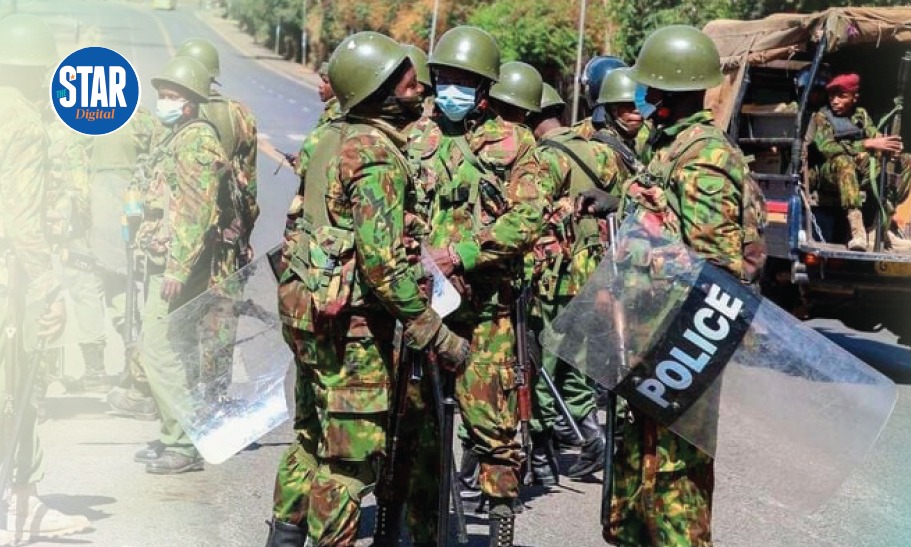
 Police officers during a past protest / FILE
The issue of compensating victims of post-election violence has garnered attention, with some supporting and others opposing payouts. However, this does not need to be a controversial issue.
President William Ruto promised compensation of victims of protests and set up a task force to make determinations.
An examination of reparations literature, both in domestic culture and international contexts, reveals that reparations and justice don’t fall into one approach or have a single definition, thus, a range of approaches is required.
This article evaluates special contributions, if any, and the ethical contributions to reparations, whether they are adjudicatory, legislative, or executive such as the current one. It describes the goal of any reparation, which focuses both on the past harms and their effect on the future behaviour and interactions of police and demonstrators.
Reparation schemes ordered by courts due to legal challenges constitute adjudicatory methods. Programmes designed by political agencies such as parliaments are legislative in nature, and those designed under executive authority fit an executive scheme.
The goal of all these reparations programmes is the principal end they seek to accomplish. They usually seek to attain three things: social reconciliation, victim remediation, and societal transformation as the primary overarching goals.
Reconciliation efforts focus upon social healing among the various groups, in this case police, public, victims and families, and government all to promote harmony and social unity.
Remediation efforts, which critics often focus on, are critical in correcting the harms inflicted upon victims through monetary and other means.
Finally, the task force is to focus on programmes geared towards societal transformation, with both the legal and political reforms meant to create a new Kenyan society that rejects the past identity associated with demonstration injustice.
In the article ‘When Sorry isn’t Enough: The Controversy over Apologies and Reparations for Human Injustice’, Roy Brooks, a leading scholar in the field, expands the pedestrian views common among those opposing the task force. He emphasises the limits of law alone in addressing some injustices, as argued by the opponents.
The fact that efforts are made to amend and offer compensation for the past harms means that damages occurred that require remediation. It also means that the Executive is assuming responsibility for providing redress for the harm.
This is a good thing because the mandate of the task force is both on retributive justice for those responsible for the harm and restorative justice for those who suffered the harm.
The question should be interrogated from a vantage point beyond law, interdisciplinary in nature with the interplay of law and insights from Christian ethics, Christian experience, political science and the African Ubuntu philosophy.
To see reparations manifest, we must focus on repairing and restoring, a task that cannot be left to one institution. Reparations viewed exclusively through the lens of justice risk a misdirection that prevents genuine reparations from taking place, even though justice might have a complementary role.
In conclusion, love will always find a way as a motivating principle of Ubuntu towards the victims. I am appealing to all Kenyans to support rather than frustrate injured groups’ efforts to restore and renew their well-being through the current reparations.
All Kenyans should discern and share their voices with the task force on the necessary aspects of reparations that should be undertaken, and what the broader society should do to avoid future deaths and destruction of properties during picketing.
Even considering the issue of reparation as a matter of law, there is a chance to work through the task force to propose public policy on future compensation of victims, thereby unlocking the various reports of historical injustice that are gathering dust on our shelves.
In this regard, I look forward to contributions that will unlock the historic and current limitations of courts and human rights bodies to remedy victims of human rights violations.
From the struggle for Independence to the present, many victims of human rights abuses have waited in vain without remedies that provided meaningful redress and restitution for harms caused by past police brutality.
In a similar fashion, entrusting responsibility for reparations to one group or a few organisations seems unwise, in light of the historical analysis of what has failed to bring change in law enforcement.
The writer is a member of the Task Force on Protest Victims Compensation