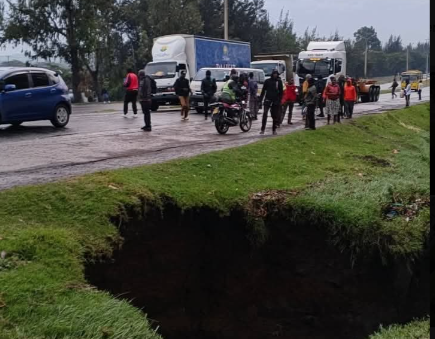
Nakuru is once again grappling with a recurring geological nightmare — sinkholes.
Over the weekend, a newly repaired section of the Nakuru–Eldoret Highway near the Eveready roundabout collapsed again, exposing motorists and nearby residents to danger and raising fresh concerns about long-standing underground instability in the area.
The Kenya National Highways Authority (KeNHA) has since issued a fresh advisory, urging motorists to exercise caution while using the A8 road.
The warning follows the reappearance of a sinkhole less than 48 hours after KeNHA crews had patched up the same spot, a clear sign that the problem runs deeper than what can be fixed with surface-level repairs.
"The Kenya National Highways Authority wishes to notify members of the public to continue exercising caution as they drive towards the Eveready roundabout on the A8 Road," read a statement from the Authority.
"This is due to earlier noted geological activities that had undermined the road shoulder and could potentially recur, especially with the rains."
Police have since closed the affected stretch of road, diverting vehicles to a single lane, which has significantly worsened traffic congestion.
The new damage sparked panic among residents and commuters alike, with visible cracks raising fears of a more extensive road collapse.
It’s a scenario that many in Nakuru have witnessed time and again, prompting the question: Why are sinkholes so common in Nakuru County?
Experts say the problem is rooted in Nakuru’s unique geological location.
The county sits directly along the geologically active Rift Valley fault line, a natural feature known for earth movements and instability.
The ground beneath Nakuru is largely composed of porous volcanic ash, pumice, and sedimentary layers, which are prone to erosion and collapse.
A sinkhole is a depression or cavity in the earth’s surface that forms when the upper layer collapses due to a lack of support beneath.
This usually happens when water dissolves soluble rock like limestone, gypsum, or chalk, leaving behind underground voids.
In Nakuru’s case, volcanic ash and loose sediments dissolve or erode even more easily, especially during heavy rains.
Water, both from natural rainfall and human activity, plays a pivotal role. When rainwater — often slightly acidic — seeps through the soil, it dissolves minerals and carries them away, enlarging underground cavities.
When these cavities grow too large to support the weight above, the ground collapses, forming a sinkhole.
Nakuru’s sinkhole issues become particularly prominent during rainy seasons.
The current rainy spell has saturated the soil, weakening already fragile ground.
Poor drainage in urban areas worsens the situation by allowing water to pool, increasing pressure on underground cavities.
In Kaptembwo and Kiambogo, recent heavy rains have caused deep fissures and visible cracks, some slicing across roads, farms, and residential areas.
In Kaptembwo, a fissure damaged homes while tenants were still inside.
In Kiambogo, farmers reported massive cracks cutting across productive land. These events are not isolated — they are symptoms of a widespread problem affecting much of Nakuru’s topography.
Nakuru’s battle with sinkholes and fissures is not new. In 1997, after the El Niño downpours, massive sinkholes appeared in the London Estate.
In 2004, a similar event unfolded at TimSales Compound and Timber Mill Road.
The problem seems to be cyclical, resurfacing with seasonal rains and intensifying with human development.
In May 2024, the government deployed senior geologists to Nakuru to investigate increased geological activity following the appearance of deep fissures in several neighbourhoods.
Areas such as Ngata and London were particularly affected, with residents fearing a complete collapse of land sections.
The studies revealed that many parts of Nakuru are essentially sitting on hollow or unstable ground, carved out over time by water flow and erosion.
While natural processes are largely to blame, human actions are also accelerating the crisis.
Excessive groundwater extraction for farming, industry, and domestic use has significantly disturbed the underground water tables.
Mining, drilling, and rapid construction have compounded the problem by shifting soil and increasing stress on already fragile underground cavities.
Leakage from water pipes, unplanned drainage systems, and construction without proper geological surveys also disturb the soil structure and water flow.
These activities create pathways for water to erode subsoil faster, increasing the chances of a collapse.
Sinkholes triggered by human activity tend to be more unpredictable and often occur in urban or semi-urban areas, where they can cause enormous structural damage, displacement of communities, and disruption of infrastructure.
Geologists classify sinkholes into three main types: Dissolution sinkholes – These form slowly when water dissolves soluble rock beneath the surface, causing the ground to subside gradually; collapse sinkholes – these occur suddenly when underground voids grow too large and the ground above them caves in and erosion sinkholes – these happen when surface water carries away loose soil or sediment, weakening the ground’s structure.
As Nakuru continues to urbanise, experts stress the need for stricter planning regulations and proactive monitoring.
Construction should only proceed after thorough geological assessments, and groundwater extraction should be regulated to prevent destabilisation of the subsoil.
Public awareness and community reporting also play a crucial role in identifying potential danger zones before disasters occur.
With climate change likely to increase rainfall variability and human development expanding into geologically unstable areas, the problem could grow worse before it gets better.