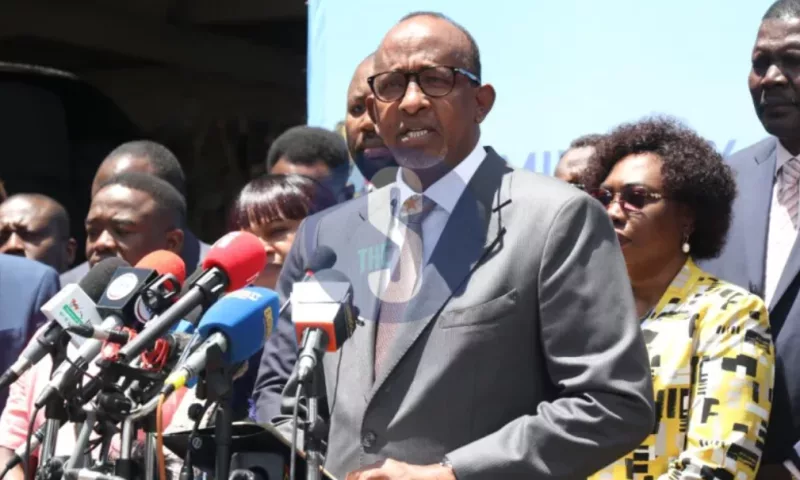
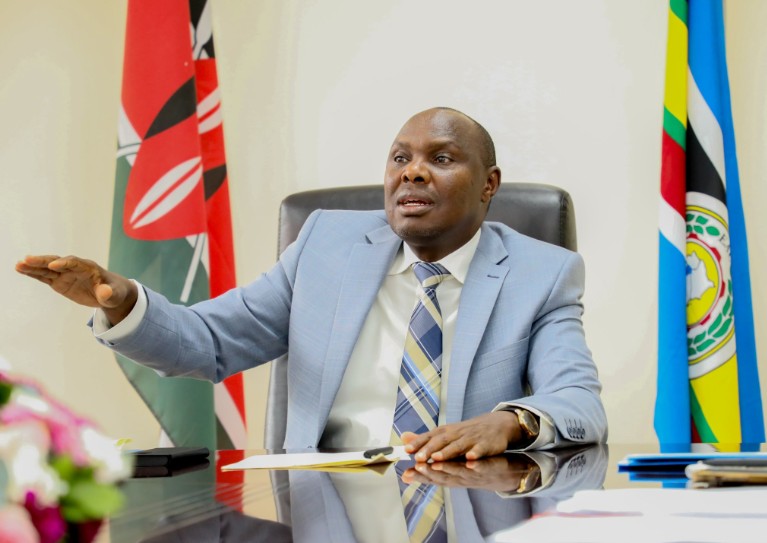
 Head of Public Service Felix Koskei./FILE
Public officers and civil servants face disciplinary action that includes sacking and prosecution as President William Ruto plans a major crackdown to get rid of inefficiency in government.
The Ruto government is collecting data from the public sector on pending disciplinary cases, unresolved graft cases, incompetence, failure to perform duty, and violation of law among claims against civil servants.
The clampdown plan is obtained in a circular, Ref. No OP/CAB 6/2 issued by the Chief to Staff and Head of Public Service to all Accounting Officers dated August 4, 2025.
Accounting officers, who include Principal Secretaries (PSs) and Chief Executives Officers (CEOs) of parastatals were provided with a matrix of a template to use in identifying non-preforming civil servants, including absentee workers.
The circular is titled; Improvement of Performance and Efficiency in the Public Service to Optional levels through taking of Prompt Corrective and Immediate Administration of Lawful Consequences for Infractions.
It was issued following a virtual meeting held by Chief of Staff Felix Koskei on Wednesday July 30, 2025 and is copied to all PSs, Solicitor General, Chief Executive Officers (CEOs) of state agencies, Inspectors General of State Corporations James Warui, Secretary State Corporations Advisory Committee Simion Indimuli and Chiefs of staff for Deputy President and Prime Cabinet Secretary
“The continued improvement of performance and efficiency in the Public Service is a core priority of this Administration, anchored in Articles 10 and 232 of the Constitution, which mandate integrity, accountability and high ethical standards,” Koskei’s circular reads.
It adds; “However, a culture of impunity, inertia, and nonperformance persists, undermining the achievement of premier service delivery, thereby eroding public trust and the credibility of public service.”
The circular stated that the evaluation of the existing surveillance and performance tracking systems has revealed: a) failure to take prompt corrective action, allowing inefficiencies and non-compliance to persist, and b) failure to administer lawful and proportionate consequences, thereby emboldening misconduct and eroding public trust.
Among the cases that Koskei wants answers on include misconduct by board chairs or members contrary to the Mwongozo Code of Governance, where affected persons have either been censured or suspended.
Other categories include infractions related to conflict of interest, failure to resolve prior audit queries, failure to implement surcharge of loss of public funds, failure to submit internal audit report timely, disclaimer/adverse audit queries, failure to account for advance imprest, abuse of officer, breach of procurement laws and disclosure of authorised information.
Officers accused of failure to address public complaints, dissemination of misleading information, unprofessional conduct include abuse of mistreatment of citizens, breaches of moral and ethical standards that constitute violations of the values and principles of public service are also under the radar.
According to Koskei, the Ruto administration promised to put in place an agile, people-centric, and responsive Public Service in order to meet the high expectations of the public in regard to service delivery.
“To address the two critical weakness started above, this office has put in place mechanisms to urgently change the institutionalised culture of public servants being tolerant of inaction and inertia, thereby compromising the quality of service rendered to citizens.”
Thus, Koskei adds that the matrix of lawful consequences for infractions in the public service has been curated by his office from existing legal frameworks for, among others, prompting the culture of change towards prompt corrective action through highlighting the lawful consequences for officer’s failure to act promptly and providing responsibility for the duty bearer required to take action.
“Prompt action is not optional. Consequence is not discretionary. The restoration of public confidence depends on public service that is responsive, ethical, and enforceable.”
The Matrix is predicated upon taking prompt corrective action in order to forestall deterioration and/or further devastation, and according to Koskei, it has been prepared in conformity with the constitution, employment law and all other relevant laws, developing jurisprudence from the court and applicable code of conduct.
“Appeals processes are available for most administrative actions, typically to the Public Service Commission or relevant tribunals and courts,” the 17-page circular reads in part.
Koskei’s directive was that the matrix and related guidelines must be formally disseminated through structured meetings across all public entities, and every officer must sign to acknowledge receipt of having undergone sensitization.
“Documented proof of dissemination, including signed-off staff registers, must be submitted to the respective PSs, who will in turn consolidate these returns and forward them to the office by 5.00pm Friday, 29 August 2025.”
In the first matrix of failure of presidential appointees to adhere to lawful instructions, the officers targeted include all cabinet secretaries, Chief of Staff and his deputy, Presidential advisors, State House Comptroller and chairpersons of Boards.
Those found culpable will either be reprimanded by the president, given warnings, suspended or dismissed as the constitution grants the President powers to hire or fire this category of public officers without let or hinderance and without further reference to anybody, the circular states.
The second category is PSs and Chairs of Boards who are to be assed against failure to comply with regulations/guidelines, or circular’s/directives, codes of conduct and awfully issued instructions.
PSs face reprimands/oral/written warnings from either the President, Koskei, Attorney General or CSs, while chairpersons face revocation of appointment, reprimand, warnings, reversal of their decisions or surcharge by the inspector general of state corporations.
In addition, the senior public servants will be reoffered to the EACC/DCI for investigation where criminality is involved while President will exercise the power to dissolve any board.
Chief Executives, Managing Directors or Director Generals of state entities face suspension/termination of their employment with their respective boards or the PSC exercising that authority.
The actions can also attract reprimands/warnings, require reversals or restitution/surcharges for financial accountability, reinforce deterrence, and must require clear evidence of loss.
Other categories of civil servants face formal disciplinary cases, suspension/termination of their employment, or are referred to the EACC/DCI in cases where they are implicated in criminal actions.
Koskei further wants information on officers charged with failure to follow the law on procurement and unauthorized use/misuse of government vehicles as well as other properties.