
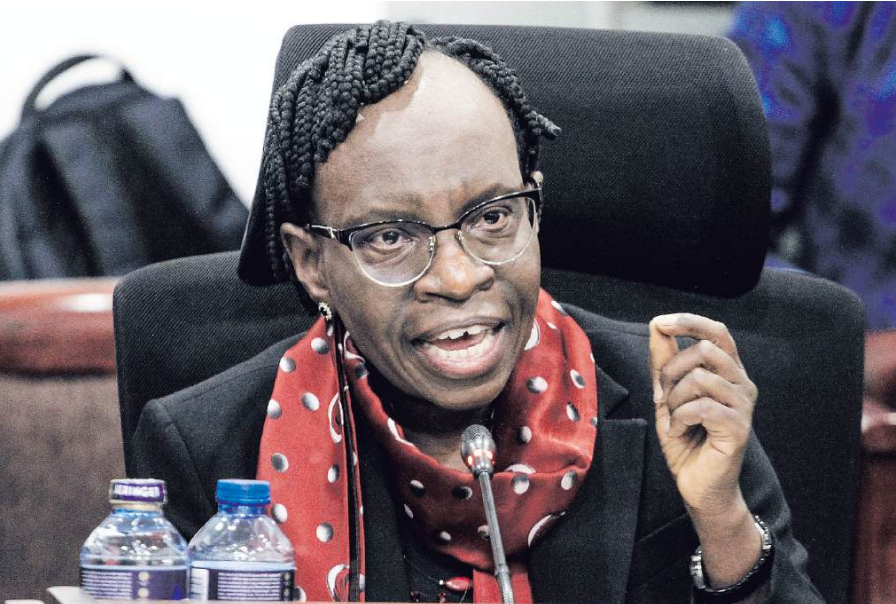
A new audit of political parties has highlighted concerns over financial management, weak internal controls, and possible breaches of the law.
Auditor General Nancy Gathungu, in a review covering the financial year ending June 30, 2024, pointed to irregularities in the handling of millions of shillings disbursed to political parties.
The audit cited inaccurate record-keeping, unsupported expenditures, and gaps in accountability in several parties’ books of accounts.
According to the report, the review scrutinised the financial statements of 45 political parties, identifying discrepancies amounting to Sh10.2 billion from the financial statements of 16 parties.
“These inaccuracies range from unreconciled cash flow variances to misstatements in the statement of financial positions and budget execution reports,” Gathungu noted.
Among the cases cited, Kanu was reported to have financial misstatements of Sh10 million, while Wiper Democratic Movement was flagged for Sh35 million. The report also mentioned Chama Cha Kazi (Sh4.1 million), Narc Kenya (now People’s Liberation Party) at Sh1.2 million, Kenya National Congress at Sh1 million, and the Party of National Unity at Sh3.5 million.
“These amounts undermine the reliability of financial information and raise concerns about transparency, accountability and governance in the use of public funds by the political parties,” the Auditor General observed.
Unverified spending
The audit further reported Sh22.4 million in unsupported expenditures across six political parties. These included staff allowances, workshop costs, and programme expenses without supporting documentation.
Kanu was cited for Sh15.7 million in unverified spending, while the United Progressive Alliance (UPA) and Wiper were reported at Sh2.6 million and Sh2.3 million respectively.
According to the report, some records, such as payment vouchers and salary structures, were not made available for audit.
In addition, unsupported debt payments totalling Sh42.8 million were flagged, with parties unable to provide invoices, supplier statements, or lease agreements. Kanu was noted for Sh37 million in supplier obligations, while the Democratic Party was cited for Sh1.5 million in trade payables.
“These balances were not accompanied by adequate documentation such as payment vouchers, invoices, supplier statements or lease agreements, rendering them unverifiable,” the report stated.
Procurement concerns
The audit identified procurement irregularities worth Sh16.3 million across 12 political parties. UPA, the Kenya Union Party, and Chama Cha Kazi were noted for significant procurement issues.
The People’s Democratic Party was flagged for making cash payments exceeding Sh2.3 million—above the legal limit of Sh50,000 per transaction. Other cited breaches included lack of procurement units, tender evaluation reports, and approved procurement plans.
Gathungu said that the absence of procurement plans created risks of mismanagement.
Seven parties were specifically noted as lacking procurement plans, including Chama Cha Uzalendo, Safina Party, United Democratic Party, Ford Kenya, and Maendeleo Chap Chap.
Legal compliance gaps
Beyond finances, the audit cited widespread non-compliance with legal requirements on establishing county offices.
Thirty-seven parties, including the ruling United Democratic Alliance (UDA), had not set up offices in at least 24 counties, as required by the Political Parties Act. ODM, led by Raila Odinga, was among the eight that had complied with the requirement.
At least 25 of the flagged parties had only one to five offices, while others lacked documentation to prove office existence.
UDA was reported to have 21 offices, Wiper 14, Green Thinking Action Party 11, Chama Cha Kazi 9, and The Service Party 9. Kanu was said to have five branches, UPA a similar number, while Ford Kenya had four. People’s Liberation Party had three.
The report also flagged three parties for exceeding the 30 per cent cap on administrative expenses from the Political Parties Fund.
In addition, UPA was cited for failing to remit statutory deductions such as PAYE, NSSF, and Social Health Authority contributions. Wiper was flagged for not accounting for VAT on rental payments.
Misleading disclosures
The audit further noted that seven parties failed to submit complete or accurate financial statements. Omissions included missing statements of changes in net assets, undisclosed member contributions, and unreported receivables.
For instance, the Communist Party of Kenya was cited for not disclosing the names and qualifications of its central committee, while Shirikisho Party of Kenya did not record member contributions as revenue.
Kanu and Wiper submitted unsigned annual reports, which auditors said weakened the credibility of disclosures.
“These findings point to a widespread failure to adhere to basic financial reporting standards,” Gathungu said.
Funding model concerns
The Auditor General also raised questions about the sustainability of political party funding, noting that heavy reliance on state support may not be sustainable in the long term.
During the year under review, disbursements from the Political Parties Fund amounted to Sh671.6 million, representing 62 per cent of the parties’ total revenue. Total income stood at Sh1.08 billion, with Sh393 million from contributions and donations, and Sh5.6 million from other sources.
Gathungu recommended immediate corrective measures, including mandatory training on financial and procurement laws, digitised record-keeping, and stricter enforcement of compliance as a condition for funding.
INSTANT ANALYSIS
The report underscores recurring challenges in party financing and compliance. Despite repeated audit findings, enforcement of sanctions remains limited. The Auditor General warned that without accountability and stronger oversight, lapses in financial management are likely to persist.






