John Kibati, a 56-year-old rice farmer in Murinduko, Kirinyaga county, is a disturbed man.
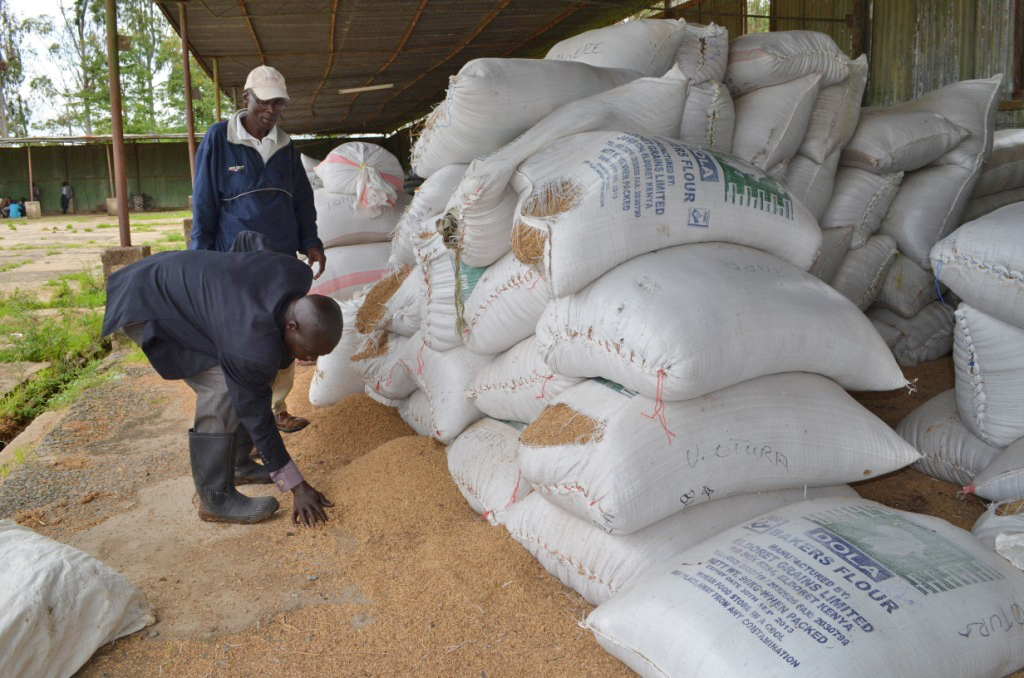
His three-bedroom house is no longer enough for his family and several bags of rice from the past two harvests.
“I hoped to sell my harvest to pay school fees for my daughters. I have several bags, both at home and at my cooperative society’s depot. It hurts to hear that the government is planning to import more instead of buying our stock,’’ Kibati tells the Star.
Another farmer, who identified herself as Wa Mugo, on the other hand, says that she is forced to sell in small quantities at a throwaway price, fearing that the value will drop further once imports flood the market.
“I sell a kilo for as low as Sh60 per kilo to brokers who are having a field day in Kirinyaga. The amount is insufficient to cover the production cost. I look forward to a day when rice farmers in this country will be listened to.”
A spot check by the Star shows that while farmers sell their produce at a throwaway price, imports are sold at a high rate, with a two-kg packet of Daawat Delli Basmati, for instance, going for Sh560 while the same quantity of Sunrice Basmati retailing at an average price of Sh740.
Ndege Muriuki is a key figure in the Mwea rice farming community in Kenya, serving as the chairman of the Mwea Rice Growers Multipurpose Co-operative Society.
He has been actively involved in addressing challenges faced by rice farmers, particularly regarding the disposal of their harvest and the impact of rice imports.
"It is true we have so much rice in our stores which has not been sold and it may go to waste if urgent measures are not taken. We have at least 5,000 tonnes," he said.
The farmers called on the government to intervene so that they would not incur heavy losses.
Ndege noted that the Kenya National Trading Corporation, which was directed by the government to buy rice at Sh85 per kilogramme since 2022, has kept away from the area.
The KNTC is not purchasing rice the way it used to do and farmers are suffering," he said.
The Mwea Irrigation Scheme is Kenya's largest rice-producing area, with over 7,000 farmers contributing to the national rice supply.
On Friday, Agriculture CS, Mutahi Kagwe, warned that the country is staring at a possible spike in food prices and an acute rice shortage if the courts uphold a petition seeking to block the importation of 500,000 tonnes of duty-free rice.
According to Kagwe, Kenya’s annual demand for rice stands at about 1.3 million tonnes against a domestic production of just 20 per cent, leaving a deficit of more than 80 per cent, roughly 1 million tonnes, that is bridged mainly through imports.
He warned that the current retail price of Grade 1 milled white rice has already surged to between Sh190 and Sh220 per kilogramme, a steep rise from last year’s duty-free period average of Sh150 per kilogramme.
“If duty-free imports are blocked, the prices are likely to soar further, deepening the cost-of-living crisis,” Kagwe said.
Kagwe noted that projections showed that Kenya’s rice consumption per capita in 2025 is expected to reach 29kgs, with the population estimated at 54.79 million.
This, he added, translates to a national requirement of about 1.5 million tonnes of rice for the year, or roughly 125,000 tonnes per month.
The country will need about 625,000 tonnes between July and December 2025 alone.
The Ministry of Agriculture disclosed that a 2020 presidential directive designated the Kenya National Trading Corporation as the lead agency to mop up excess locally produced rice for supply to government institutions, a policy that has since paid Mwea farmers Sh2.6 billion for 18,500 tonnes of pishori rice and another Sh948 million to Sindano rice farmers for 7,900 tonnes.
He stressed that over 95 per cent of imported rice is non-basmati and therefore does not compete with the high-value pishori grown locally, which targets a niche market.
“Previous importations have not depressed prices. They have stabilised them,” Kagwe said, warning that without imports, shortages could push consumers to maize, wheat and potatoes, triggering a chain reaction of food price hikes.
Economic Survey 2025 indicates the area cropped in rice schemes increased from 38,942 hectares in 2022-23 to 43,057 hectares in 2023-24.
Consequently, the number of plot holders increased from 27,812 in 2022-23 to 29,108 in 2023-24. Payment to plot holders increased by 13.0 per cent, to Sh11.8 billion compared to Sh10.5 billion in 2022-23.
Paddy production recorded a growth of 23.2 per cent to 282.2 thousand tonnes in 2024, primarily due to the expansion of acreage under irrigation.
During the period under review, Taveta clusters, Anyiko, Kimira, Oluch and Nanundu Manya were looped into rice production through the support of the National Irrigation Authority in rehabilitation of the existing irrigation infrastructure and construction of new structures to support rice production.
Paddy production from the Bura irrigation scheme declined by 38.0 per cent to 5,600 tonnes in 2023-24 because of drought during the year.
The Tana irrigation scheme also recorded a decline in paddy production from 4,942 tonnes in 2022-23 to 3,440 tonnes in 2023-24.
The drought severely affected the River Tana water flow, which affected water intake in the Bura irrigation scheme, leading to decreased acreages under production as well as the yields.
Kenya imports the majority of its rice from India and Pakistan. Other markets include Thailand, Tanzania and Myanmar. In 2023, India accounted for 68 per cent of Kenya's rice imports, while Pakistan accounted for 26 per cent.
Several politicians, mostly drawn from the opposition, have joined farmers to oppose the import.
Irungu Nyakera, Farmers Party leader, is one of the politicians who have called out the state’s plan to import a sizeable bulk of rice.
In a press statement dated August 11, Nyakera praised the court for halting the importation of 500,000 tonnes of duty-free rice worth over Sh50 billion.
“This is a win for our farmers, our economy and our sovereignty. God bless the Farmers Party and its bold leadership. We shouldn't import cheap rice when our rice is rotting in stores,’’ Nyakera said.
Opposition leaders Martha Karua (PLP), Eugene Wamalwa (DAP-K) and Kalonzo Musyoka (Wiper) have slammed the plan, calling it a “scheme to swindle billions” through shadowy cartels.
Speaking at a press event, Karua accused the current administration of orchestrating systemic harm to both the economy and citizens.
Kirinyaga Governor, Anne Waiguru, is also opposed to the import plan until the government buys all local production.
Waiguru said while it is understandable that the country does not produce enough rice to meet the national demand, it is only imperative that priority is given to local rice farmers.
She warned that the planned importation of 500,000 tonnes of milled white rice announced in a notice by Cabinet Secretary for the National Treasury, John Mbadi, would hurt Mwea rice farmers.
“Before you import rice from outside, just note that our stores are full of rice and we ask that you first buy that one and then import to meet the deficit,” she said, noting that as a governor, she cannot sit back and watch farmers from the county suffer.
This is not the first time the government has been fighting with farmers over food importation.
Last year, the government imported 500,000 tonnes. Three months later, after it emerged that a consignment totaling two million kilogrammes, which had been declared unfit for human consumption, was diverted into the market.
Documents obtained from the Kenya Bureau of Standards show that the rice that was imported from Pakistan in September and October had failed the aflatoxin tests as it contained higher levels than locally permissible.