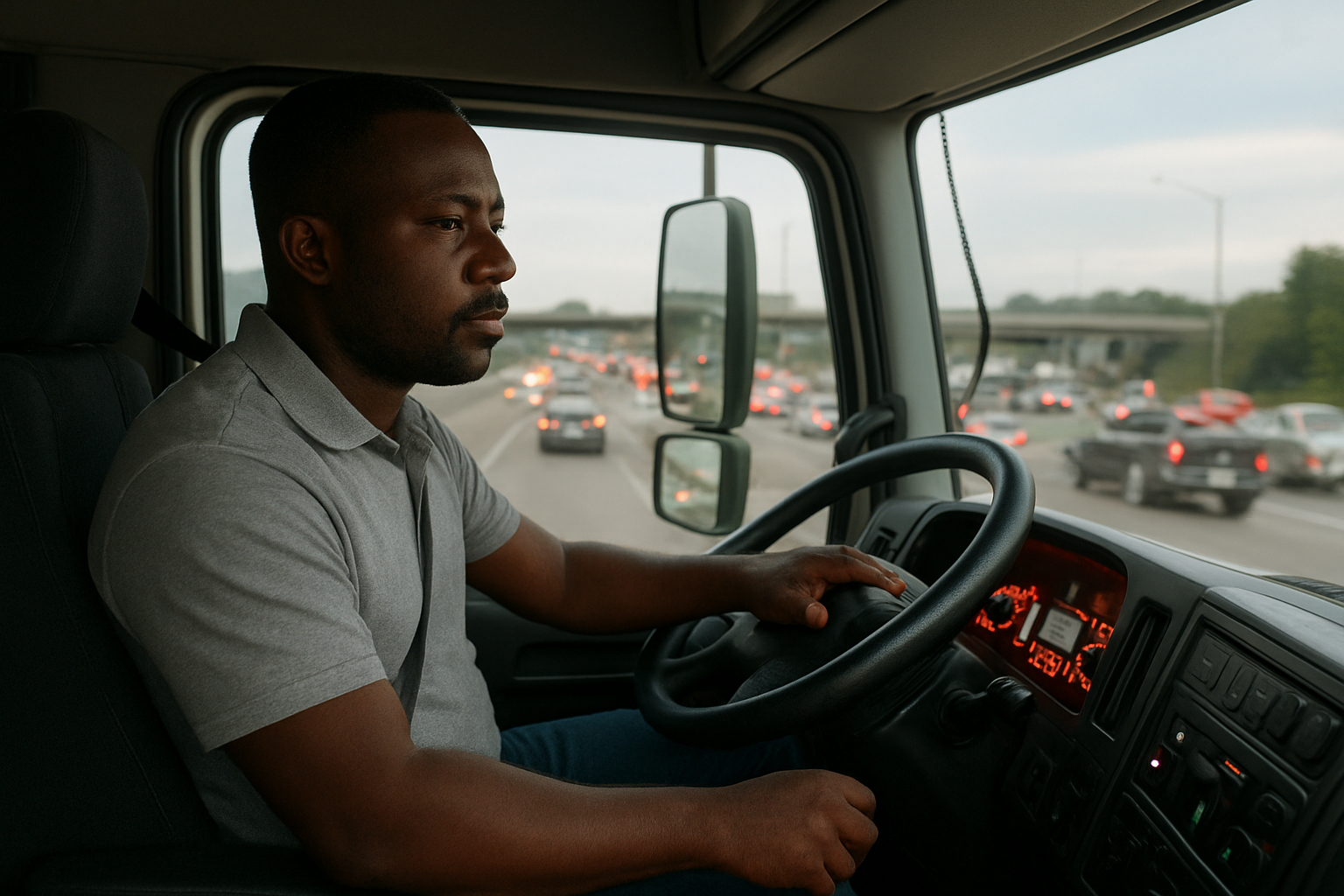
 AI generated image of a driver in a lorry cabin.
In the wake of a spate of deadly road accidents across the country this August, the government is turning to technology to tackle what has become a persistent national tragedy.
Transport Cabinet Secretary Davis Chirchir announced that long-distance trucks and passenger vehicles will soon be fitted with telematics devices to monitor driver behaviour and vehicle performance in real time.
“It is unfortunate that we have lost so many lives in the recent week. We are going to employ more technology to assist drivers on the road. For those driving for many hours, we will deploy telematics in the drivers’ cabins,” the CS said while appearing before the National Assembly Committee on Transport on Thursday, August 14.
Chirchir explained that the devices will track critical parameters such as speed, braking patterns, engine performance, and driver alertness, helping to identify fatigue-related risks before they escalate into crashes.
He added that the government will also intensify mechanical checks for cars, lorries, and buses, working with licensed private operators to make inspections more efficient and accessible.
The urgency of this move is clear. In the past week alone, nearly 50 people have lost their lives in road accidents in different parts of Kenya.
The deadliest occurred on August 8 at the Coptic Roundabout in Kisumu, where a bus ferrying mourners veered off the road and landed in a ditch, killing 26 people.
Investigations revealed the driver lost control while negotiating a bend.
Just a day earlier, nine people died when a Kenya Pipeline Company staff bus collided with a Kenya Railways cargo train at a railway crossing in Morendat, Naivasha.
The bus was carrying 32 employees coming off a morning shift.
What is a Telematics Device Tracker?
A telematics device tracker is essentially an intelligent monitoring system installed in a vehicle that records, analyses, and transmits data on how that vehicle is being driven.
The word “telematics” blends “telecommunication” and “informatics” and refers to the use of communications technology to collect and process information remotely.
The device typically consists of a hardware unit fitted in the driver’s cabin, equipped with sensors, a GPS receiver, and sometimes cameras.
These components work together to track location, speed, acceleration, braking patterns, and engine performance, and in some models, to detect driver fatigue through facial recognition or steering patterns.
Once installed, the telematics device continuously collects information and transmits it to a central platform via mobile networks or satellite links.
This allows data to be viewed in real time by fleet managers, transport companies, or even government regulators.
In some cases, the system also feeds information back to the driver, issuing audible or visual alerts when unsafe driving behaviours such as overspeeding, harsh braking, or prolonged driving without rest are detected.
In this way, the technology functions like a black box for vehicles—recording and reporting key data that can be used both for immediate safety interventions and for longer-term behavioural change.
How Does It Work?
Telematics devices have a wide range of capabilities.
They can monitor driver behaviour, track the health of the vehicle, and send automatic crash alerts with precise location data to emergency responders.
They can also set virtual boundaries, known as geofences, to ensure a vehicle stays on an approved route, and can generate detailed reports that help identify training needs for drivers.
In Kenya’s case, the government hopes the technology will play a critical role in reducing accidents caused by driver fatigue, overspeeding, and poorly maintained vehicles.
Why Does It Matter?
Kenya’s road safety record has been worrying for years, with human error and unroadworthy vehicles cited as the leading causes of fatal crashes.
According to the National Transport and Safety Authority, human error accounts for more than 80 per cent of road accidents in the country.
Telematics can address this problem in several ways.
The benefits of such technology are well-documented globally.
In South Africa, insurance companies offering telematics-based policies have recorded significant drops in high-risk driving incidents among clients.
In the UK, commercial fleets using telematics have cut accident rates by as much as 40 per cent, largely due to improved driver coaching and accountability.
Australia’s mining and logistics sectors have reported over 50 per cent reductions in fatigue-related accidents after introducing systems that monitor driver alertness, while in India, state-run transport corporations fitting buses with telematics have seen a noticeable decline in overspeeding and improved punctuality.
For Kenya, the potential impact could be transformative.
By providing a constant stream of accurate, real-time data on how vehicles are being driven, telematics could help curb reckless behaviour, identify mechanical faults before they lead to breakdowns, and ensure that drivers adhere to safety regulations.
It also creates a culture of accountability, as both drivers and vehicle owners know that their actions are being monitored and recorded.
However, the introduction of telematics is not without challenges.
The cost of purchasing, installing, and maintaining the devices could be a barrier for some transport operators, particularly smaller businesses.
Data privacy is another concern, requiring clear regulations on who can access the information and how it is stored.
The success of the system will also depend on the government’s ability to enforce rules and respond quickly to data alerts, as well as on the public’s understanding that the technology is intended to save lives rather than merely police drivers.
The recent tragedies in Kisumu and Naivasha have underscored the urgent need for effective solutions to Kenya’s road safety crisis.
With nearly 50 lives lost in a single week, the deployment of telematics technology may represent a turning point.
If properly implemented, it could give authorities the tools they need to intervene before accidents happen, while also driving a shift in attitudes towards safer, more responsible road use.
As CS Chirchir made clear, technology may now be Kenya's most important ally in the fight against road carnage, offering the potential not just to track the problem but to change the behaviour that causes it.
He said the government will be counting on a whole-of-society approach to maximise on the benefits of the telematics gadgets where private players other than the government will certify the roadworthyness of vehicles.
Chirchir stressed the need for all road users to take personal responsibility saying safety is a shared duty and not a preserve of the government.