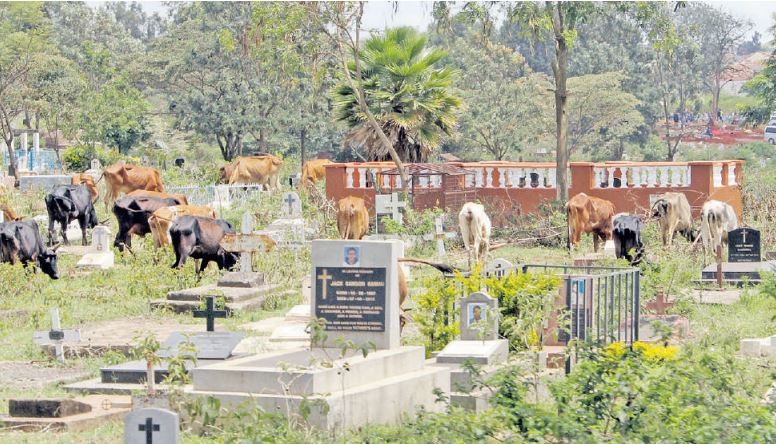
The dead at Lang’ata Cemetery can get anything else but peace and rest.
If developers are not ripping their coffins and graves with excavators constructing new projects, the newly dead are being piled over them due to lack of space—or the metal bars surrounding their graves, as well as tombstones and crosses, are getting stolen by vandals scavenging for scrap metal.
Watchmen at the facility say they only pay specific attention to graves whose families pay up for extra protection. The dead here are literally alone.
Families with loved ones interred at the facility recounted to the Star their raw pain of double loss: death of their loved ones and defilement of the integrity of their memories.
And to depict an ongoing, perhaps lifelong pain, most of them requested anonymity, fearing that divulging too many details could make the graves vulnerable to further defilement.
Take the case of MW. Her only son died suddenly of misdiagnosed pneumonia in November 2019, and to retain his memory, she not only bought a site for a permanent grave for her boy at the cemetery, but also a space for her own grave beside his.
A journalist and communication consultant, the son was 32 at the time of his death.
“I want to rest beside him when my time comes, even though I will be cremated,” MW says.
To secure the space and the grave, she had the grave plastered, cast and painted with a tapestry of colours. She also fenced the space with metal bars and put up a blue bench beside it—on the space her ash remains will be interred.
For six years, she has visited the gravesite four times a year to spend time with her boy—sitting by, gazing into the blank future, refreshing the memories she had with him, relieving the emotion of his untimely death at the hands of medical negligence and juxtaposing them with the lonely life she now has to contend with.
“The gravesite is the only company I have now, and it is unspeakably precious to me,” she said in a phone interview.
In fact, so precious that she asked the watchmen at the facility to keep an eye on it specifically.
But now, the memory of her boy is getting defiled—one metal rod at a time.
Vandals have descended on the grave and carted away three sides of the metal bars around it, as well as the bench.
“They have defiled my son. It is a pain no one wants to feel,” she said.
She paid Sh120,000 at the time to be allowed to bury him in the section of the cemetery that permits permanent structures.
“According to the agreement, no one will come and bury on top of my son—and on top of me—once I’m gone,” she said.
For James Muriuki, every year on his daughter’s birthday, he carries a foldable chair, a thermos of tea and a small radio to a corner of the cemetery. He sets them down beside her grave and spends the day there—talking to her, playing her favourite childhood songs, and sometimes, just crying in silence.
His daughter died in 2015, aged 25, from injuries sustained in a hit-and-run incident. She was a postgraduate student at the University of Nairobi. A retired teacher, Muriuki bought a private burial space for her and had the grave marked with a marble headstone and surrounded it with a low stonewall engraved with verses from the Psalms.
“This is where I feel closest to her,” he said by phone. “Not the house. Not her room. Beside her. This earth is soaked with my tears.”
Last month, he arrived to find the headstone cracked and the engraved verses barely legible after a section of the grave had collapsed. Someone had tried to dig into the site. He says it felt like burying her all over again.
For Mary Bogonko, her sister’s grave in Lang’ata cemetery is the only place where her family still gathers without argument.
Her sister, Kwamboka—who died by suicide in 2018—had long been the glue of the family: soft-spoken, generous and loyal. Her sudden death broke her in ways words cannot explain.
Determined to preserve her sister’s dignity, Bogonko, the elder sibling, turned the grave into a quiet garden. She planted white lilies and red hibiscus at the site and returns every second Saturday with fresh water to tend to the plants.
But late last year, someone uprooted the flowers and stole the iron nameplate from the head of the grave.
“It’s like erasing her name from the world,” she said, her voice cracking.
She now carries a small handwritten placard each time she visits, placing it where the nameplate once stood.
“So she is not forgotten,” she said.
For MAO, he never got to say goodbye. His father died during the Covid-19 lockdowns, and he—stuck abroad in Australia—watched the funeral over a choppy livestream. His father was buried at the public facility, thankfully, in the permanent graves section.
When he returned a year later, he bought a plot next to his father’s grave—his own future resting place.
Every Sunday, he drives from Kiserian to the cemetery, parks under the old jacaranda tree and walks to the grave with a newspaper and two thermoses—one with coffee for himself, the other symbolic for his father.
“I come here to speak the words I couldn’t when he was dying,” he says. “I read the headlines to him. It makes no sense, but it gives me peace,” the 39-year-old father of two says.
That peace was shattered last week when he found the wrought-iron cross he had installed stolen and the small ceramic portrait of his father smashed.
“Defiling the dead is a kind of violence,” he said. “The cemetery is not just a place of bones. It's a place of love.”
City Hall concedes the place is not just crowded with the dead but also poorly manned.
Tom Nyakeba, the public health chief officer in Nairobi county, confirmed that the dead at the overstretched public cemetery are too many to be guarded—meaning security at the facility is not guaranteed.
“The place is very expansive. It is almost 120 acres, and we don’t have enough security officers to guard it. It is also not fenced, meaning there is easy access by anyone,” he said.
He added that the cemetery only has five guards but that efforts were being made to shore up surveillance, including engaging the National Police Service for patrols.
“We are now having arrangements for NPS officers to patrol it, but it is an uphill task.”
He conceded that vandalism of graves has been the order of the day at the cemetery—but that the trend has declined.