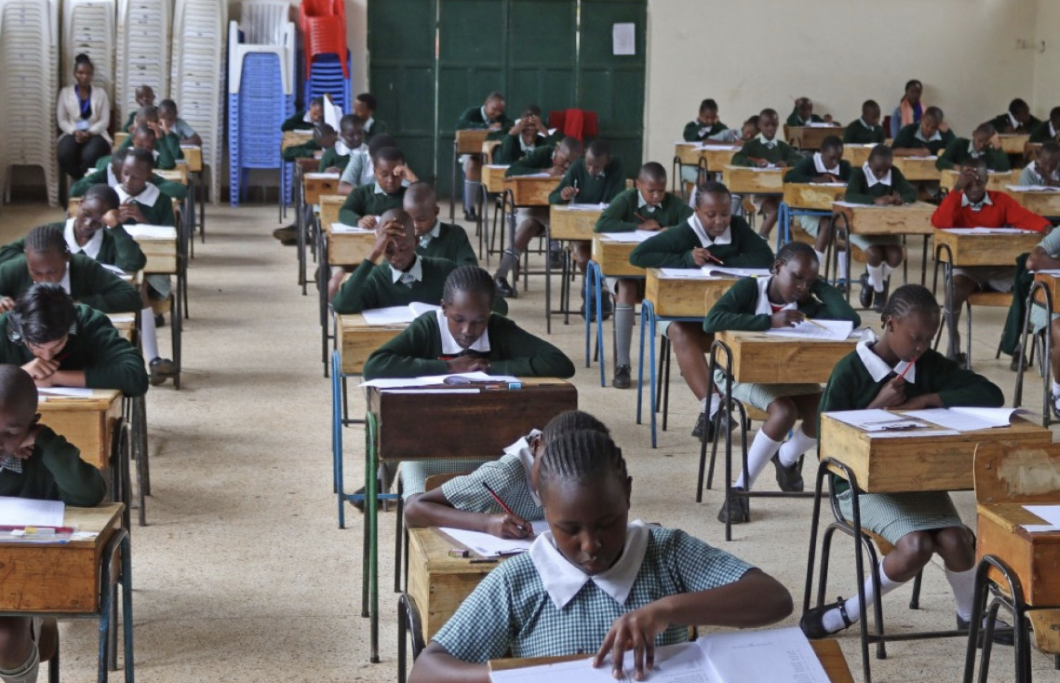
 Learners sit a previous class assessment under the Competency-Based Education. /FILE
Senior School represents the fourth level of basic education under the CBE system, following Pre-Primary School (PP1 and PP2), Primary School (Grades 1 to 6), and Junior School (Grades 7 to 9).
Senior School comprises Grades 10 to 12 and typically caters to learners aged between 15 and 17 years.
At this stage, the CBE is designed to provide learners with a pre-tertiary, pre-university, or pre-career experience.
It allows learners to select subjects from specific pathways in which they have demonstrated interest or potential during their earlier education.
The three subject pathways are Science, Technology, Engineering and Mathematics (STEM), Arts and Sports Science, and Social Science.
Learners at Senior School are required to take seven subjects in total, as recommended by the Presidential Working Party on Educational Reforms (PWPER, 2023).
Among these seven subjects, four are compulsory across all pathways.
These compulsory subjects are English, Kiswahili (or Kenya Sign Language), Community Service Learning (CSL), and either Core Mathematics or Essential Mathematics, depending on the learner's pathway.
All learners must take English, Kiswahili, and Community Service Learning (CSL).
Those following the STEM pathway are required to take Core Mathematics, whereas learners in the other two pathways must take Essential Mathematics.
However, if a learner outside the STEM pathway wishes to take Core Mathematics, this should be allowed if justified by their assessment results from Junior School.
Beyond the compulsory subjects, learners are supposed to choose three additional subjects.
Flexibility is permitted when a learner's anticipated career requires subjects spanning multiple pathways.
It is recommended that at least two of these subjects come from the learner's chosen pathway to align with their career interests and aptitudes.
A learner may also opt to take all three additional subjects from their pathway or take two from their pathway and one from another pathway.
Selection of one subject from each pathway is also permitted.
In a circular to regional, county and subcounty directors of education, CS Julius Ogamba said the choice of subjects should be guided by the learner’s career aspirations, aptitude, interests, and personality, with proper guidance from the school leadership.
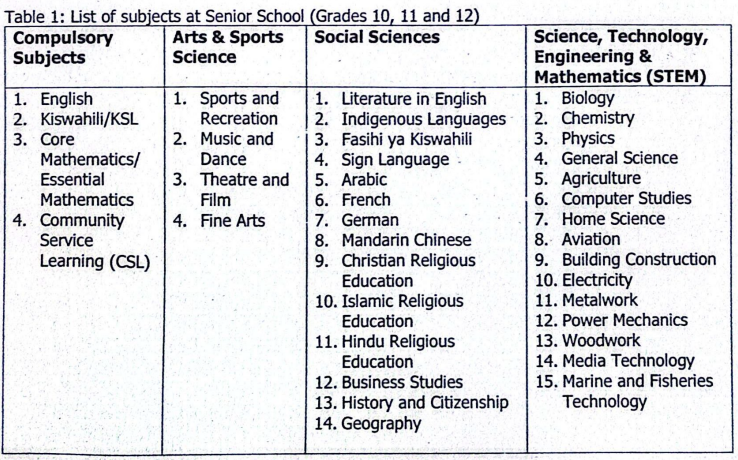 List of subject choices in Senior School. /EDUMIN
Ogamba said the curriculum designs for all subjects offered at Senior School have been developed by the Kenya Institute of Curriculum Development (KICD).
The complete list of subjects available at Senior School is categorised by pathway.
The compulsory subjects include English, Kiswahili or Kenya Sign Language (KSL), Core or Essential Mathematics, and Community Service Learning.
The Arts and Sports Science pathway offers subjects such as Sports and Recreation, Music and Dance, Theatre and Film, and Fine Arts.
The Social Sciences pathway includes Literature in English, Indigenous Languages, Kiswahili Literature (Fasihi ya Kiswahili), Sign Language, Arabic, French, German, Mandarin Chinese, Christian Religious Education, Islamic Religious Education, Hindu Religious Education, Business Studies, History and Citizenship, and Geography.
The STEM pathway covers Biology, Chemistry, Physics, General Science, Agriculture, Computer Studies, Home Science, Aviation, Building Construction, Electricity, Metalwork, Power Mechanics, Woodwork, Media Technology, and Marine and Fisheries Technology.
"Physical Education (PE) and Information Communication and Technology (ICT) will be offered to all learners to facilitate learning and acquisition of life skills," Ogamba said.
Furthermore, all schools must offer a Pastoral/Religious Programme of Instruction (P/RPI) to promote learners’ moral, spiritual, and character development.
However, schools should not force learners to take part in religious rites or activities that contradict their personal beliefs.
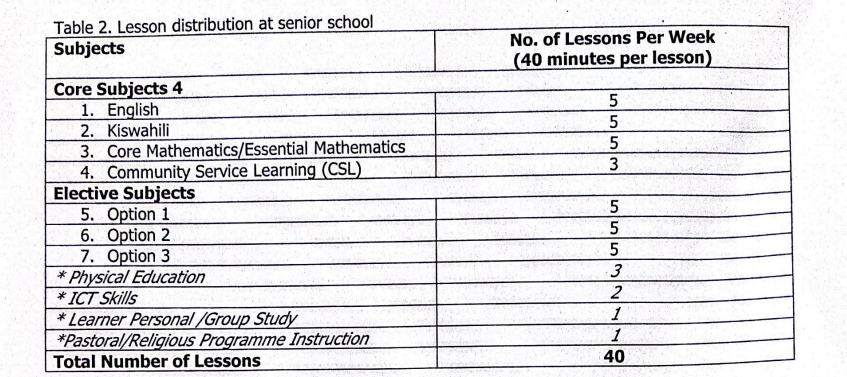 Lesson distribution in Senior School. /EDUMIN
In terms of lesson allocation per week, a total of 40 lessons of 40 minutes each are prescribed.
Core subjects (English, Kiswahili, Core or Essential Mathematics, and Community Service Learning) are allocated a total of 18 periods per week.
Each of the three elective subjects receives five lessons weekly, summing to 15 lessons.
The timetable also includes lessons for Physical Education (3 lessons), ICT Skills (2 lessons), Learner Personal or Group Study (1 lesson), and Pastoral/Religious Programme Instruction (1 lesson).
Ogamba instructed county directors of education to communicate the information to all Quality Assurance and Standards Officers as well as Principals of Senior Schools within the respective jurisdictions to ensure full implementation.
Additionally, the Departments of Technical and Vocational Education and Training (TVET) and Higher Education have been advised to review and align their courses in preparation for the first cohort of CBE students expected to join tertiary education by 2029.