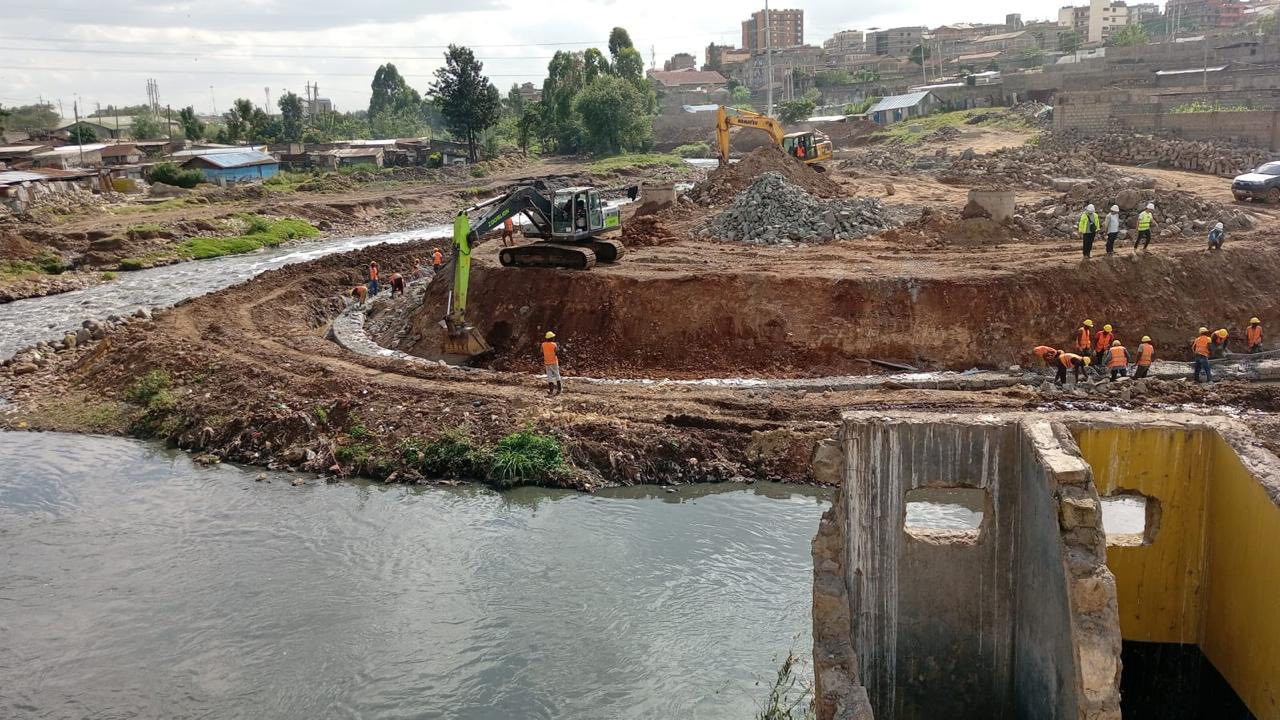
Ongoing works at Lucky Summer/Courtesy
The Nairobi River is currently undergoing a significant transformation as the government intensifies its efforts to clean and restore the 27-kilometre stretch of the heavily polluted river corridor.
This initiative, spearheaded by the Nairobi Rivers Commission, includes the alignment of a new trunk sewer line as part of a broader endeavour to reclaim the river and convert it into a clean, green and vibrant urban space.
On Wednesday, commission CEO Brigadier Joseph Muracia announced that projects are already in progress, including vital river engineering works downstream near Lucky Summer.
“For decades, the river has been choked by solid waste, ageing sewer infrastructure, and untreated industrial and institutional waste. This project aims to change that,” Muracia said.
The overarching vision is to redefine the Nairobi River as a crucial public asset—an urban waterfront that enhances quality of life, supports biodiversity and provides sustainable water resources.
The regeneration efforts are being implemented through the Nairobi River Regeneration and Engineering Works Programme, which was launched in March by President William Ruto.
The comprehensive plan seeks to reclaim the Nairobi River and its basin through a combination of infrastructure upgrades, environmental protection, and community engagement.
Key components of the plan include a new sewer system, wastewater treatment plants, pedestrian bridges, cycle lanes, landscaping and affordable housing along the reclaimed corridor. At Kamukunji, the construction of a football pitch and a community hall is already underway.
The Ministry of Defence is overseeing the design and execution of the project, collaborating with government agencies including the commission, Nairobi county, the State Department for Housing, Nairobi Water and Sewerage Company and Energy China.
According to Muracia, more than 35,000 young people have been involved in cleanup efforts, with an additional 5,000 expected to join soon. These youth are part of the Climate WorX initiative, which aims to empower communities while tackling climate and environmental challenges.
During the project’s launch, Ruto described the Sh50 billion regeneration initiative as transformative, promising cleaner living environments, safer transportation corridors, and improved livelihoods for thousands of residents. The project is anticipated to create 40,000 jobs, significantly expanding on the 22,000 previously generated under the Climate WorX Mtaani initiative.
“This initiative will ensure dignified living, sustainable transport, and economic empowerment,” Ruto said. “In 24 months, Kenyans will begin to see a transformed Nairobi River.”
Stretching beyond the city’s boundaries into Kiambu, Kajiado, Machakos, Murang’a and Makueni counties, the programme will address issues such as river pollution, flood mitigation, urban resilience, and public health risks. It includes the construction of a 60km sewer line and 50,000 affordable housing units in reclaimed areas.
In the 2025/26 national budget, Treasury CS John Mbadi allocated Sh26.8 billion to water and sewerage infrastructure, Sh16.5 billion to water resource management and Sh1.9 billion to flood control and water storage. These funds will support both the river regeneration and other national water projects.
An action plan developed last year estimated that Sh7 billion is needed to remove solid and liquid waste along the Nairobi River alone. However, a full recovery strategy over six years is projected to cost up to Sh20 billion. Of this, Sh3 billion will go toward rehabilitating dumpsites and employing youth for cleanup efforts. The funds will also support the procurement of machinery, fuel, personnel and the setup of material recovery sites.
The budget breakdown across counties is as follows: Nairobi (Sh900 million), Kiambu (Sh486 million), Kajiado (Sh516 million), Machakos (Sh647 million), and Makueni (Sh433 million).
To improve the sewerage infrastructure, Sh4.9 billion has been earmarked for upgrading old lines, creating new connections, and building faecal sludge management points. Kiambu will receive the largest allocation at Sh2 billion, followed by Nairobi (Sh964 million), Kajiado (Sh725 million), Machakos (Sh304 million) and Makueni (Sh450 million).
The Water Resources Authority will install beacons to prevent future encroachment into riparian areas, with an additional Sh62 million set aside for geospatial mapping and Sh3 billion allocated for drainage and hydrological improvements. Other budget items include Sh9 billion for catchment protection, and Sh11 million to address industrial and institutional waste.
As Muracia emphasised, “This is not just a clean-up project. It is a bold transformation of how Nairobi—and the surrounding counties—interact with their rivers.”
Instant analysis
The Nairobi River regeneration marks a bold shift in urban environmental policy, combining infrastructure overhaul, community involvement, and climate resilience. With Sh50 billion allocated, the project aims to transform the polluted river into a vibrant urban corridor, integrating social housing, sewer systems and public spaces. It engages over 35,000 young people, creating jobs while restoring ecosystems. However, success hinges on sustained political will, inter-agency coordination, and transparency in budget execution. If delivered effectively, the initiative could become a model for urban river restoration across Africa—addressing pollution, flooding and informal settlements while enhancing livability in a rapidly expanding capital.