
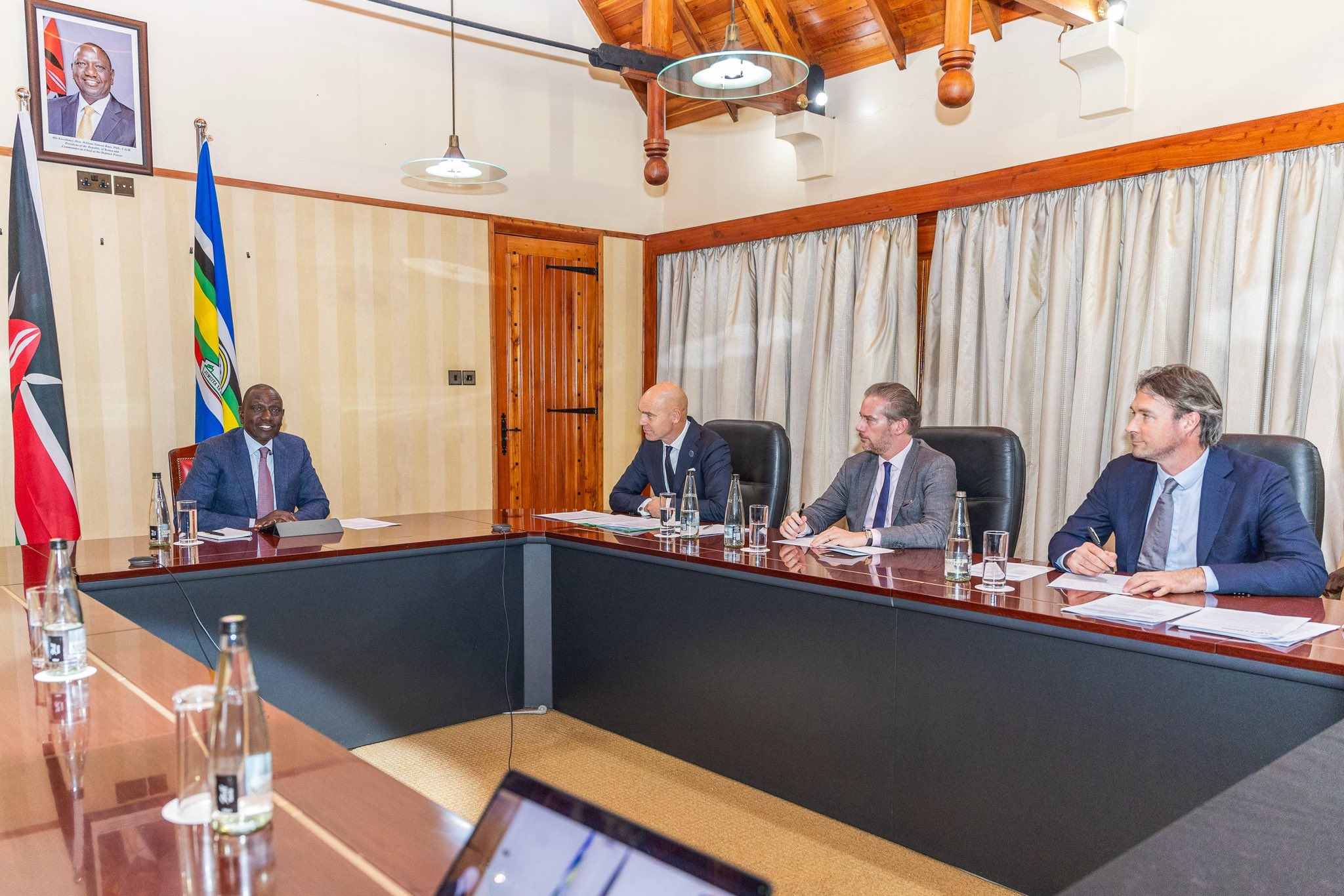
 President William Ruto hosts Global Centre on Adaptation president and UoN Chancellor Prof Patrick Verkooijen at Sagana State Lodge on April 1, 2025/ PCS
 The government’s decision to grant diplomatic privileges and immunity to yet another international non-governmental organisation has sparked criticism and concern.
Through Legal Notice No 82 of 2025, the government conferred diplomatic status on the Global Centre for Adaptation (GCA), effectively exempting it from certain local laws and to some extent, placing it beyond the jurisdiction of Kenyan courts.
The notice, which took effect on May 2, states that GCA—an international organisation established to accelerate climate adaptation action—will enjoy these privileges after signing a cooperation and hosting agreement with the government.
GCA is headed by Prof Patrick Verkooijen, who was appointed by President William Ruto as Chancellor of the University of Nairobi in January.
On April 1, the organisation announced it would establish its second dual-headquarters in Nairobi during its board meeting hosted by the President at Sagana State Lodge.
The privileges extend to exemption from taxes on goods and services imported or purchased locally for official use or export, as well as duty-free importation of the organisation’s publications.
Furthermore, its director, officials and staff will benefit from privileges and immunities.
These include immunity from legal proceedings for actions undertaken in the course of official duties, exemption from direct taxation on salaries and emoluments and immunity from national service obligations.
Additional benefits include exemption from immigration controls and alien registration for officers, their spouses and dependants; repatriation assistance during international crises; andtax-free importation of furniture, personal property and household items for staff taking up posts in Kenya.
However, foreign policy observers have raised concerns—especially as the move comes just months after the High Court in November suspended a similar grant of privileges to the Gates Foundation.
International lawyer Dr Owiso Owiso said the controversy surrounding the now-revoked Gates Foundation order—and subsequent court cases at the High Court and the East African Court—highlight a troubling lack of transparency and accountability in how Kenya grants immunities to non-governmental organisations.
“As a matter of international law, immunity from legal process is generally reserved for sovereign states,” he told the Star.
“Even then, this immunity is not absolute. State entities are only accorded immunity for sovereign or governmental acts, but can be subject to domestic legal process for commercial, private, or other acts.”
Owiso acknowledged that limited immunities—such as tax exemptions—may be necessary to facilitate the operations of non-profit organisations, but warned that such privileges should be narrow and well-justified.
“These should be restricted only to those necessary to facilitate the accountable and effective performance of their activities,” he said.
He emphasised that while the Privileges and Immunities Act empowers the Cabinet Secretary for Foreign Affairs to grant immunities, this power must be exercised in accordance with constitutional principles of accountability, publicparticipation and transparency.
“This authority is not unilateral and cannot be exercised by fiat [a decree or authoritative order],” he said.
According to Owiso, the Act requires a formal agreement between the organisation and the government, specifying the activities the agency intends to undertake and the scope of cooperation.
Under Articles 10, 35, and 232 of the constitution, the government is obligated to publish such agreements both in draft form and upon finalisation.
He added, “Kenya’s current approach is unconstitutional, is unknown in international law, isdangerous and poses a real risk to the sovereignty of the people of Kenya.”
Lawyer Evans Ogada noted that Kenya should be extra careful considering sovereignty, reciprocity and global power balance.
Ogada pointed out that absolute immunity with regard to the legal processes is untenable.
Kenyan registered NGOs and African NGOs would not have such a level of immunity in the West, where INGOs are registered, thus lack of reciprocity.
"We have, as Africans, been moaning about the skewed balance of power globally, to our disadvantage. We will be compounding such imbalance structures by granting such heretic immunities," the lawyer said.
A separate foreign affairs commentator, who asked not to be named, argued that the root of the problem lies in the Privileges and Immunities Act itself, calling for a comprehensive review of the law.
“The Act itself should be the next to be challenged. Otherwise, it will be a game of whack-a-mole every time it is used to confer legal immunities, especially to INGOs,” the analyst said.
Popular social media commentator Shoba Gatimu also weighed in on the issue via his X account, triggering a wave of online reactions.
“Accelerating action and support for Adaptation Solutions has to do with carbon credits, carbonremoval and adaptation,” Gatimu posted.
“Why does a broker organisation that deals with such things need all those privileges and immunities? And why is this information not widely available, given that it will touch on land owned by Kenyans?”