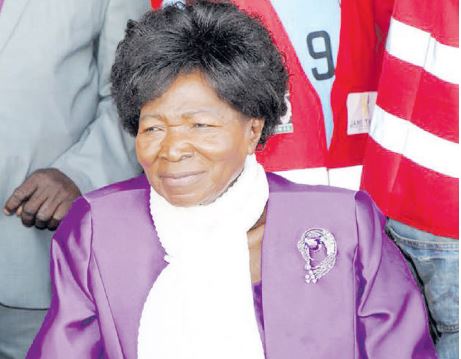
 Veteran politician Phoebe Asiyo /FILE
As the country comes to terms with the loss of Phoebe Muga Asiyo, who passed on peacefully in North Carolina USA last Thursday, many recall with awe her immense contributions as a matriarch whose brave resolve to have women get a significant voice is viewed with satisfaction with a stride of achievements.
Popularly referred to by her admirers as ‘Nyar gi Opande’ (the Opande’s daughter), Phoebe had come from a rich background. Born in 1932 to a prominent and respected Luo elder, her father Pastor Joel Omer was amongst the first Adventist evangelists in the greater South Nyanza region where the church had a huge presence.
Pastor Omer succeeded Jaramogi Oginga Odinga as the chairman of Luo Union East Africa to the position known as ker (president) in 1957.
Her husband, Richard Asiyo, became the pillar of her life as he supported her while serving in various capacities in public life.
Like her close friend and contemporary Grace Monica Onyango, who became the first woman mayor in East Africa as mayor of Kisumu, Phoebe was the first African woman to be elected as chairperson of the Maendeleo Ya Wanawake Organisation in 1958.
This was no mean achievement, since her election to the post was fiercely contested by four white women sitting on the Board. But Phoebe navigated that storm at the heights of racial discrimination.
Her efforts later saw the organisation evolving into a giant movement that gave women a voice and recognition in terms of women gender empowerment.
Phoebe became the first African to occupy the position of Senior Superintendent of Prisons at the turn of Independence in 1963, where she led numerous reforms, especially seeing to the improvement of the conditions of inmates.
She was also instrumental in the mobilisation of the caucus of women and a movement she steered closely with her close network of prominent women friends.
Among them were the first woman mayor of Nairobi Margaret Kenyatta, Muthoni Likimani and Eda Gachukia.
Never one to shy away from any contest or obstacle, Phoebe entered into the murky waters of politics and against all odds, challenged the incumbent MP for Karachuonyo David Amayo during the parliamentary contest of 1979.
Before then Amayo had controlled the Karachuonyo politics like a colossus. He had won the seat in 1969 replacing Omolo Agar—then a shrewd political mobiliser and gifted with unmatched oratorical skills—and prevailed.
He repeated this in 1974 against prominent personalities that included key challengers like Amos Midamba, Gordon Sibuor, David Opar, Ochieng Maena, Odiayo Nyandega and Haggai Koyier.
Few gave Phoebe a chance against Amayo, whom many had regarded as invisible. It turned out to be one of the most closely contested duels, never witnessed in that region before.
Phoebe won and repeated the same with petitions filed against her. She floored Amayo again during the 1983 election.
Though she had a good campaign team headed by Adhu Awiti, the duels with Amayo drew interest and at one point as the campaigns shaped up, Jaramogi Oginga Odinga visited Kendu Bay – the ‘heart’ of Karachuonyo constituency.
As Jaramogi drove through the town, his message while waving a flywhisk was, “Go pass my greetings to Phoebe, the daughter of my longtime bosom friend Joel Omer if you see her.”
That message spread like bushfire and is believed to be one of the reasons for Amayo's defeat.
As a representative and while on the floor of the House, Phoebe became a strong voice, advocating for gender balance and the plight of the less privileged.
Her lonely onslaught in the House came after Grace Onyango—who passed her the baton—exited Parliament in 1979, following her loss to Ndolo Ayah.
Phoebe became one of the brave and critics of the excesses of the Kanu regime amongst members of the backbench.
She is remembered for a motion on Affirmative Action in April 1997, that though was defeated, drew a fierce debate on issues of gender balance.
Another of her motions—against the introduction and use of the harmful Depoprovera contraceptive by women—made her viewed as women’s voice in the House.
Phoebe opted not to run in the 1997 general elections, choosing instead to support her longtime chief campaigner, Awiti.
Vying on a NDP ticket, Awiti triumphed against Kanu’s Lazarus Amayo. He was also the younger brother to former MP Amayo.
Phoebe later ventured into supporting women groups and served various international bodies, namely UN, UNIFEM, UNDP and CIDA.
She was the first woman named as a Luo elder by the council in 2009.
When Kenyans honour great mothers with an unrivalled contribution to the nation, the name Phoebe Asiyo will definitely find its fitting place amongst them.
The writer is a historian scholar and analyst