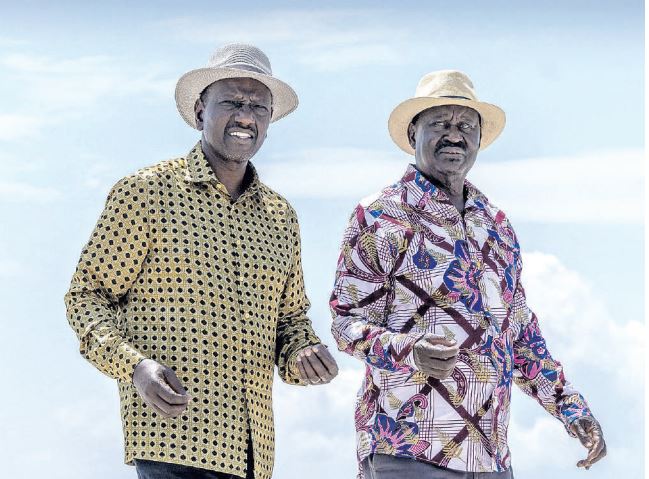
 President William Ruto and former Prime Minister Raila Odinga during the launch of the Homa Bay pier that will boost trade, create jobs, promote tourism and advance the region’s blue economy/PCS
The potential alliance between ODM leader Raila Odinga and President William Ruto ahead of the 2027 general election is a political deal laden with complexities, contradictions and far-reaching consequences.
On one hand, some observers may see it as a masterstroke of realpolitik. On the other, it carries serious risks – both for the individual political actors involved and for Kenya's broader democratic health.
Some analysts argue that the possible political marriage is a double-edged sword, tucked in a mixed bag of blessings and curses, as the country hurtles toward its most consequential presidential duel.
“The marriage was a forced one because of circumstances but obviously it is fraught with suspicions and smacks of a grand attempt to override the masses in 2027 with Raila and Ruto ready to die for each other,” argues diplomacy and international relations expert, Francis Mwangangi.
The Machakos deputy governor argues that Raila’s traditional space in the opposition benches has been taken over by the Kalonzo Musyoka-Rigathi Gachagua axis backed by the country’s Gen Z.
“For the first time in history, the 2027 elections will be determined by millions of young people resisting misrule and keen to reclaim their country through their power of their votes and that is when that will dawn on Raila and Ruto,” he says.
Raila’s decision to work with Ruto – especially after a hard-fought 2022 election and years of portraying himself as the moral compass of the opposition – is viewed by many of his traditional supporters and the youth as a betrayal.
This sentiment is most visible among the Gen Z, who were at the forefront of the anti-government protests that forced Ruto to withdraw the Finance Bill, 2024 after the storming of Parliament.
With Gen Z and millennials now appearing to upstage Raila in his traditional opposition space, his perceived silence or complicity during the protests and his proximity to Ruto at the time, has tainted his brand among a generation that once revered him as a freedom fighter.
For the first time in decades, Raila faces a legitimacy crisis within his own strongholds – Western Kenya, Nyanza and Coast – with a new generation of opposition voices eclipsing him.
There are concerns that Raila risks losing the youth vote – not just in Luo Nyanza, but across the country – as his current brand of politics contrasts starkly with his decades-old pro-reform agenda.
On social media platforms like X, Raila has been labelled a "traitor," a term once reserved for political sellouts who abandoned causes for expedience.
While he has for months walked a political tightrope – supporting Ruto while trying to maintain an oversight role – his 2027 options appear to be shrinking amid growing public backlash.
His ODM party has called for a major National Delegates Convention in October, a session seen as a Waterloo moment to formalise a union with Ruto ahead of the 2027 polls.
In what appeared to be a deliberate move to salvage his standing with the youth, Raila recently condemned the President’s controversial “shoot-the-leg” directive, which sparked national outcry.
“As a country, we must at all times opt for the rule of law and due process and reject the temptation to give police illegitimate and deadly powers over citizens, even when the citizens are perceived to have broken the law,” Raila stated on July 11.
“This preserves the dignity and respects the human rights of suspects while at the same time confers credibility to the actions of the State.”
In a further effort to align with youth concerns, Raila warned against a militarised approach to governance.
“As a country, we should do everything to avoid the militarised approach to policing. Examples from around the continent show that such an approach only increases the risk of violence. A militarised approach to policing endangers both the suspect and law enforcement officers,” he said.
Raila’s statement came in the wake of Ruto’s call for police to shoot rioters in the leg.
“Anyone who burns down someone else’s business and property, let them be shot in the leg and go to the hospital as they head to court... shoot and break the legs,” Ruto said on July 9.
Besides condemning the directive, Raila also proposed fresh dialogue, branding it a “national conclave.”
Analysts believe the swift support Raila received from top Kenya Kwanza figures suggests the dialogue plan had already been discussed – and that he had been released to champion it.
The ODM leader dismissed criticism of the conclave, saying it would be key to forging a new, inclusive national path.
“50 per cent must be youth, the remaining 50 per cent should be middle-aged people and only a few should be elderly. All Kenyans should come together in a national dialogue to talk about where the problem is. We don’t want to go into the 2027 election full of anger,” he said.
The proposed conclave would have 40 representatives drawn from across the 47 counties.
However, critics view the proposal and Raila’s criticism of the President’s shoot-to-disable policy as part of a calculated effort to regain youth support amid his controversial ties with Ruto.
Former Chief Justice David Maraga, who has already made public his 2027 presidential bid, says he wants dialogue; but not the inclusive Inter-Generational National Conclave proposed by Raila.
“If there's going to be any dialogue, it should be people-driven. People are expressing concerns and saying we should have dialogue. What can only help is a people-driven dialogue that will involve the youths who have suffered most and maybe a voice from that group,” he said.
“There are groups already thinking about that. I have myself requested and talked to some people, we come together and think about what we should do in my capacity as a leader and former Chief Justice, not as a presidential candidate. We put our heads together and see what we can do for the good of this country. That talk is going to be like a stopgap measure.”
Coincidentally, after rejecting the Finance Bill, Ruto had also in 2024 proposed a national convention to bring together leaders across sectors to deliberate Kenya’s future.
In an address during the height of the Gen Z protests last year, Ruto announced a six-day multi-sectoral forum beginning July 15, bringing together political parties, civil society, faith groups, employers and youth.
“In the interest of making sure we live within our means, all participants will bear their own attendance costs,” he said.
Raila joined Ruto in endorsing the dialogue, calling it “the best way out of the crisis.”
“We will give people an opportunity to be heard,” he said, adding that the forum would allow Kenyans to express grievances and propose solutions.
Still, questions remain as to why similar proposals were shelved for a year, despite the earlier national dialogue at Bomas that birthed eight legislative proposals.
Opposition leaders have dismissed the renewed push for a conclave, calling it a waste of time and a strategy to derail anti-Ruto momentum.
Former Deputy President Rigathi Gachagua rejected Raila’s call for dialogue, claiming he is opportunistic and always seeks a way into government after every election.
“Raila is totally irrelevant. Every election cycle he loses, then finds a way into government... if he were patriotic, he would disengage from Kasarani but he’s talking with his mouth full,” Gachagua said in Seattle.
He insisted the ballot box in 2027 is the only legitimate dialogue.
“We need transformative leadership, not endless dialogues. Let’s persevere for two more years and sort this out once and for all,” Gachagua added, accusing Raila of planning to support Ruto.
While Gachagua welcomes a Raila-Ruto alliance to “deal with both of them at once,” the partnership is already reshaping political alignments.
For the Luo community, the alliance offers long-denied access to state power. Ruto’s appointments of Luos to top government roles – Cabinet, PSs and ambassadors – have softened perceptions of exclusion.
Many Luo youth, who had opposed Ruto in 2022, now view him positively as development projects arrive in the region.
Raila’s allies in Nyanza have endorsed his re-election in 2027 and mocked efforts to retire him.
For Ruto, partnering with Raila is both symbolic and strategic. It silences his fiercest critic and weakens the opposition, potentially paving a smoother re-election path.
On July 12, Deputy President Kithure Kindiki declared that a Ruto-Raila-Kindiki team would be “unstoppable” in 2027.
“We are focused on service. When campaigns come, who can beat William Ruto, myself and Raila Odinga?” Kindiki posed in Migori.
By winning over part of the Luo base, Ruto positions himself as a national leader – a critical image as discontent over the economy grows.
Kenya Kwanza has used this to paint Ruto as unifying, while accusing Gachagua of tribalism and exclusion.
Yet, there’s a political cost: Raila still carries historical baggage among Mt Kenya elites. In 2022, even with Uhuru’s support, he got less than a million votes from the region.
Now, the Ruto-Raila partnership has reignited Kikuyu-Luo rivalries, with Mt Kenya politicians accusing Ruto of sidelining the region for “the enemy.”
This narrative is splintering Kenya Kwanza in Mt Kenya, where leaders are shifting toward post-Ruto succession and aligning with Gachagua, Kalonzo Musyoka and Fred Matiang’i.
Historically, Kenya’s politics has been ethnic. An alliance between the Kalenjin and Luo – communities at odds since the Moi-Odinga fallout in the 1980s – heals one rift but worsens the Luo-Kikuyu divide.
Analysts say Ruto risks alienating Mt Kenya voters who feel betrayed and excluded economically and politically.
Bomet Governor Hillary Barchok pushed back on tribalism claims:
“We have nothing against the Kikuyu community. These are people we’ve come a long way with and have stood together with. What we have rejected is an individual bringing hatred among Kenyans,” he said.
Kericho Senator Aaron Cheruiyot rallied support for a new alliance.
“The way you and the President have started engaging Baba, continue. When the time comes, we’ll lock you in a room and go with whatever you agree on,” he said.
As the Raila-Ruto axis becomes the face of 2027, Mt Kenya appears to be drifting toward the opposition.
One major consequence of the alliance is the hollowing out of the opposition. Raila, long the face of resistance, is now seen as co-opted.
This has created room for new voices, particularly Gen Z – though they lack the formal organisation or political experience to mount a structured opposition.
Analysts warn this is dangerous for democracy. Without a credible opposition, the government can push through controversial policies unchecked – as seen with the Finance Bill 2024 before Gen Z intervened.
If Raila fails to reclaim his voice, the opposition vacuum may be filled by disruptive forces rejecting institutions altogether – a recipe for instability.
Perhaps the most seismic outcome of the Raila-Ruto alliance is the generational realignment it is triggering.
Raila’s credibility among youth is crumbling. The era of struggle credentials and ethnic loyalty is waning.
If Raila is seen as enabling an oppressive regime, he risks being recast – from hero to villain.
Yet, this shift may also spell the end of Kenya’s “big man” politics. The next generation of leaders may need to rise through activism, grassroots organising and ideas – not surnames and tribal arithmetic.
From a political strategy standpoint, the Raila-Ruto alliance may seem like a 2027 masterstroke: it consolidates power, weakens the opposition and builds ethnic bridges.
But from a democratic, generational and ideological view, it may ultimately be a curse – one that betrays Raila’s values, polarises communities, alienates youth and destabilises Kenya’s democratic balance.
The fate of the alliance – and of Kenya – now rests on how both leaders navigate the next two years: delivering development, managing perception and guiding a peaceful generational transition.