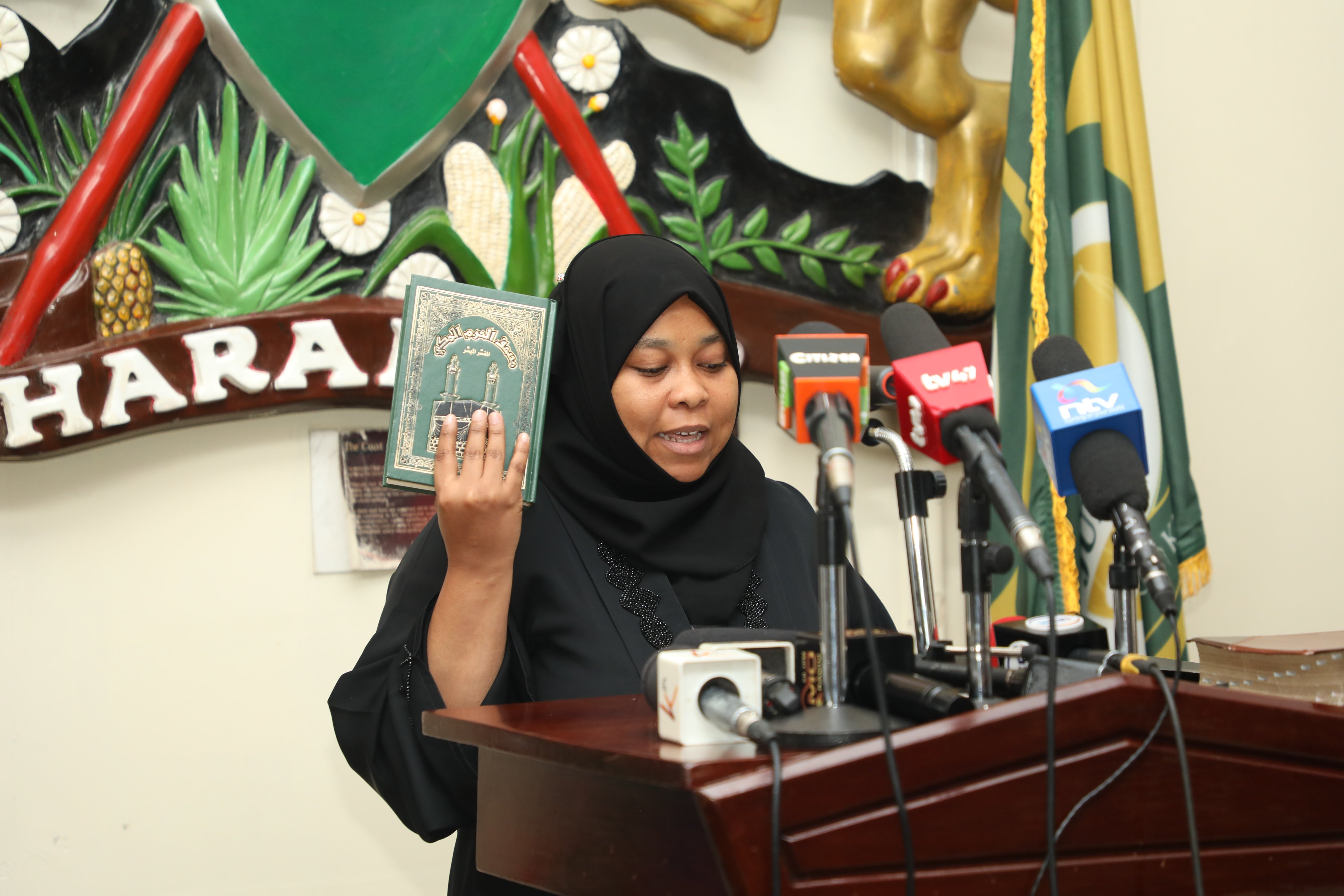
 Fahima Araphat Abdallah takes oath during the swearing-in ceremony on July 11, 2025/JUDICIARY
 When Fahima Araphat Abdallah was elected as the Vice Chairperson of the Independent Electoral and Boundaries Commission (IEBC) on July 11, 2025, it marked a historic moment for the country’s electoral leadership.
At just 32 years old, Fahima became the youngest person to hold such a senior position in the commission’s history.
Her appointment is not only a testament to the country’s gradual shift toward youth and gender inclusion in governance but also a significant milestone for her Swahili Bajuni community in Lamu County, from where she hails.
Early life and background
Born in 1992 in Shela village, a coastal settlement in Lamu County, Fahima Araphat grew up in a region often described as beautiful but marginalised.
Lamu, known for its historical significance and rich Swahili culture, has long faced challenges in infrastructure, youth opportunities and development.
Fahima's upbringing in such an environment helped shape her perspective on public service and community empowerment.
As a member of the Swahili Bajuni community, Fahima's rise to national leadership has been particularly inspirational.
The Bajuni people, often underrepresented in national politics, now have one of their own in a top electoral management position, a source of pride and hope for inclusive representation.
Academic Achievements
Fahima’s academic journey is marked by consistency and commitment.
She earned her Bachelor’s degree in Commerce from Kenyatta University in 2014, a course that gave her firm grounding in business administration and public finance.
She later pursued a Master’s degree in Project Planning and Management at the University of Nairobi, which she earned in 2020.
It equipped her with the skills to lead complex programmes and understand the dynamics of governance and service delivery.
She also undertook a Project Management Professional course at the Project Management Institute and obtained a Diploma in Investment Advice from the Chartered Institute of Securities and Investment, both in 2024.
Her education reflects a blend of administrative insight and development planning, a fitting combination for someone working in an institution like IEBC, where both strategic oversight and logistical execution are key.
Early career in Lamu County Government
Immediately after completing her undergraduate studies, Fahima returned to serve her county.
She worked as the Ward Administrator for Shela from 2014 to 2017, making her one of the youngest administrative officers in the region at the time.
In this role, she gained firsthand experience in community engagement, local government operations, and service delivery.
Her tenure coincided with the early years of the country’s devolved system of governance, which presented both challenges and opportunities for young leaders entering county service.
In 2017, she was appointed as a County Executive Committee Member (CECM) in Lamu, a position she held until 2022.
During this period, Fahima managed a diverse range of portfolios, including land, infrastructure, energy, finance, tourism, agriculture, fisheries, livestock, cooperatives, and the blue economy.
Her extensive docket provided her with significant experience in high-level policy-making and strategic planning.
Fahima’s work as a CECM received positive attention for her ability to lead with integrity and for her effectiveness in service delivery within a challenging political and geographical environment.
After her term as a CECM, she was appointed to the Lamu County Public Service Board, a position that further strengthened her credentials in human resource management, public policy implementation, and institutional oversight.
She has held the position since 2023. Fahima has also been a part-time facilitator at the Institute of Corporate Governance and the Africa Institute of Devolution since the same year.
National appointment and IEBC vetting
In May 2025, Fahima was nominated as one of the new commissioners to the IEBC.
The nomination by President William Ruto was part of the process to reconstitute the electoral body following the expiry of the previous commissioners’ terms and the resignation of others in the wake of the contested 2022 General Election.
During her parliamentary vetting before the National Assembly’s Justice and Legal Affairs Committee, she impressed the panel with her clarity, confidence and grasp of electoral issues.
Her performance drew praise across the political divide.
One member of the committee, Zulekha Harun, remarked, “You are an inspiration to many girls and ladies all over this country.”
In her own words during the vetting, Fahima stated, “I have gained enough experience that will enable me to hold this national position at this juncture.”
Her calm demeanor and detailed responses to legal and operational questions reinforced her suitability for national leadership.
On July 11, 2025, immediately after her swearing-in, Fahima was unanimously elected as Vice Chairperson of the IEBC by fellow commissioners during the body’s 288th plenary meeting.
The election signalled strong internal support and a desire for dynamic, youthful leadership within the commission.
IEBC Chairperson Erastus Ethekon, who was elected the same day, lauded the decision and noted that the new leadership would restore public confidence in the electoral body.
Significance and outlook
Fahima Araphat Abdallah’s appointment comes at a critical time for the IEBC, as the commission rebuilds following the exit of previous commissioners and prepares for upcoming by-elections and the 2027 General Election.
Her presence is a symbol of generational change and the expanding role of women in governance.
It also signals a push toward restoring trust in public institutions by bringing in leaders with clean track records and technocratic competence.
For many Kenyans, especially in the coastal and northern frontier counties, Fahima’s rise is deeply personal.
Her journey from Shela to the IEBC boardroom serves as a beacon of possibility for young women in underserved communities.
It also affirms the value of decentralised leadership pathways, where local governance can nurture and elevate future national leaders.
As Vice Chairperson, Fahima will play a central role in shaping policies on voter registration, electoral transparency, and civic education.
While her youth may seem unusual in a position historically held by older career bureaucrats, her experience and local credibility position her as a formidable figure in the new-look IEBC.