When reports of plans to build a church at State House, Nairobi, by President William Ruto came to the attention of the public, it brought up discussions, especially relating to the intersection of faith, power, and politics.
Initial reports said the church would be built at the cost of Sh1.2 billion, further fuelling complaints from members of the public.
At one point, Anglican Church of Kenya (ACK) Archbishop Jackson Ole Sapit raised concerns about the project, questioning both its intent and its constitutional implications.
“Will the president be the bishop or leader of this church, as we have seen him recently lead public prayers?” Sapit posed a rhetorical jab aimed at the President.
Ruto explained that State House already had a chaplain who had been serving before he assumed office and continued to lead services.
“We already have a chaplain. I heard one bishop asking, who will be the head of the church? We have a chaplain there who I found already serving, and he is the one leading services even now. I didn’t appoint him; I found him there,” Ruto said.
This signified the weakening relations that have developed in the recent past between the church and the Presidency over the state of the country.
Critics have raised concerns about potential misuse of public funds, lack of transparency, and the blurring of lines between government and religion in a secular state.
President Ruto, however, defended the move, saying he does not know where the figure came from.
Speaking at the ACK Diocese of Embu Diocesan 35th Anniversary Thanksgiving at Kigari Teachers Training College, in Embu, Ruto insisted that there is no way the church would cost more than an 11-storey building that costs Sh350 million.
The President cautioned against spreading propaganda and hatred against the church of God.
He added that he is not the one who built the church at State House, but found it there.
According to Ruto, it is mostly used by over 300 State House staff and their children.
“The church we are building is big enough for those children and the three hundred families. We have a Sunday school there, and I didn’t start the church, I found it there. What I have done is to say that instead of the church there being made of iron sheets, let's build a stone one.”
Supporters argue it's a necessary facility for State House staff and a reflection of the President's faith.
Ruto also affirmed that no state funds would be used to build the church.
Religious messaging has played a significant and often controversial role in Ruto’s political life and has publicly admitted that he would become a preacher when he retires from the leadership of the country.
His strong evangelical Christian faith is a prominent aspect of his public persona and political strategy, influencing various aspects of his administration. It upscaled when he served as Deputy President and would spend most of his weekends in various parts of the country leading church fundraisers.
Ruto used this to mobilise political support across the country as he frequently attends church services, makes donations to religious institutions, and openly attributes his political success to God.
This resonates strongly with Kenya's largely Christian population, particularly the evangelical community, which has seen growing influence in East African politics.
First Lady, Rachel Ruto, has also been actively involved in faith diplomacy and healing the nation crusades, further solidifying this religious connection.
President Ruto has often declared his intention to lead a "God-fearing government" and integrate religious values into national affairs, including publicly dismissing attempts to regulate religious organizations.
He emphasises the constitutional guarantee of freedom of worship.
The construction of a new church inside State House, spearheaded by Ruto, carries significant implications that extend far beyond simply providing a place of worship.
It has ignited a national debate about the separation of church and state, transparency in public spending, and the role of religion in governance.
Article 8 of the Kenyan Constitution explicitly states that "there shall be no State religion," and the presence of a dedicated Christian church within the seat of executive power could be perceived as establishing Christianity as a de facto state religion, or at least favouring one faith over others.
Already, critics argue that if a Christian church is built, then equivalent facilities should be provided for other religions, such as Islam, Hinduism, or African traditional religions, to ensure inclusivity.
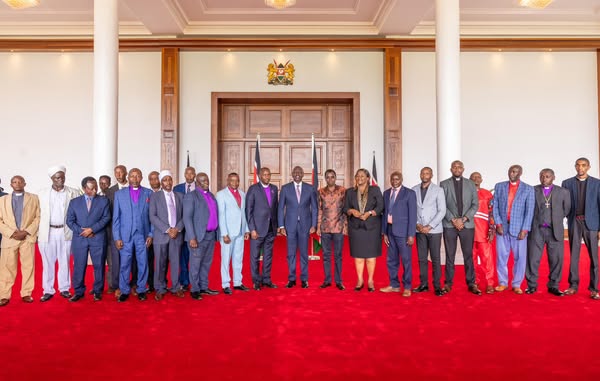
Muslim faithful have already asked for a Mosque within State House.
They said that since the State House serves all Kenyans regardless of their religious beliefs, it is only fair that space be allocated for Muslim faithful as well.
“Since the State House is a place that represents people of all religions, just as a church has been established for Christians, we are also requesting that a place of worship be set up for Muslims so that when we visit such a place, we have somewhere to pray,” the leaders said.
For others, the move is seen by some as an attempt to integrate religious values too heavily into national affairs, potentially alienating citizens of other faiths or those with no religious affiliation.
Historically, while Kenyan presidents have often engaged with religious leaders and hosted interfaith prayer services, they have generally refrained from institutionalising worship structures exclusively for one faith within State House.