In recent weeks, Kenya has witnessed a historic civic awakening.
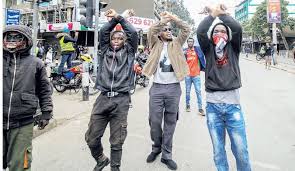
The streets of Nairobi and other cities and towns have been gripped by the determined voices of a generation once dismissed as apolitical, distracted and disengaged. But Kenya’s Gen Z has erupted into the public sphere with a clarity of purpose, strategic defiance, and ethical conviction that is reconfiguring the contours of civic engagement and governance discourse.
What began as resistance to a punitive Finance Bill has morphed into a radical reclamation of democratic space and a bold reinvention of civic agency.
Predictably, the political establishment has responded with contempt, misinformation and repression. Senior politicians have branded the demonstrators as violent, goons, criminal, unpatriotic, irresponsible and even coup plotters. This reaction, while not surprising, is telling: it betrays a flawed political class fundamentally out of sync with a new political consciousness and deeply averse to the demands of public accountability.
Yet while nefarious state agents seek to criminalise dissent, observers across the continent are celebrating this new wave of agency.
From Accra to Dar es Salaam, Addis Ababa to Johannesburg, Lagos to Cairo, Yaoundé to Malabo, African youth see Kenya’s Gen Z not as troublemakers, but as trailblazers — governance giants boldly confronting the hollow performance of statecraft. In reclaiming their civic space, they are inspiring a continental renaissance in youth-led civic action.
At the heart of this movement is an audacious redefinition of civic agency. Civic agency once narrowly theorised as the individual or collective capacity to participate in political life — often through formal structures such as voting or membership in organised civil society — has been flipped.
Gen Z has taken this theory and animated it with urgency, innovation, and moral clarity.
Their decentralised, digital, leaderless movement defies the conventional scripts of civic action but embodies its deepest ideals: voice, accountability, and transformation.
The Gen Z protests are grounded in ethical and constitutional demands, not just economic grievances. They are asking: what does leadership mean in a constitutional democracy? How do we co-create a taxation regime rooted in justice, inclusivity and transparency?
What mechanisms can safeguard national budgets from elite capture? In refusing to be co-opted, commodified, or silenced, these young citizens are articulating a form of radical democratic vigilance that cross-examines not just the “what” of governance, but the “how” and “why”.
In so doing, they are not only transforming protest; they are transforming citizenship. They are holding up a mirror to our civic complicity, our resignation, and our silence. In a nation where protest has long been associated with partisan mobilisation or elite manipulation, Gen Z has restored its integrity. They have reminded us that protest, at its core, is not the enemy of peace but the soul of democracy.
This is beyond a generational moment, it is a national reckoning. The rest of Kenyan society — teachers, clerics, mama mboga, boda boda, entrepreneurs, farmers, traders, civil servants, artists, and professionals — must now decide: will we remain spectators, or will we answer the civic summons?
The constitution gives every citizen a duty — not just a right — to participate in the life of the nation. Gen Z has fulfilled their part. The question now is whether we will fulfil ours.
More importantly, this is a moment to re-theorise civic urgency. Civic urgency, often assumed to emerge from crisis, is here being reframed as an ever-present ethical imperative. Gen Z has shown that the time to act is not only when the crisis becomes unbearable, but when injustice becomes normalised. Their protests are not reactive — they are prefigurative. They imagine and demand a future where dignity, transparency, and shared prosperity are not aspirational slogans but governing principles.
The implications are profound. If Kenya is to move from protest to transformation, we must institutionalise this civic energy. This means building intergenerational alliances, translating protest into policy influence, and creating infrastructure for sustained citizen participation — both online and offline. It also requires rejecting the false binary between protest and policy, between activism and governance. The Gen Z moment reminds us that active citizenship is not opposed to statecraft — it is its lifeline.
Kenya is now a seedbed for democratic renewal. Across Africa, youth are watching, learning, organising. For far too long, civic spaces have been controlled by elite actors — CSOs, political parties, donor agencies. But the Gen Z movement offers a new model: autonomous, ethical, creative, and deeply rooted in lived realities. It is a call to co-create democracy.
This struggle is not merely about changing a regime — it is about reimagining the Republic. Will we continue to accept a nation where leaders remain indifferent while citizens are pushed deeper into despair?
Or will we commit to building a society grounded in shared sacrifice, ethical leadership and civic equality? Gen Z has thrown down the gauntlet. They have shown us what is possible. Now, it is up to the rest of us to rise — not just in solidarity, but also through purposeful action.
Edwin Wanjawa teaches Globalisation and International Development at Pwani University and is a Programmes Associate at DTM, a Media nonprofit CSO, [email protected]