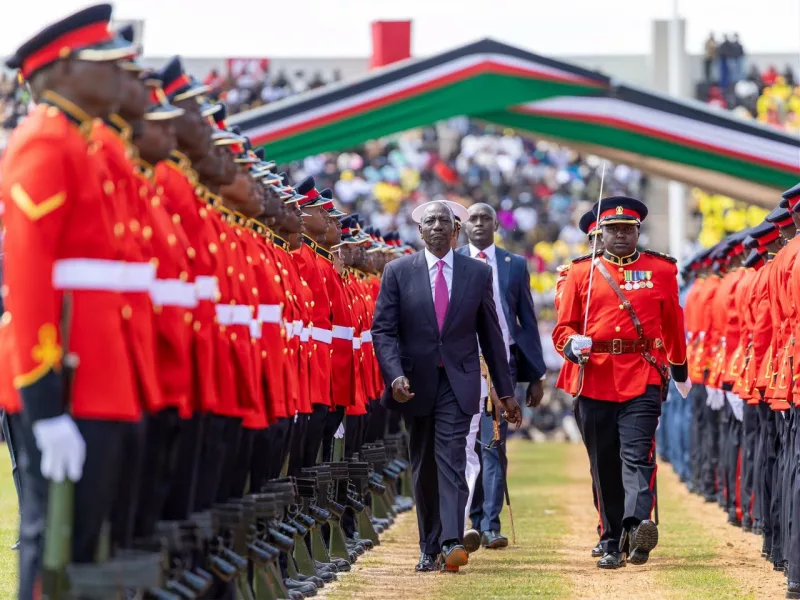
National Assembly Speaker Moses Wetang’ula’s contradictory remarks on the contentious Western Sahara has added confusion on Kenya’s foreign policy.
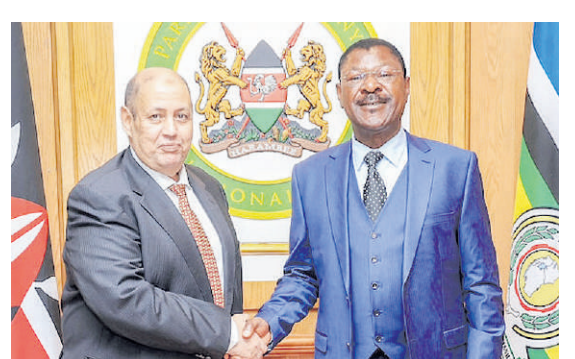
Wetang’ula on Thursday hosted Sahrawi Arab Democratic Republic (also known as Western Sahara) Ambassador Mohamed-Liman Ali Ami at Parliament Buildings and discussed ways to strengthen the bilateral ties.
In a statement, the Speaker said they also explored ways to deepen diplomatic engagements for the mutual benefit of the two countries.
“I assured the Ambassador that Kenya, as a committed member of the African Union, stands in solidarity with the Sahrawi Republic and remains steadfast in supporting and safeguarding its interests as a sovereign state. I reaffirmed that the Sahrawi people have an inherent right to self-determination and independence,” Wetang’ula said.
Wetang’ula – a one-time Foreign Affairs minister – also called upon the AU to champion Sahrawi’s self-determination cause, in order to promote the growth, peace and prosperity of this young nation.
“Ambassador Mohamed-Liman Ali Ami expressed his appreciation for the unwavering support Kenya has extended to his country, acknowledging it as a critical pillar in their journey towards lasting stability. He further noted that Kenya has much to offer the Sahrawi Republic and emphasized that enhanced cooperation between our two nations would be instrumental in advancing shared development goals,” the statement added.
Wetang’ula’s remarks are a departure from the Foreign Affairs CS Musalia Mudavadi’s communication, who, during an official visit to Morocco in May, endorsed Morocco's autonomy plan.
The Western Sahara dispute remains one of Africa's most protracted conflicts, with Morocco controlling 80 per cent of the territory while the Algeria-backed Polisario Front seeks independence.
Morocco, which considers Sahrawi as part of its territory, has put forward an autonomy proposal for the Sahara, within the framework of the Kingdom’s sovereignty and national unity.
“Thus, the Sahara populations will themselves run their affairs democratically, through legislative, executive and judicial bodies enjoying exclusive powers. They will have the financial resources needed for the region’s development in all fields and will take an active part in the nation’s economic, social and cultural life.
“The State will keep its powers in the royal domains, especially with respect to defense, external relations and the constitutional and religious prerogatives of His Majesty the King,” the proposal says.
Musalia said the plan is the "only credible and realistic solution" to the decades-old conflict.
“The Republic of Kenya welcomes the growing international consensus and the momentum led by His Majesty King Mohammed VI in favour of the autonomy plan presented by the Kingdom of Morocco as the only credible and realistic solution to the Sahara dispute,” the communication said.
The Western Sahara question has been a contentious foreign policy issue for Kenya and Morocco recalled its ambassador to the country for consultations over the matter in June 2005.
Rabat at the time said it “strongly deplores the unjustified and unjustifiable decision announced by Kenya to recognise the pseudo RASD (Saharwi Arab Democratic Republic) and to establish with it so-called diplomatic relations".
In February 2014, there was another diplomatic row after Western Sahara opened a mission in Nairobi. Then Senate Speaker Ekwe Ethuro had to visit Morocco to calm the tensions.
Mudavadi’s position was a departure from Kenya’s long-held position that aligned with the OAU admission of Western Sahara to its membership on August 22, 1982.
This departure is viewed as a policy shift by the Kenya Kwanza Administration.
With the shift, Kenya drew some economic benefits with Morocco, chief among them a market for tea and coffee, as well as the resumption of direct flights from Nairobi to different cities in Morocco.