TOP police commanders are facing a reckoning as public outrage mounts over systemic police brutality, impunity, and extrajudicial killings, triggering an unprecedented wave of investigations, suspensions, and arrests within law enforcement ranks.
The tipping point came with the death of blogger Albert Ojwang, which has drawn sharp national condemnation and forced Deputy Inspector General of Police Eliud Lagat to step aside.
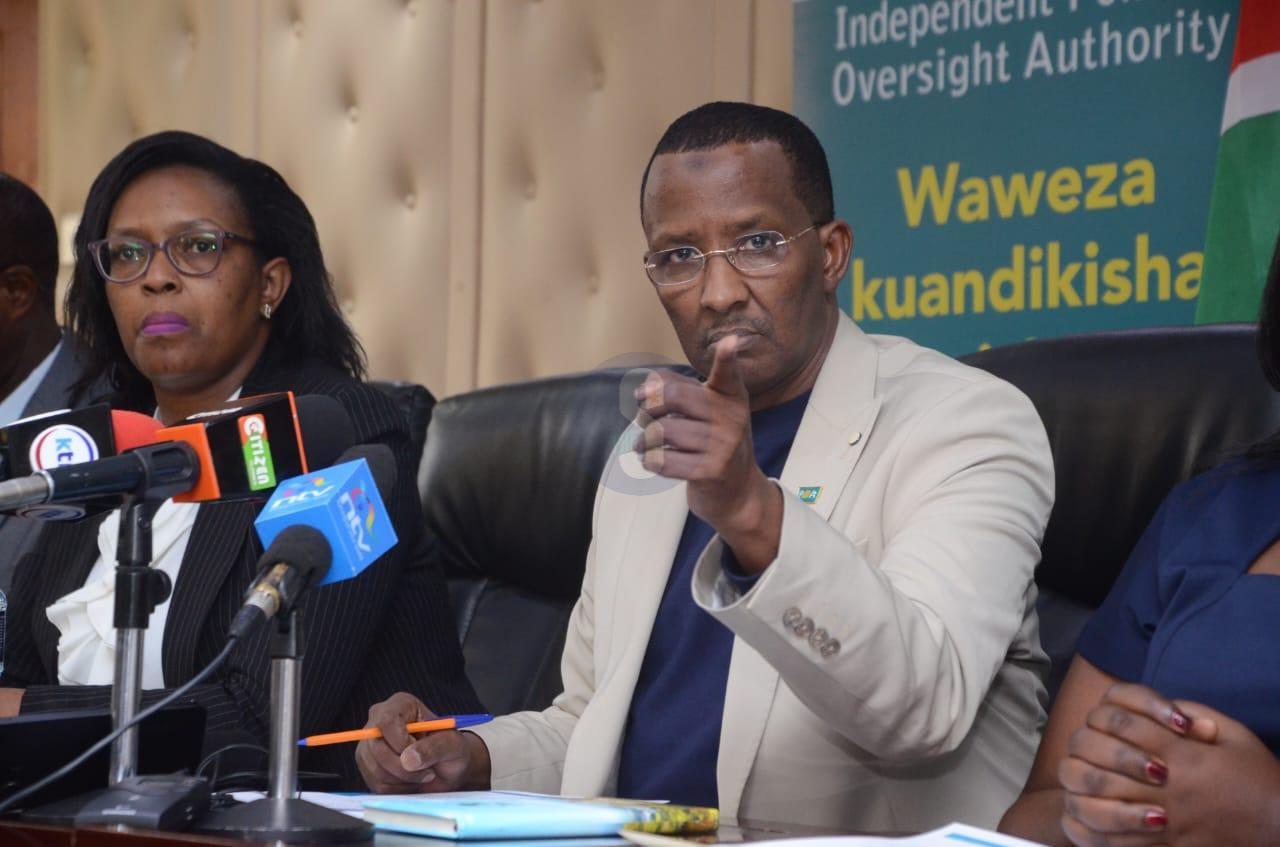
On Thursday, Lagat was grilled for almost three hours by the Independent Policing Oversight Authority, a move described by insiders as a "humbling moment" for one of the country’s top cops.
This is the first time a senior cop at Lagat's level is facing investigations and possible prosecution of that magnitude.
Sources said Lagat submitted documents confirming he had lodged a complaint about online posts but denied any role in Ojwang’s death.
Ipoa had initially scheduled his appearance for Wednesday, but it was postponed to Thursday.
His statement will undergo further scrutiny. The DIG has been reportedly mentioned adversely in Ojwang's murder.
Meanwhile, Ipoa chairperson Isaac Hassan confirmed that 20 police officers have already recorded statements in connection to the death.
Among them are deputy OCS Central police station Inspector Samuel Ng’ang’a, OCS Samson Talaam, and Constable James Mukhwana, the cell sentry on duty the night Ojwang died.
Ng’ang’a and Mukhwana have since been arraigned and detained for two weeks pending further investigations.
Also detained are Kelvin Mutava, a civilian accused of tampering with CCTV footage, and three inmates—Brian Mwaniki Njue, Collins Karani, and Gin Ammitou—who were present at the station on the night Ojwang' died.
As scrutiny on the police deepens, more cases of alleged abuse and excessive force have surfaced.
In Nairobi, two officers Klinzy Barasa and Duncan Kiprono of Kileleshwa police station were arrested following the shooting of 22-year-old face mask vendor Boniface Kariuki, also known as Eli Joshua.
Kariuki was shot on Tuesday along Moi Avenue. The officers were dispersing crowds during protests when they reportedly accosted Kariuki, who was not part of the demonstrations.
Eyewitnesses and video footage widely circulated online show one officer shoving the vendor before the other fired a shot at close range as he attempted to walk away.
Kariuki remains in critical condition in the ICU at Kenyatta National Hospital after undergoing emergency surgery.
His father, Jonah Kariuki, confirmed his son was still alive and called for justice.
“My son was just doing his job. He didn’t deserve this. We want those responsible held fully accountable.”
Ipoa has indicated that the two officers could face attempted murder charges and unlawful use of a firearm once investigations are complete. A court has approved their detention for 15 more days.
In Nakuru, seven police officers are in custody over the fatal shooting of a protester in London estate on June 11.
Sergeant Nicasio Njue, corporals Eric Mwangi and John Kihara, and constables Naftali Gitonga, Ephantus Njeru, Marceler Tanui, and Isaac Anampiu are being investigated for their role in the incident.
These developments come amid a wave of public protests in Nairobi, Kisumu, Nakuru, and other towns, where victims’ families, civil society, and human rights activists are demanding accountability.
“This is not about a few bad apples anymore—this is about a broken tree,” said a rights activist during a demonstration in Nairobi.
Senior police officials have been compelled to issue public apologies, promise internal investigations, and suspend officers linked to abuse cases. However, critics argue that these moves are reactive and insufficient.
Human rights organisations have documented patterns of systemic failures, where similar abuses have gone unpunished for years.
“We’ve seen this cycle before—public outcry, promises of reform, then silence. The difference this time is that the victims’ stories are louder, and the people aren’t backing down,” legal analyst said.
Despite repeated promises of accountability and institutional transformation, law enforcement remains heavily militarised, with officers still accused of using disproportionate force against peaceful protesters and unarmed civilians.
Former Ipoa chairperson Anne Makori said behavioural change among officers remains the biggest gap in efforts to reform the police service.
“There is still a lot of work to be done to drive behavioural change. We tried during our time to implement some of these reforms, and we hope they will be continued,” Makori said in an interview with the Star.
Makori underscored the importance of sustained Ipoa involvement in the training of police recruits.
“Officers must be made aware of professional accountability and the standards expected of them. They should know that if they operate outside these standards, they will be held personally liable,” she said.
Security expert George Musamali termed the reforms half-hearted, stating that the political class has mutilated the law and placed the police under the ambit of the Executive.
“All these things we are seeing – police brutality, killings and enforced disappearance among others – hang around politics,” he said.
Musamali said the intended reforms, triggered by the 2007 post-election violence, were diluted in the 2014 amendment to the security laws that took away the independence of the police, the National Police Service Commission and Ipoa.
“Now, we have a service that is answerable to the political class who use them as their militia. Unless we de-link the police from politicians, we will continue blaming the IG, yet he is not the problem."
As Kenya grapples with a crisis of public trust in its police force, the question remains: Will this moment lead to meaningful reform or will it be yet another chapter in a long history of impunity?
INSTANT ANALYSIS
Protests are expected to continue in Nairobi and other towns in the coming days, fueled by the city shooting. As public pressure builds, questions now turn to whether the government will take meaningful action or allow the cycle of abuse to continue. Critics argue that the heavily funded police reforms have yet to achieve meaningful change within the security forces.