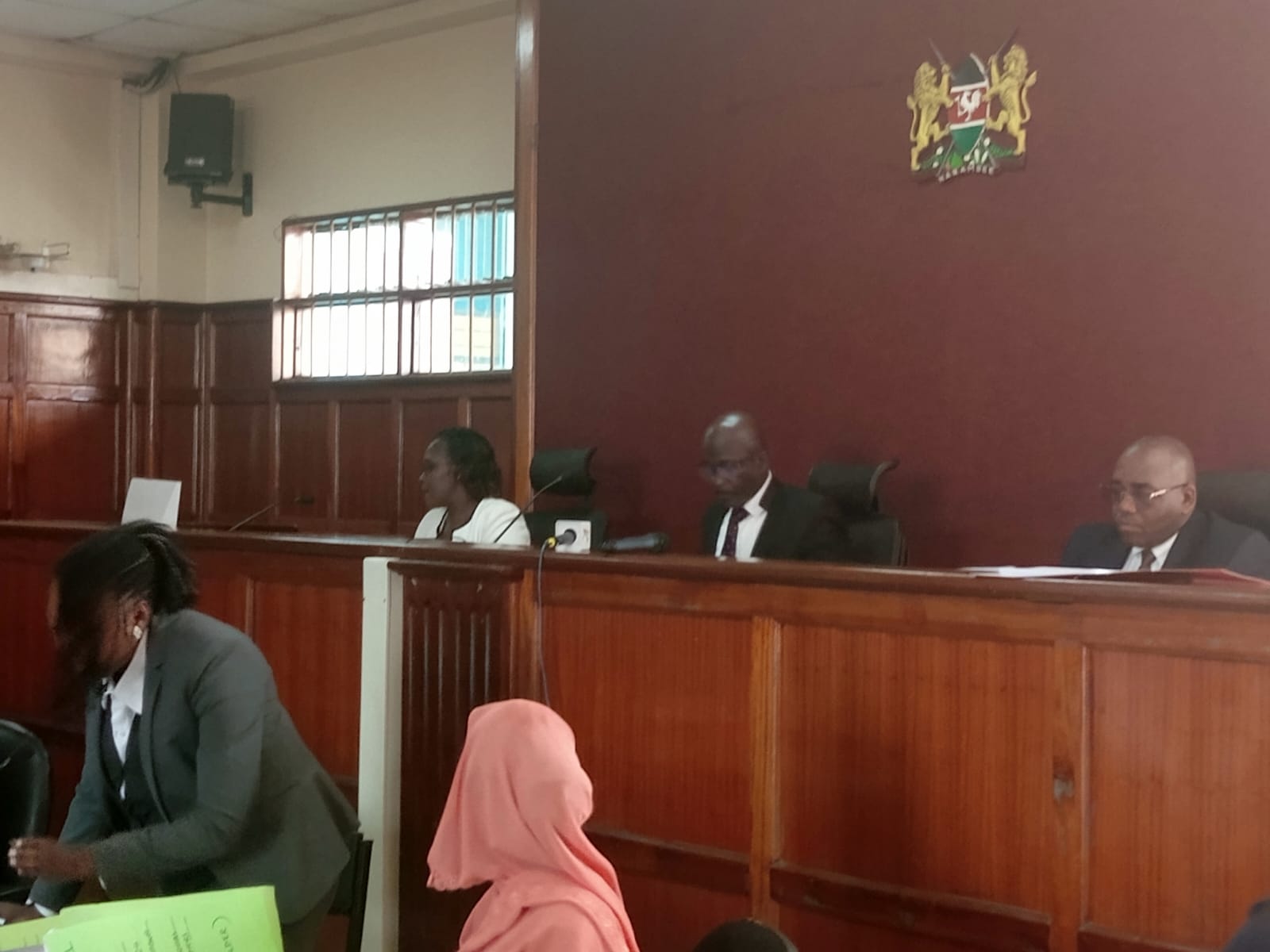
 Three-judge bench in court proceedings at Milimani High Court on June 19, 2025/JAMES GICHIGI
A three-judge bench of the High Court will deliver a critical ruling on July 31, 2025, in a legal battle involving former Deputy President Rigathi Gachagua.
The outcome could shape the future of two consolidated petitions that have become a maze of legal and procedural wrangles.
Justices Eric Ogolla, Anthony Mrima, and Freda Mugambi are presiding over Petitions E522 and E565 of 2024, which initially sought to challenge Gachagua’s impeachment and raise questions of financial accountability.
However, the proceedings have since expanded into complex disputes involving petition withdrawals, attempted substitutions, and even challenges to the legitimacy of the bench itself.
At the centre of the legal storm is an unusual application filed by one Fredrick Mula, who is seeking to replace Gachagua as petitioner in Petition E522.
Mula argues the issues in the case are of significant public interest and should proceed regardless of Gachagua’s withdrawal.
But Gachagua’s lead counsel, Senior Counsel Paul Muite, dismissed the move as a "hostile takeover," telling the court:
“We were served with an application by someone we don’t know, who wants to step into our shoes on grounds of public interest.”
Muite further disclosed that his team had already filed a notice withdrawing Gachagua’s earlier decision to step back from the petition, aiming to prevent any legal vacuum or adverse rulings.
The substitution bid was referred to the current three-judge bench for determination—one of several procedural hurdles the court must now address.
Meanwhile, another twist emerged through a separate application by lawyer Kibe, representing other petitioners.
He called for the disbandment of the current bench, arguing that it was improperly constituted and that Chief Justice Martha Koome’s role in empaneling the judges ought to be reviewed.
Kibe cited Article 165 of the Constitution and said: “The application can be allowed or rejected, but by the right judicial officer.”
Respondents opposed the application, insisting that the Chief Justice's role in empaneling judges is administrative and cannot be challenged by the same bench she constituted.
They labelled the challenge a tactic to delay proceedings and insisted that concerns over bench composition should be raised through formal appeals or separate judicial review.
They also urged the court to uphold its earlier directions issued on May 29, affirming the bench’s mandate to hear the consolidated matters.
Further complicating matters, both sides admitted they had faced delays in filing amended petitions.
Gachagua’s team blamed the unresolved substitution issue, while Kibe’s team cited confusion over petition titles due to the consolidation of the cases.
During the latest session, Justice Ogolla noted that key applications—including Mula’s May 19 substitution request and Kibe’s June 16 bench challenge—were not on record when earlier directions were given. He allowed all parties seven days to respond.
“The respondents to those applications are at liberty to file their respective responses within seven days,” ruled Justice Ogolla. “Applicants may file supplementary responses and submissions within seven days of service.”
The bench is now set to issue a consolidated ruling addressing three main issues: whether Fredrick Mula can lawfully replace Gachagua as petitioner? Whether the current bench can continue hearing the case amid challenges to its constitution? And whether interim conservatory orders should remain in force?
The July 31 ruling is expected to have far-reaching implications—not only for Gachagua’s political future, but also for broader questions of legal standing, judicial process, and public interest in constitutional litigation.